

The 2026 Data Cloud Roadmap: How Snowflake is Pivoting from Storage to AI-Native Data Products.
The enterprise data landscape is undergoing a foundational transformation. What began as centralizing data in cloud warehouses has evolved the creation of AI-native data products that serve as the foundation for intelligent enterprise operations. Snowflake is explicitly repositioning itself along that trajectory. From a strong data storage and warehousing foundation it is now moving to a platform designed to host, operationalize, and commercialize AI-native data products at enterprise scale.
Snowflake’s roadmap through 2026 shows a clear repositioning to support this new requirement. The company is transitioning from a warehouse-centric layer into a platform that enables Snowflake AI-native data products. This typically means it will now be focusing on governed model access, native AI applications running inside the customer environment, real-time data pipelines, AI-ready compute, and enterprise-grade governance. This brings the entire data and models into a unified domain.
For enterprises navigating the complexities of AI adoption, understanding the strategic direction of Snowflake is essential. The decisions made now about the data architecture, platform selection, and AI integration will determine competitive positioning later.
In this blog, we will examine how Snowflake is executing this transformation, what it means for enterprise technology strategy, and how executives should evaluate their own data infrastructure investments during this changing time.
Market Forces Driving the Pivot
AI-driven workloads, real-time inference demands, and increasing expectations for embedded intelligence are changing enterprise data architectures. Traditional warehouses are not able to handle these low-latency, model-integrated use cases. Snowflake’s shift shows this change, positioning the platform with AI-native data products, operational inference, and efficient application delivery at scale.
How AI is reshaping data value chains
The most significant force that is influencing Snowflake’s pivot is the rise of generative AI and agent-driven workloads. Instead of getting information from the dashboards, employees and customers are now expecting conversational interfaces, automated reasoning, and instant recommendations. These use cases require integrated data models that have low latency and high reliability.
Why real-time decisioning has become essential
Enterprises are shifting from batch analytics to real-time data processing. This includes fraud detection, supply chain predictions, customer experience personalization, risk scoring, and automated decision workflows. The traditional warehouse architectures were not built for millisecond latency expectations. AI-native data products require a layer that can process both data and model inference within the same environment.
How leadership expectations have changed
Decision makers are no longer evaluated only on platform stability or efficiency. They are mainly measured on how effectively they can enable the revenue teams, operations, product owners, and customer functions to embed intelligence in their workflows. Therefore, the demand for AI-native cloud platforms and data products is becoming a high-level priority. Snowflake’s pivot provides the solution to many of the leaders’ needs to meet these evolving expectations.
Accelerate your AI-powered data transformation with Infojini, a Snowflake partner.
How Snowflake is transforming into an AI-native data product
The evolution of Snowflake can be summarized as a shift from a platform optimized for BI to a platform optimized for AI-native intelligence. Its roadmap includes several directional changes.
Moving from warehouse-first to data cloud-first
Initially, Snowflake focused on high-performance SQL analytics and storage. However, the platform is now itself an operational ecosystem that includes data services, model access, application runtimes, and governed sharing layers.
Integration of models inside the platform
Snowflake allows users to access, run, and manage models directly within the data environment. This cuts down on data movement and supports governance. As a result, Snowflake helps companies achieve AI workflows that meet compliance and security standards.
Expansion of the Marketplace and native application ecosystem
Instead of limiting the ecosystem to data-sharing exchanges, Snowflake is creating a marketplace. This marketplace will host third-party models, AI applications, and curated data products within the customer’s Snowflake account. It supports secure, low-latency AI use cases. It also lets vendors earn money from AI-native data products on a large scale.
Developer-first orientation
Snowflake is selectively investing on developer tooling, runtime capabilities, and streamlined workflows. This makes it easier to build and optimize AI applications within the platform. The goal is to reduce the gap between raw data and ready-to-use AI experiences for businesses.
Snowflake’s Shift Toward AI-Native Infrastructure
Snowflake’s data cloud roadmap for 2026 shows its shift from being primarily a data warehouse to a key component of enterprise AI. With $1.09 billion in revenue for Q2 FY26, over 6k+ weekly AI users, and half of its new customers focusing on AI applications, Snowflake is now seen as essential AI infrastructure rather than just a place for analytics storage.
Core Platform Enhancements Powering AI-Driven Workloads
Snowflake is enhancing its unified data foundation with better cataloging, lineage, and interoperability. This supports reliable AI-native data products. The platform now includes model governance features such as version control, usage tracking, inference logging, and secure execution. This allows businesses to manage their data and models under one policy framework.
AI-Optimized Compute, Native Apps & Developer Tooling
The roadmap increases the capabilities of native applications so that they can operate with less data movement within the customer accounts. New AI-optimized compute features, including GPU acceleration, upgrades to orchestration, and cost management, support scalable inference workloads. To speed up development, Snowflake is refining developer tools with simplified runtimes and workflows for quicker AI application deployment.
Strategic Partnerships Strengthening the AI Ecosystem
Snowflake’s AI evolution is amplified by key partnerships.
- Microsoft incorporates Azure OpenAI models into Cortex AI and integrates Snowflake data into daily workflows through Copilot and Teams.
- SAP enables zero-copy, bidirectional data sharing between SAP Business Data Cloud and Snowflake, enabling real-time operational analytics.
- Anthropic adds its Claude models to the platform, supporting a multi-model approach with strong reasoning and governance integration.
A Unified, AI-Native Enterprise Platform
Together, these improvements and partnerships position Snowflake as a single AI-native data cloud. It combines data, models, applications, and governance into one platform made for large-scale enterprise intelligence.
Snowflake Cortex AI: The Foundation of AI-Native Data Products
Snowflake Cortex AI is central to Snowflake’s AI-native strategy. It provides large language models, machine learning features, and complete AI development tools right within the Data Cloud. This means companies no longer have to move sensitive data to external platforms. Designed to meet strict governance and security standards, Cortex AI works with several LLM providers, including Anthropic and Azure OpenAI, and it also features Snowflake’s own foundation model.
In addition to foundation models, Snowflake Cortex AI offers specialized tools like semantic search that works across structured and unstructured data. It features natural-language SQL generation with Cortex Analyst and workflow-managing Cortex Agents. These agents break down complex business tasks and carry them out using the appropriate analytical or AI tools, all embedded directly where enterprise data is present.
Get a Snowflake-ready strategy for 2026 and beyond.
Open Semantic Interchange: Solving the Metadata Chaos
Among the Snowflake Data Cloud Roadmap 2026 initiatives, the Open Semantic Interchange (OSI) could be the most important for long-term enterprise AI success. This open-source initiative started with support from over 15 industry partners, including Mistral AI, Salesforce, ThoughtSpot, and dbt Labs. It tackles a challenge that all organizations encounter but few have managed to resolve it, thereby, creating consistent semantic definitions across various AI and analytics tools.
Navigating Competition from AWS, Google Cloud, and Databricks
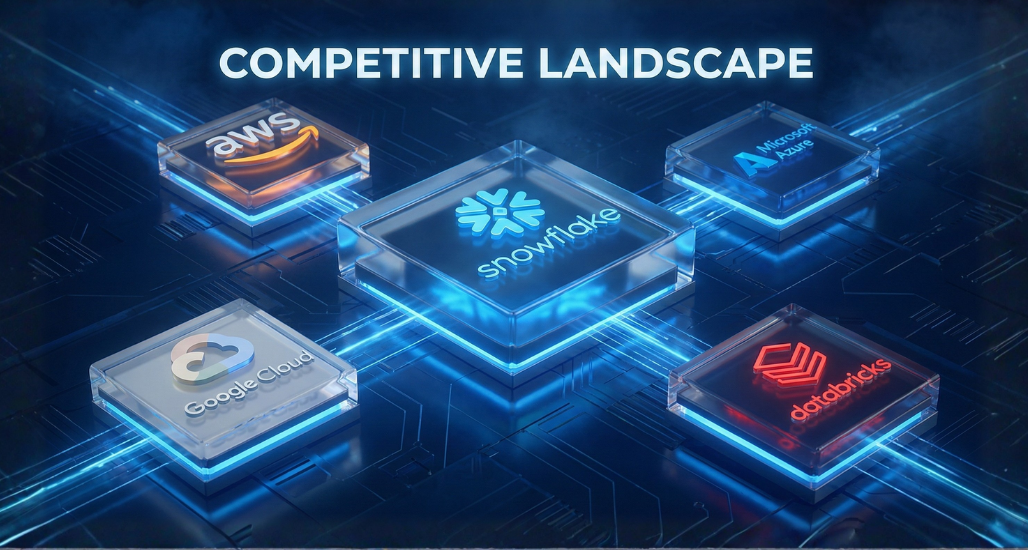
| Category | Snowflake | AWS (Redshift, Athena) | Google BigQuery | Microsoft Synapse | Databricks |
| Core Positioning | Multi-cloud AI Data Cloud with unified storage, compute & AI-native data products | Deeply integrated analytics within AWS ecosystem | Serverless analytics tightly integrated with Google services | Hybrid analytics & data integration in Microsoft ecosystem | Unified data lakehouse with strongest ML/AI emphasis |
| AI & ML Capabilities | Cortex AI, multi-model access (OpenAI, Anthropic, Arctic), agents, semantic functions | Amazon Bedrock, SageMaker, model hosting | Vertex AI, Gemini integrations | Azure OpenAI, ML Studio | Lakehouse AI, MosaicML, strong ML-first platform |
| Cloud Deployment Model | True multi-cloud (AWS, Azure, GCP) with workload portability | AWS-only | GCP-only | Primarily Azure | Multi-cloud, but optimized for notebooks and code workflows |
| Governance & Security | Strong enterprise governance, secure data sharing, native collaboration | Strong but AWS-specific; governance tied to AWS stack | Good governance within Google ecosystem | Strong Azure AD–centric governance | Strong for technical teams; governance improving but less turnkey for business users |
| User Accessibility | Designed for data teams and business users (Cortex Analyst, NLQ, agents) | More technical orientation | BI-friendly but cloud-centric | Business-friendly for Microsoft users | Technical and notebook-first; less accessible for non-technical users |
| Pricing Model | Consumption-based with clear separation of storage & compute | Pay-as-you-go tied to AWS services | Serverless per-query or slot reservations | Consumption-based in Azure environment | Consumption-based with ML workloads often higher cost |
| Key Differentiators | Multi-cloud, AI-native architecture, integrated data products, enterprise governance | Deep AWS ecosystem integration, mature cloud services | Scalable serverless analytics, strong ML with Vertex | Enterprise productivity ecosystem (Office, Power BI) | Strongest ML/AI for data scientists, open lakehouse vision |
| Ideal For | Enterprises needing cross-cloud flexibility, secure AI, governed data products | AWS-committed organizations | Google-centric analytics and marketing/data teams | Microsoft-centric enterprises | ML-heavy organizations and code-first teams |
Strategic Implications for Technology Leaders
Architectural Considerations for CXOs
For technology executives evaluating Snowflake AI-native data products direction, several architectural considerations emerge.
First:
Organizations must decide if a data product operating model fits their structure and skills. This model needs dedicated teams responsible for data quality and governance, unlike traditional centralized data teams.
Second:
Decisions about AI-native architecture depend on whether integrating AI into the data platform or using separate AI infrastructure provides better flexibility and cost control. Snowflake makes governance easier but increases reliance on the platform, which may not work for teams looking for modular AI solutions.
Third:
Snowflake’s multi-cloud model still requires deployment for each cloud, so true cross-cloud execution needs multiple instances. Organizations that require simultaneous multi-cloud operations must prepare for this and understand the limits of Snowflake’s portability.
Investment and Resource Allocation
Snowflake’s move toward AI-native data products requires organizations to rethink how they allocate technology investments. This means directing resources not just to infrastructure but also to developing data products and supporting talent. Teams need to go beyond traditional data engineering by adding product management skills focused on data. They should also invest in training programs that help business users effectively use tools like Snowflake Intelligence. As the platform’s AI features increase usage across the organization, companies must establish strong cost monitoring and financial governance. This will help them manage Snowflake’s consumption-based model and ensure that AI-driven workloads remain efficient and financially sustainable.
Risk Management and Vendor Strategy
AI governance and model lifecycle management in Snowflake’s ecosystem is all about understanding the challenges that come with its fast pace of innovation. This pace introduces new features that should be evaluated carefully, rather than adopted blindly. Organizations with strict regulatory obligations must carefully design their deployments to meet compliance needs. It is important to understand that Snowflake native application offers governance frameworks,but the accountability ultimately lies with the customer.
The Enterprise Benefits of Snowflake AI-Native Data Products
Snowflake’s AI-native transformation brings immense value to businesses by combining data, models, governance, and applications into one compliant platform. For tech leaders, this means faster AI adoption, simpler operations, and better returns on data investments. Key benefits include:
- Reduced Complexity and Faster AI Delivery: A unified data and AI environment cuts down on the integration work and speeds up the time it takes to get value from AI projects.
- Stronger Governance and Compliance: Built-in model governance, lineage tracking, and secure execution ensure that AI workloads meet enterprise risk and regulatory standards.
- Real-Time Intelligence at Scale: Low-latency pipelines and AI-optimized compute allows quick decision-making across areas like fraud detection, supply chain management, customer experience, and operations.
- Optimized Cost and Resource Efficiency: Pricing based on usage, less data movement, and native AI execution help lessen overall AI infrastructure costs.
- Cross-Cloud Flexibility Without Rebuilds: The ability to deploy on AWS, Azure, and GCP gives leaders options while maintaining consistent governance and performance.
- Accelerated Innovation: Access to multiple LLMs, semantic search, enterprise agents, and a growing AI application marketplace helps with rapid experimentation and new revenue opportunities.
The Path Forward
Snowflake Data Cloud Roadmap 2026 represents a clear vision. It will change the data platform from a passive storage and query layer to an active, smart system that drives enterprise AI on a large scale. Through:
- Cortex AI,
- Comprehensive data product capabilities,
- Strategic partnerships, and
- Continued platform innovation
Snowflake is set for modern data stack evolution. It will execute against this vision with impressive velocity.
For CXOs and CTOs, the implications are clear. Today, the decisions they make about the data architecture and platform selection of the company will eventually impact their ability to capitalize on AI opportunities over the next decade. Snowflake marketplace distribution strategy suggests that integrated platforms that combine data, governance, and AI capabilities in cohesive architectures will increasingly dominate over fragmented, best-of-breed approaches that require extensive custom integration.
Infojini helps enterprises navigate Snowflake platform transformation with confidence. Our experts provide end-to-end guidance, to make sure that you understand both the pros and cons of adopting Snowflake. Our experts help you with a roadmap that align with your business goals. We also help organizations scale their AI capabilities, leveraging Snowflake’s evolving ecosystem to accelerate innovation and unlock measurable value.
Get a Snowflake-ready strategy for 2026 and beyond.
As we progress through 2026, tracking Snowflake’s performance against this roadmap will give important insights into the future of enterprise data platforms. The company’s achievements or difficulties will offer lessons that apply beyond Snowflake, guiding wider strategic choices about data setup, AI adoption, and technology development. For tech leaders facing these complicated decisions, grasping Snowflake’s direction is crucial for planning their own organization’s future in the AI-driven business world.