 Digital Transformation
 Data Engineering
 Implementation
 Staffing Services
There is a fine line between AI agents and AI chatbots. While AI agents do the planning, tool utilization, and complex activities, AI chatbots deliver responses in an ongoing dialogue. Chatbots are better at performing easy but repetitive tasks. Agents justify their existence in judgmental processes.
The difference between an AI agent and an AI chatbot is that AI agents handle work, and AI chatbots handle conversations. That single difference affects the return on investment, risk profile, integration costs, and governance models, which is why it matters to know whether your business needs AI agents, AI chatbots, or both, before getting pulled into a technology debate that misses the point entirely.
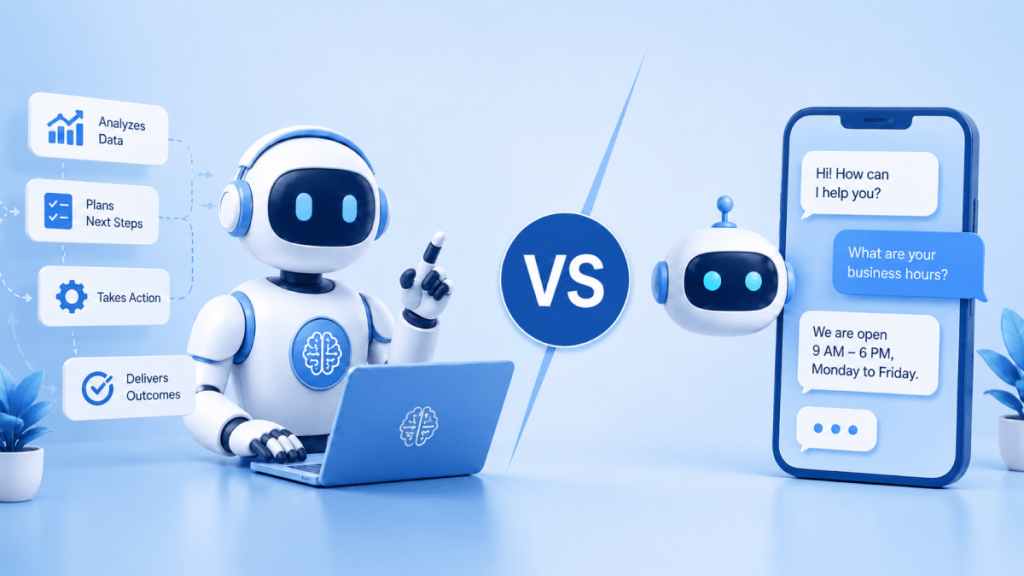
This blog lays out the practical difference between the two, where each earns its place in an enterprise stack, and where the market is headed.
What Is an AI Agent?
An AI agent is an autonomous software system based on language models that use tools and operate in loops to achieve multi-step tasks. In contrast to the chatbots which respond to prompts once, AI agents plan, perform actions, verify their results, and repeat. That loop runs on a specific architecture underneath it. This architecture generally has four working parts.
- A reasoning layer: It is usually a large language model that breaks the goal into sub-tasks and decides what to do next.
- A tool-use layer: This layer allows the agent to call APIs and operate the software like a human would. For example, reading a spreadsheet, filing a ticket, or updating a record.
- A memory layer: This layer tracks what’s already been tried, so the agent isn’t starting from a blank page at every step.
- An orchestration layer: It is majorly standardized through open protocols; governs how much autonomy the agent has and where a human must sign off before it proceeds.
If put together, these AI agents signal something categorically different from conversation: planning, tool invocation, self-correction when a step fails, and execution against a real system of record, not just a description of what should happen next. This is the reason why agents carry more operational weight than chatbots.
A vulnerable AI agent doesn’t just give a bad answer; it can take wrong action. This is why permissions, logging, and human review matter as much as the model that drives it.
What Is an AI Chatbot?
AI Chatbot is an artificial intelligence software that interacts reasonably with users. Major technologies used in AI Chatbot are natural language processing, machine learning, and large language models. The major function of such an application is to interpret queries or commands from users and give a suitable reply.
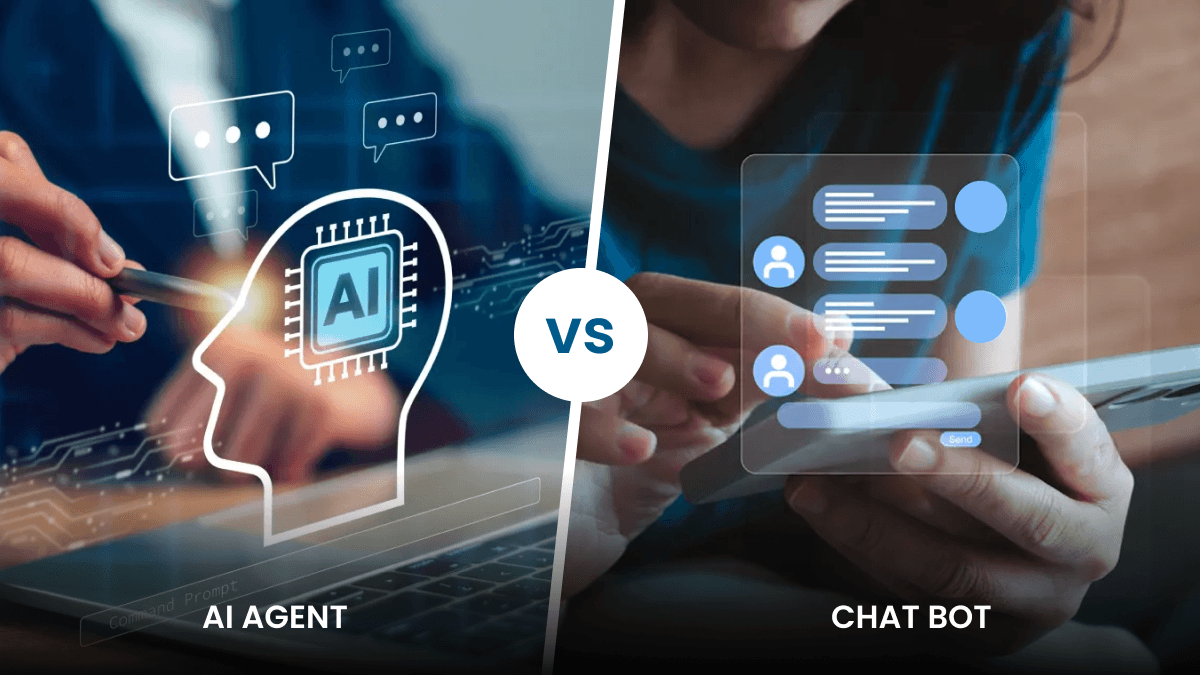
The initial models used to perform the job involved the rule-based approach, where decision trees in disguise provided a conversational flow by matching input text with pre-defined commands. However, since 2022, enterprise chatbots have been using large language models. Still, the task remains the same as interpreting input and giving output.
That job is bound by design. It works in one turn or a small series of turns without having an agenda across sessions and without checking the chatbot’s responses after the fact. If you ask about the status of your order, it retrieves it and delivers it to you. If you ask about anything outside the scope of its training and permissions, like an exception to a refund, a contractual clause, it must recognize it and pass it on to a human. This is exactly what makes the chatbot reliable, predictable, and economical.
Fact Check
- 17% of organizations deployed AI agents in production as per the 2026 Gartner CIO survey, while over 60% are expected to so within two years.
- 88% of enterprises now report regular AI use in at least one business function, with agent use concentrated in IT and knowledge management.
AI Agent vs. AI Chatbot: A Detailed Enterprise Comparison
Set side by side, the operational differences between an AI agent and an AI chatbot become a matter of contract, not a degree. The table below reflects how each is actually evaluated inside an enterprise architecture review.
| Dimension | AI Agent | AI Chatbot |
|---|---|---|
| Core function | Pursues a defined goal through multiple steps and tools | Interprets input, generates a conversational response |
| Interaction model | Proactive: plans, executes, and adapts across a task lifecycle | Reactive: responds within a single turn or session |
| Autonomy level | Bounded autonomy; can execute actions within defined permissions | None; output requires a human to act on it |
| Memory & context | Persists context and prior steps across the full task | Limited to the current conversation |
| System integration | Read/write access to tools, APIs, and business systems | Typically, read-only that retrieves information |
| Decision-making | Evaluates options, chooses a path, self-corrects on failure | Follows a script or model response, no independent judgment |
| Governance needs | Permissioning, audit trails, human-in-the-loop checkpoints | Content and tone review |
| Typical KPI | Task completion rate, cycle-time reduction, cost per outcome | Deflection rate, response time, resolution satisfaction |
| Implementation complexity | Moderate to high; requires system access, orchestration, and guardrails | Low to moderate; largely a conversational layer on existing data |
The question is not which technology is more advanced. It is how much autonomy the workflow requires.
Benefits: AI Agents vs. AI Chatbots
Despite the many differences between AI Chatbot and AI Agent, both bring a bundle of benefits to your business as well. Decision makers aren’t always sure which ones will be appropriate for their enterprise. The benefits of each below will help you make the right choice for your business.
AI Agents
The benefits of AI agents sit on a different layer entirely; not the conversation but the process behind it. An agent doesn’t just answer a question about an invoice; rather, it can reconcile the invoice, flag the discrepancy, and route the exception to the right approver, without a person opening three separate systems to do it manually. That’s where the return shows up, not in faster replies, but in compressed cycle times for work that used to require a person moving between tools.
The results of both are very encouraging. However, there is an important lesson that, as a decision-maker, you need to understand. Enterprises that focus on one use case – one clear goal, specific business function, and integration in one area – see the benefit quickly and can evaluate faster as to which one is better for them.
AI Chatbot
The business use case for a chatbot is a straightforward calculation. It absorbs a volume of data, which otherwise would require substantial human effort. AI chatbots is always available and gives the same accurate first response to every customer, regardless of their time zone or queue length. A chatbot doesn’t improvise policy; it simply generates response based on the information provided. The benefit is contained, predictable, and easy to measure against a deflection target.
The organizations seeing real returns aren’t the ones that deployed the most agents. They’re the ones that redesigned the workflow the agent sits inside.
When to Use AI Chatbots vs. AI Agents
The right choice between the two isn’t about which technology is more advanced. It’s about matching the tool to how much the task requires interpretation of language versus execution across systems, and how much risk is acceptable if it gets something wrong.
| Criteria | Which One to Choose |
|---|---|
| You need AI to answer, explain, retrieve, or guide | AI Chatbot |
| You need AI to decide, execute, update, or coordinate | AI Agent |
| You need AI to converse with users and execute behind the scenes | Both |
| You need AI to handle high-volume, repetitive queries | AI Chatbot |
| You need AI to pursue a defined goal through multiple steps and tools | AI Agent |
| You need AI to qualify leads or schedule appointments | AI Chatbot |
| You need AI to reconcile data or trigger actions across platforms | AI Agent |
| Output only needs to inform a person, not act on their behalf | AI Chatbot |
| Actions need to execute automatically within defined permissions | AI Agent |
| Only the current conversation needs to be remembered | AI Chatbot |
| Context and prior steps need to persist across the full task | AI Agent |
| Read-only access to information is enough | AI Chatbot |
| You need read/write access to tools, APIs, and business systems | AI Agent |
| Governance can be limited to content and tone review | AI Chatbot |
| You need permissioning, audit trails, and human-in-the-loop checkpoints | AI Agent |
| Success is measured by deflection rate or response time | AI Chatbot |
| Success is measured by task completion or cycle-time reduction | AI Agent |
| You need a single interface with complex execution happening behind it | Both |
So, Which One Does Your Business Need?
When an AI Chatbot Is the Better Business Choice
More autonomy isn’t automatically more value. If the job is answering predictable questions at high volume, giving an AI access to your operational systems can add cost and risk without improving the outcome. A chatbot that retrieves the right answer quickly is often the whole solution, and there’s nothing about the task that calls for permission to act on your systems.
This is where chatbots consistently earn their keep:
- Customer support FAQs
- HR policy queries
- Order-status enquiries
- Product guidance
- Lead qualification
- Internal knowledge retrieval
The pattern across all six is the same: high volume, a predictable answer, and little to no action required once the answer is given. High volume plus a predictable answer plus low action requirement is what makes chatbot economics work. You’re paying for a conversational layer, not for orchestration and governance. On the contrary, an AI agent needs to operate safely.
When an AI Agent Earns the Extra Complexity
AI agents cost more to integrate, govern, and monitor. It’s just the reality of giving software permission to act on real systems. So before reaching for one, the business case has to justify that complexity rather than assume it away.
An agent tends to earn its keep when:
- The work crosses multiple systems
- Someone today moves information manually between tools
- The task has several steps
- Each next action depends on what happened in the step before it
- Cycle time is what matters to the business
Finance reconciliation, IT ticket resolution, supply-chain exception handling, claims processing, and software engineering workflows all fit that shape. This is exactly why they keep showing up as the use cases enterprises reach first.
If the value lies in answering the question, you probably need a chatbot.
If the value lies in what happens after the answer, you may need an AI agent.
Conclusion
The AI agent vs. AI chatbot question isn’t a debate about which is better. It’s a design decision about where language ends, and where action should begin in each process. Chatbots remain the right, cost-effective answer for high-volume conversational work. AI agents earn their place where a task spans systems, requires judgment, and can be scoped tightly enough to govern responsibly.
The enterprises pulling ahead in 2026 aren’t the ones that deployed the most of either. They’re the ones that stopped treating “AI agent” as a marketing label, understood the architecture underneath it, and matched the tool to the actual shape of the problem, deliberately, and with the governance to back it.
Frequently Asked Questions
What is the basic difference between an AI agent and an AI chatbot?
A chatbot responds to a question, whereas an AI agent plans the steps to reach the goal it is given. AI agent also uses tools or systems to execute those steps and can act with limited human supervision. The basic difference is that of autonomy: a chatbot’s output is based on the data given by humans; an agent can take the action itself, with little human help.
Can an AI chatbot be upgraded and used as an AI agent?
No, not by simply adding features. The two require different architecture; an agent needs tool access, memory across steps, and a permissioning framework for a conversational interface doesn’t. Many enterprise “agentic AI” products today are effectively chatbots with a limited set of actions bolted on. It’s worth asking a vendor directly what systems the product can write to, not just what it can talk about, before treating it as a true agent.
Is AI agent implementation riskier than deploying a chatbot?
No, it is not riskier; however, AI Agent implementation does carry more operational risk because an agent can act on real systems, not just generate text. That risk is manageable with scoped permissions, audit logging, and human checkpoints at defined stages, but it does require a governance model for a simple chatbot deployment doesn’t.
Are both AI agents and AI chatbots required in an enterprise?
Not always. It majorly depends on requirements based on which you can deploy either or only one. AI chatbots and AI agents aren’t competing. Both solve different problems. Chatbots manage routine conversations like answering common questions and handling large volumes of user interactions. AI agents, however, completes tasks that involve multiple applications, business rules, or decision-making.
Key Takeaways
- AI agents act; AI chatbots respond. Agents plan, use tools, and complete multi-step work with limited supervision. Whereas chatbots interpret and answer within a single exchange.
- Autonomy is the core difference: A chatbot needs a human to act on its output; an agent can execute the action itself across systems.
- Synchronize the tool to the task. Chatbots suit high-volume, low-complexity conversations. Agents suit workflows spanning multiple systems or requiring judgment.
- Adoption is uneven. AI chatbots are already in the mainstream, embedded in most customer service and support stacks. AI agents are moving fastest in IT, software engineering, and customer service, but production still trails experimentation.
- It’s not a replacement story. Enterprises will run both, with the boundary set by risk tolerance and process of ownership, not novelty.
