 Digital Transformation
 Data Engineering
 Implementation
 Staffing Services

Migrating Healthcare Data to Snowflake for Faster, Reliable Reporting
From reporting downtime to a single source of truth: How Infojini improved reporting availability and centralized enterprise analytics.
About the Client
The client is an innovative healthcare provider based in Huntington Beach, CA and delivers care solutions to people suffering from chronic diseases, especially elderly patients. Its multidisciplinary care teams help patients manage their chronic diseases at home and avoid unnecessary hospital admissions and visits to the emergency room.
The Business Challenge
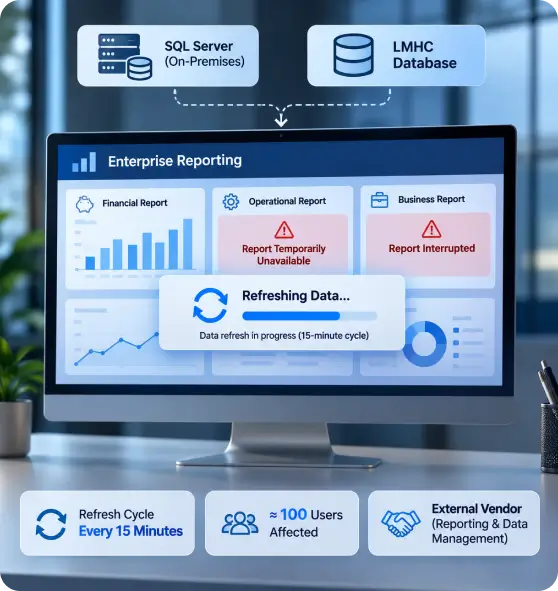
The electronic health record (EHR) system ran on an on-premises SQL Server, where data was replicated into a separate LMHC database every 15 minutes. Each refresh cycle caused reporting downtime for approximately 100 users.The operational impact extended beyond reporting downtime:
Reporting interruptions:
01Recurring refresh cycles disrupted report access for approximately 100 users.
Fragmented data:
02The absence of a centralized repository left enterprise reporting and analytics dependent on partial, disconnected copies of data.
Third-party vendor dependency:
03Relying on an external vendor for reporting and data management limited flexibility, speed, and control.
Limited access to timely insights:
04Business teams lacked timely data insights and a self-service natural-language agent to answer questions without waiting for a report developer.

Objectives
The overall goal of the initiative was to update the client's current data architecture with respect to its healthcare data by transitioning CareTend EHR data and SQL Server objects to Snowflake without any downtime associated with reporting.The main goals included the following:
- Eliminating Reporting Downtime: Maintain constant reporting access for about 100 people without the interruption of the database refresh process.
- Centralize Healthcare Data: Create a single data source for the EHR data and reporting tools within Snowflake.
- Enhance Data Quality: Increase data accuracy, security, and governance by implementing source-to-target validation and control over access.
- Empower Self-Service Analytics: Provide business insights for Finance, Operations, and Sales with the help of interactive applications and Power BI reporting.
The Solution
Infojini modernized the client's reporting architecture by migrating CareTend EHR data and SQL Server objects to Snowflake. The solution combined migration automation, source-data validation, layered data modeling, security controls, and business-facing reporting applications.Here's how Infojini delivered the solution.
Secured multi-environment Snowflake architecture: Implemented role-based access control (RBAC), single sign-on (SSO), access controls, and a multi-environment Medallion architecture to strengthen security and separate development and testing from production reporting.
Automated SQL Server migration: Used SnowConvert to automate database-object conversion and Cortex Code to accelerate remaining migration work, reducing manual effort while keeping converted code consistent and reviewable.
Data ingestion and validation: Migrated CareTend EHR data and SQL Server objects into Snowflake and validated the migrated data against its source to support accuracy and trust in downstream reporting.
Medallion-based data modeling: Built on the Bronze raw-data layer with Silver transformations to standardize and clean data, followed by Gold models designed for business-ready reporting and analytics.
Streamlit-based self-service applications: Developed applications directly on Snowflake to enable interactive data exploration and improve access to information.
Power BI enterprise reporting: Delivered reports for Finance, Operations, and Sales, providing departmental teams with access to business-relevant insights.
Foundation for future analytics: Established a governed data platform that can support additional data sources, expanded departmental reporting, real-time insights, and a separately planned self-service natural-language agent.
Technology Stack Used
The solution combined Snowflake engineering, automated migration, layered data modeling, and BI applications, with security controls and data validation ensuring governed reporting and greater data control.
Core platforms and tools
Snowflake
Microsoft SQL Server
SnowConvert
Cortex Code
Streamlit
Power BI
Security and access controls
Role-Based Access Control (RBAC)
Single Sign-On (SSO)
Data architecture
Medallion Architecture (Bronze, Silver, and Gold)
Data quality and validation
Source-to-target data validation
Automated data quality checks
Immediate Business Impact
With the Snowflake modernization, reporting availability increased, analytics became more centralized, and migration accelerated. There was governed data modeling and self-service reporting.
- Reporting Downtime
- Reduced to zero
- Report Rendering Time
- Reports rendered data in 5 seconds
- Users with Improved Reporting Availability
- Approximately 100 users gained uninterrupted reporting access
- Migration Time Saved
- 70% reduction in migration time
- Manual Migration Effort Saved
- Two months of manual effort saved
- Departments Supported
- 3 departments: Finance, Operations, and Sales
- Vendor Dependency
- 80% reduction in vendor dependency
- Data Trust
- 100% increase in data trust
- Enterprise Analytics
- Established a single source of truth for enterprise analytics
- Data Security and Governance
- Strengthened data security and access governance
- Greater Control Over Reporting
- Increased control over data and reporting
Ready to Modernize Your Enterprise Data Platform?
Build a governed Snowflake platform that improves reporting availability and gives your teams access to trusted data.