 Digital Transformation
 Data Engineering
 Implementation
 Staffing Services


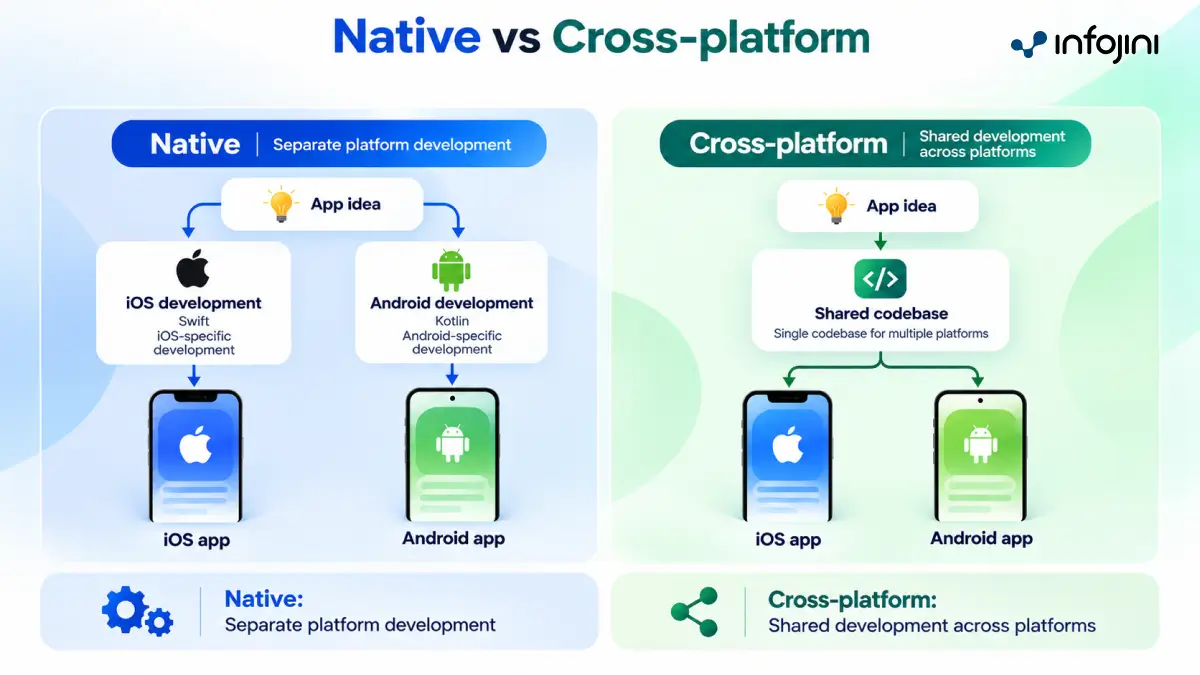
When a company thinks about making an app, one technical issue that gets debated is whether to use native or cross‑platform development. At first, it seemed like a choice. Native refers to building two apps, one for iOS and one for Android. Cross-platform development lets a team share much of its code across both.
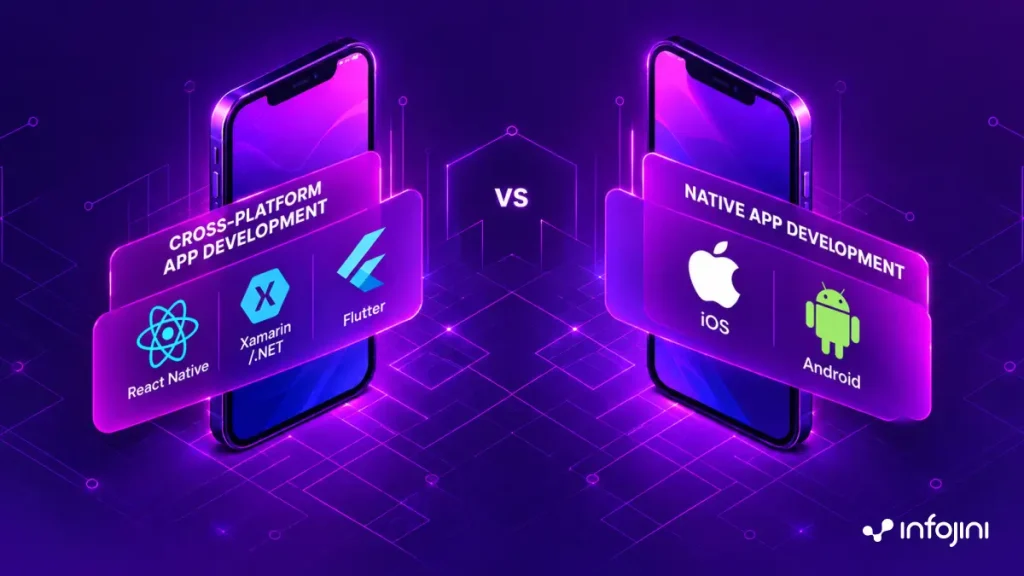
The real decision, however, comes down to the product. Does the app need deep access to device hardware? Is performance critical? Does the business need both platforms quickly? How much budget can be allocated to development and ongoing maintenance? The answers to those questions make the native vs cross-platform decision much easier. But first let us understand what native and cross-platform app development is.
What is Native App Development?
Native app development involves creating an application specifically for one operating system. For iOS, developers typically use Swift and Apple’s development tools. Android development commonly uses Kotlin and Google’s Android development ecosystem.
If the business wants both iOS and Android versions, separate development work is generally required. The advantage is control. Developers can work directly with the features of each platform, which can be important for apps that depend a lot on cameras, sensors, graphics, background tasks or other things that only a specific device can do. Native also makes sense when the look and feel of the app needs to match a platform closely. For a business app, though, that extra control might not be worth the extra work.
Native development gives teams control over updates and platform‑specific features. When Apple or Google introduces a capability, a native team can work with the platforms’ own tools and APIs without waiting for a cross‑platform abstraction to catch up.
That control can be useful for products where mobile experience is a core part of the business. For example, a financial application may need specific security features, while a fitness or healthcare application may rely heavily on device sensors. In these cases, having direct access to the operating system can make future development more predictable.
What is Cross-platform App Development?
Cross-platform development lets you use one codebase to create apps that run on different operating systems. Tools like Flutter and React Native are popular for this. Flutter helps build apps for platforms using the same code. React Native lets developers use it while still working with features from each platform.
The biggest advantage is efficiency. The development team can reuse most of the business logic on both iOS and Android without developing it twice for two different platforms. The changes can be made in one place and then propagated to both platforms. This will reduce the need to repeat the same development work for iOS and Android. Still, some parts may need tweaking for each system. This makes platform development a smart choice for companies with small engineering teams or those needing to launch on both iOS and Android quickly.
Shared code does not mean that everything must look or behave the same on every device. A good cross‑platform implementation can still account for differences between iOS and Android where differences matter.
For a business, that distinction is important. The benefit is not simply writing less code. It is reducing unnecessary duplication while keeping enough flexibility to adapt the app to each platform. That can make a meaningful difference when the product is expected to evolve through frequent releases.
Native vs Cross-platform: What Really Changes?
The differences between native and cross-platform development become clearer when you look beyond the technology itself.
1. Performance
A. Native app performance: Native provides an advantage when an application needs performance or deep access to platform features. This advantage matters for products such as games, AR applications, advanced video tools, or apps that carry out processing, on the device.
B. Cross-platform app performance: For an employee portal, booking platform, or customer-facing business application, the difference may be less important. Modern cross-platform frameworks can create applications.
2. User experience
A. Native app user experience: Native development provides more control over platform-specific interface behavior. That can be valuable when an application depends on the conventions of iOS or Android rather than simply presenting the same interface everywhere.
B. Cross-platform app user experience: Cross-platform development allows teams to create a consistent experience across iOS and Android using a shared codebase. However, when an app needs to follow platform-specific navigation patterns, interactions, or interface behavior, developers may need to add platform-specific code.
3. Development time
A. Native app development time: With native development, separate applications are generally built for iOS and Android. This means platform-specific development, testing, and release of work may need to be handled independently.
B. Cross-platform app development time: Cross-platform development has a natural advantage here because a significant amount of code can be shared between platforms. This can reduce the time spent building the same functionality separately for iOS and Android. However, that does not mean the entire development process takes half the time. Design, backend work, testing, security, integrations, and release processes still require substantial effort. The main benefit is that the team does not have to repeat as much platform-specific development as in the case of native apps.
4. Maintenance
The same logic applies after launch.
A. Maintenance for native apps: If there are individual native apps, the particular feature will have to be built and tested individually for each platform.
B. Maintenance for cross-platform apps: In a shared codebase, you do not need to create the functionality for iOS and Android individually. Nevertheless, as the app is filled with numerous custom native implementations, some of the benefits get lost. So, the architecture needs to account for where the product is going, not just what version one looks like.
Native App vs Cross-platform: Which One Fits Your App?
There is no universal answer to native app vs cross-platform. Consider a typical enterprise workflow application. It might include employee login, forms, notifications, document access, location services, dashboards, and API integrations. Such an application may not need two separate codebases.
Cross-platforms may be a practical choice. Now take into account applications based on complex camera processing, augmented reality, graphic sophistication, or specific hardware. If your application demands high-performance computing, advanced hardware capabilities, or platform-specific functionalities, you might want to opt for native development.
The same distinction applies to consumer apps. An online marketplace or food delivery application may benefit from getting common experience onto both platforms quickly. A graphics-heavy gaming product has very different requirements. Technology should follow the product rather than the other way around.
Native vs Cross-platform App Development Cost
The cost aspect plays a role in this particular business decision as well. The creation of two native applications usually results in higher costs since it takes separate development efforts for each platform, as opposed to cross-platform mobile app development. The average cost of native mobile app development greatly varies depending on a few factors including but not limited to characteristics of the app itself, its complexity, platforms used, etc. The same applies to average cost of cross-platform mobile apps development.
Forrester talks about the tradeoffs between cross‑platform approaches. It points out the development and maintenance of investment involved in supporting platforms. Cross‑platform development can lower investment by cutting down duplicated work. The actual savings depend on the applications’ scope, complexity, and platform-specific requirements.
The framework is only one part of the budget. Features, backend development, third‑party integrations, security, testing, UI complexity, and post‑launch support can have a larger impact on the final cost.
Let’s look at the difference between the two in details:
| Cost factor | Native development | Cross-platform development |
|---|---|---|
| Initial development | Higher when building for both iOS and Android because each platform requires a separate implementation | Generally lower because much of the codebase can be shared |
| Development effort | More platform-specific development and testing | More shared development across platforms |
| Maintenance | Updates and fixes may need to be handled separately for each platform | Shared code can reduce duplicated maintenance work |
| Platform-specific features | Strong support for deep OS and device capabilities | May require additional native code for certain features |
| Long-term cost | Can increase as two separate codebases evolve | Can be more efficient when most functionality is shared |
| Best fit | Performance-heavy or highly platform-specific applications | Business apps, e-commerce, marketplaces, portals, and similar multi-platform products |
When Should You Choose Native App Development?
Native development is easier to justify when the application depends heavily on:
- Advanced device or hardware capabilities
- High-performance graphics
- AR or intensive camera functionality
- Platform-specific operating-system features
- Highly customized iOS and Android experiences
- Specialized background processing
Another consideration is how much control the team needs over each platform. With native development, iOS and Android can be developed and refined independently, which gives teams more flexibility when the two versions need to behave differently. This can be useful when each platform has different technical requirements or release priorities.
If those capabilities are central to the product, the additional investment in native development can be worthwhile. The goal is not simply to choose the cheaper architecture, but to avoid building the product around limitations that could become expensive to address later.
When Does Cross-platform Development Make More Sense?
Cross-platform is often a good fit when the business needs:
- Both iOS and Android
- A faster path to market
- A smaller engineering team
- A largely shared user experience
- Lower duplication between platforms
- Faster rollout of common features
This can be especially useful for enterprise applications, marketplaces, e-commerce products, booking systems, internal tools, and other applications built around standard mobile capabilities. Money saved on duplicated development can instead go toward product design, security, backend infrastructure, customer research, or features that users actually care about.
It can be particularly useful when the core experience needs to remain consistent across devices. For example, an internal business application may need the same workflows, forms, and approval processes on both iOS and Android. In that situation, maintaining a shared foundation can reduce unnecessary differences between the two versions.
Conclusion
The native vs cross-platform debate is often presented as a choice between performance and cost. It is actually a choice of priorities. Native gives a business more platform-specific control. Cross-platform can reduce duplicated development and make launching across iOS and Android more efficient.
That said, neither approach is automatically the right one.
A business application that mainly handles forms, APIs, dashboards, payments, or workflows may have little reason to pay for two separate implementations. A product built around advanced graphics or specialized device capabilities may have very different needs.
The best architecture is the one that supports the product without creating unnecessary engineering work.
Frequently Asked Questions
Is native better than cross-platform?
Native is usually the choice when you need platform integration, advanced hardware access, or demanding graphics. Cross‑platform is often preferred when your application shares most of its work across iOS and Android.
Is cross-platform app development cheaper than native?
Yes. It may be more cost-effective to develop cross-platform applications compared to the development of separate applications for iOS and Android platforms. There could be some time saving in the development process of cross-platform applications; however, the cost saving will largely depend on the application’s complexity.
What are the main drawbacks of cross-platform app development?What are the main drawbacks of cross-platform app development?
The main drawbacks of cross-platform app development include limitations in handling platform-specific features, performance issues in certain types of applications, and the need for additional native code in some cases. Apps that rely heavily on device hardware, complex animations, or operating-system-specific capabilities may require developers to write platform-specific code alongside the shared codebase. This can make the application more complex to develop and maintain.
When should you choose native app development?
The approach of native app development is more suited in cases where an app depends highly on the features of the device; performance levels are high, or there is a need for user interface that blends well with the platform. This also comes in handy when the two apps for iOS and Android behave differently.