 Digital Transformation
 Data Engineering
 Implementation
 Staffing Services


Generative AI won’t build your data platform, but it can draft the boilerplate code, chase the schema drift, write the docs, and diagnose the 2AM pipeline failure before you’re even awake. The teams winning aren’t the ones moving fastest, but they’re the ones who never let a generated draft pass without a human check.
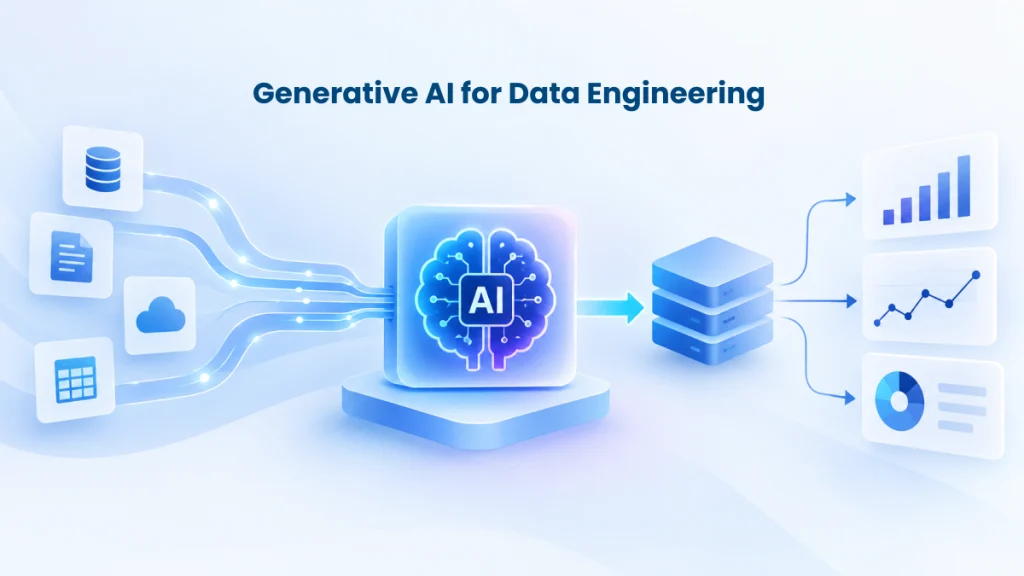
GenAI in data engineering isn’t a replacement, but the fastest junior engineer you’ve ever worked with, and the only one that should never be left unsupervised.
Key Takeaways
- Generative AI is a co-pilot, not a developer replacement tool. Generative AI removes the blank-page portion of pipeline work. The engineer still owns the decision.
- Four use cases are proven today. Code and transformation generation, documentation and lineage, pipeline diagnostics, and synthetic test data.
- Governance is not optional. Hallucination, data security, cost, and the skill shift all need a plan before scale, not after an incident.
- The role is moving up the stack. From manual execution toward architecture, review, and oversight of AI-assisted work.
Why the Pressure on Data Teams Has Changed
More sources, less time, and a business that no longer waits for a nightly refresh
Data engineers today work with a moving target. Every quarter brings a new source system, a new format, and a business that doesn’t want to wait for the next scheduled batch job anymore. Reporting used to be the main thing a pipeline served. Now it’s competing with AI applications that need current, well-structured data just to function, which means there’s more work to do, and getting it wrong costs more than it used to.
Part of that shift is architectural. Enterprise data teams are moving away from batch-only design. They’re building real-time, event-driven pipelines now, for things like fraud detection and supply chain decisions that can’t wait for a refresh.
This is the pressure that has made GenAI for data engineering worth serious budget attention rather than a side experiment. Used well, it does not remove the engineering work. It removes the blank-page portion of that work, so a team can absorb more sources and more urgency without simply hiring its way through the backlog.
What Is GenAI in Data Engineering?
How it differs from the predictive machine learning data teams already use
A generative AI is a model built to produce new outputs like code, text, query, and a synthetic dataset. That definition matters more in data engineering than it might appear.
Most AI already used in this field is predictive. A model trained to flag an anomaly, forecast a load, or score a record against a fixed dataset. Predictive machine learning answers a question about data that already exists.
However, Generative AI in data engineering does something different. Give it a plain-language instruction, a messy schema, or a stack trace, and it drafts something that didn’t exist a moment ago. A transformation script, a lineage note, a corrected query that an engineer then reviews, edits, or discards.
That is also why GenAI for data engineering changes the shape of an engineer’s day more than earlier automation did. Rule-based tooling executes the instructions that were already written. A generative model reads a situation it has not seen in that exact form before and proposes a response, the way a competent colleague would sketch an approach before writing final code. The output is a draft, not a decision, which is precisely the design point.
Generative AI Use Cases in Data Engineering
Where GenAI in data engineering has moved from pilot to repeatable production.
Let’s look at where generative AI for data engineering have proven out, rather than merely been promised. Four areas account for most of the real deployment today.
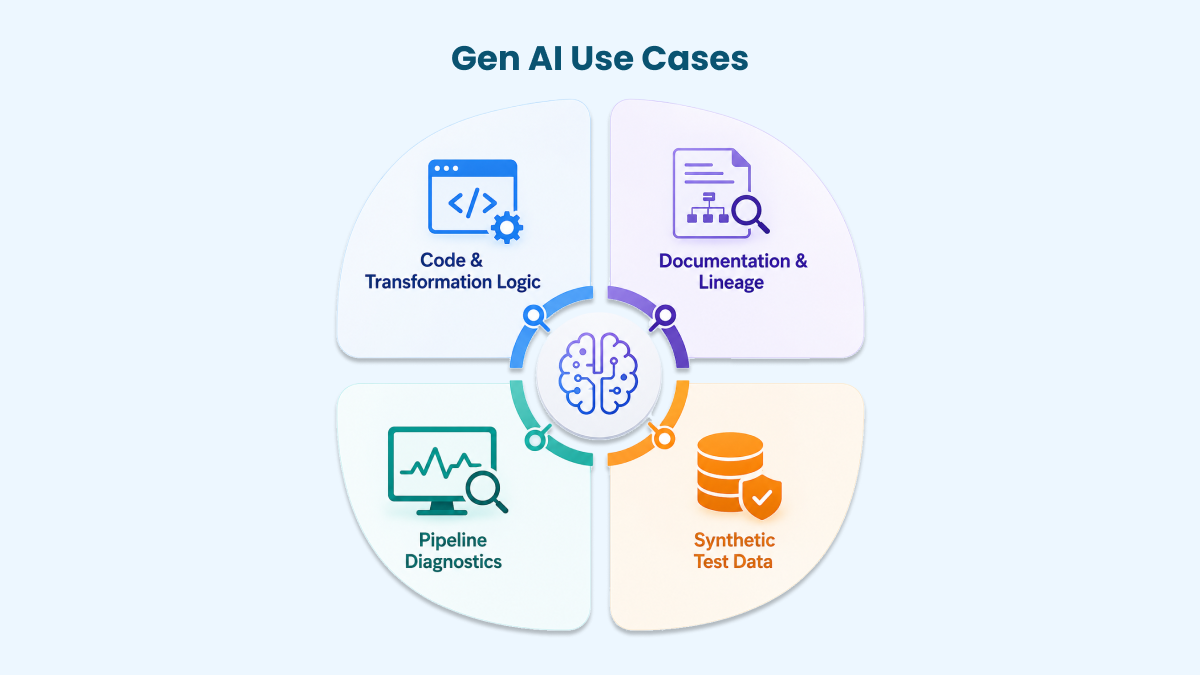
| Code & Transformation Logic | Plain-language request in, reviewable pipeline code out. |
| Documentation & Lineage | Column definitions and lineage maps that stay current. |
| Pipeline Diagnostics | Reads logs, proposes the specific fix, not just an alert. |
| Synthetic Test Data | Realistic patterns, no exposure of real customer data. |
Code & Transformation Logic Generation
Every data engineer has written the same kind of mapping logic a hundred times. Two schemas that were never designed to talk to each other, and someone had to translate between them field by field. It’s necessary work, and it’s rarely an interesting part of the job.
How GenAI Helps
A model can read the source and target schemas, propose the field-level mapping, and draft the transformation logic. It first passes an engineer edits rather than one they write from a blank file. An IEEE-published benchmark of a generative-AI ETL automation system, tested against established rule-based methods, found the generative approach reached 97% transformation accuracy, automated roughly 85% of the pipeline-building work, and adapted to a changed source schema in about six hours instead of the days a manual rebuild usually takes. That adaptation figure is the one worth remembering, because schema drift, not the original build, is what quietly eats a data engineering team’s calendar all year.
Documentation, Metadata, and Lineage
These three get used interchangeably, but they’re different:
- Documentation explains what a table or column means.
- Metadata is the structured detail about the data itself, the type, owner, last updated.
- Lineage traces where data came from and everywhere it flows downstream.
All three decay fast. Tables get renamed, columns get repurposed, and the written record falls behind within a sprint, right when a new analyst or a downstream AI application needs it most.
How GenAI Helps
Generative AI closes that gap by reading the pipeline code itself instead of waiting for someone to update the document. It can generate a lineage map, write plain-language column definitions, and keep a running explanation of what a job does. That explanation updates as often as the code changes, not as often as someone remembers to write it up. This use case doesn’t get the attention code generation does, but it might have the better payoff. Undocumented pipelines are a big reason data engineering work runs longer than leadership expects.
Pipeline Diagnostics & Self-Healing
A pipeline failure has traditionally meant an engineer opening a log file at an inconvenient hour and working backward from a stack trace, guessing all causes until one click.
How GenAI Helps
Generative AI shortens that guesswork. It can read the failure logs, narrow in on the likely cause like a memory ceiling, a bad join, a partition sized wrong for the current data volume, and propose the specific fix rather than a generic alert. The more advanced version, agentic self-healing, goes further still by applying a pre-approved class of fix automatically and flagging it for review afterward. Enterprise software is adopting this fast: Roughly 40% of enterprise applications are projected to feature AI agents by the end of 2026, up from under 5% in 2025, and data pipelines are one of the categories driving that curve, simply because of failures. There are frequent, pattern-based, and expensive to leave sitting until the next business day.
Synthetic Test Data Generation
Testing a pipeline properly means running it against data that behaves like the real thing. Real production data does that well, but it also brings privacy exposure most compliance teams won’t sign off on for a test environment.
How GenAI Helps
Synthetic data solves a real headache: you need production-realistic data to test a pipeline properly, but actual customer records carry privacy exposure most compliance teams won’t clear for a test environment.Generative AI gets around that by generating data that behaves statistically like the real thing, same distributions, same weird edge cases that only show up at scale, without any of it tracing back to an actual person.Gartner puts a number on how fast this is catching on: 75% of businesses will be using generative AI to create synthetic customer data by 2026, up from under 5% in 2023. Data engineering is one of the main reasons for that jump, second only to using synthetic data to train the AI models themselves.
The Future of the Data Engineer’s Role: Evolution, Not Replacement
What changes about the job when GenAI in data engineering is done well
The question every data engineer eventually asks about this technology is some version of “does this replace me,” and the honest answer is “no”, but the day-to-day shape of the job does change. Work that used to be manual execution moves toward review and design, which is a more strategic use of an experienced engineer’s judgment, not a smaller one.
| Before: Manual Execution | After: Strategic Oversight |
|---|---|
| Writing boilerplate transformation code by hand | Reviewing and refining AI-drafted transformations against business rules |
| Reverse-engineering undocumented pipelines | Validating AI-generated lineage and documentation for accuracy |
| Reading logs line by line after a failure | Approving or overriding AI-proposed fixes and defining what gets auto-applied |
| Building test datasets manually, often skipped under deadline | Setting the standards synthetic data must meet before a test counts as valid |
The thread running through that shift is a judgment. A model can draft a transformation, a fix, or a dataset, but deciding whether that draft is actually correct for this business, this regulation, and this downstream use still requires an engineer who understands the domain, which is precisely why the skill in shortest supply is shifting from typing speed to review discipline.
Where GenAI in Data Engineering Still Breaks
Four risks worth planning for before scaling adoption
1. Hallucination and silent errors
A model can generate transformation code that runs without an error and still produces subtly wrong output, because it matched a plausible pattern rather than the actual business rule. Every generated artifact needs to be checked against known-good outcomes, not just confirmed to execute.
2. Security and governance
Routing schema details, sample data, or pipeline logs through an external model’s API raises real questions about where that information is stored and who can access it. This needs a defined governance policy before rollout, not an assumption that the vendor has it covered.
3. Cost management
Running generative models at pipeline scale, especially for diagnostics and documentation that fire on every job, can become expensive quickly if usage is not scoped and monitored the same way any other infrastructure cost would be.
4. Skill shift
Engineers need to build a new kind of fluency: writing prompts precisely, recognizing when a generated draft is subtly wrong, and knowing when to take manual control back.
That is a different skill than writing the code from scratch, and it takes deliberate practice, not just tool access.
5. The Reality
Hallucination is the risk teams underestimate most, because the failure mode is quiet. A wrong prediction is visibly wrong; a plausible-looking transformation that silently drops rows is not.
Review discipline is not a model choice, but what separates the teams that get real value from generative AI in data engineering from the ones that get an incident.
Conclusion: A Partnership, not a Replacement
Generative AI for data engineering is here to change how the core work gets done, not here to take away the jobs of data engineers.
It helps in drafting transformation code to keeping documentation honest, from diagnosing failures to producing test data that is safe to use. The organizations getting real value from it are treating every artifact the way they would treat a capable junior colleague’s first draft: useful, fast, and never shipped without review.
|
It’s a co-pilot, not a replacement. Generative AI removes the blank-page portion of pipeline work; the engineer still owns the decision. |
Four use cases are proven today. Code and transformation generation, documentation and lineage, pipeline diagnostics, and synthetic test data. |
|
Governance is not optional. Hallucination, data security, cost, and the skill shift all need a plan before scale, not after an incident. |
The role is moving up the stack. From manual execution toward architecture, review, and oversight of AI-assisted work. |
Frequently Asked Questions
How is generative AI different from the predictive AI data teams already use?
Predictive machine learning scores or forecasts against data that already exists. Generative AI drafts something new like a code, a query, documentation, a synthetic dataset that an engineer then reviews before it ships.
Will generative AI replace data engineers?
No. It removes the manual, repetitive portion of pipeline work like creating the boilerplate code, stale documentation, first-pass diagnostic, and shifts engineers toward review, architecture, and governance of AI-assisted output.
What are the most practical generative AI use cases in data engineering today?
Code and transformation logic generation, documentation and lineage management, pipeline diagnostics and self-healing, and synthetic test data generation are the four areas with the most production deployment right now.
What is the biggest risk of using GenAI in data engineering?
Silent errors like generated code or transformations that run without failing but produce subtly wrong output. A validation step against known-good outcomes is the main defense, not just confirming the code of execution.
Can generative AI build an entire data pipeline on its own?
It can generate most of the code and configuration for a pipeline, but engineers still need to review, test, and approve it before production. Full autonomy without review is where most reported incidents originate.