 Digital Transformation
 Data Engineering
 Implementation
 Staffing Services


A few years ago, AI began helping recruiters automate routine tasks such as screening applicants’ resumes, matching candidates’ skills with requirements of positions, and scheduling interviews. That improved efficiency, but recruitment is not a series of isolated tasks. It requires coordinating across the hiring process, adapting to changing requirements, and keeping candidates engaged at every stage.

Agentic AI in recruiting goes beyond this. Rather than completing a single task at a time, an agentic AI can manage several tasks towards accomplishing a recruitment objective, adapting to new situations, and driving processes with minimal manual interaction.
This, however, does not take the recruiter out of the picture. The human is required for assessing results, identifying errors or biases, and making judgments when necessary.
Key Takeaways
- Agentic AI connects recruiting tasks into goal-driven workflows.
- 52% of talent leaders plan to add autonomous AI agents.
- Faster hiring means little if quality of hire doesn’t improve.
- Recruiters must oversee AI outputs and retain control of critical hiring decisions.
- Clean ATS and HRIS data are essential for reliable AI-driven recruiting.
The Growing Challenges of AI Alone
Something strange showed up in a PR Newwire published in March 2026. It found that 67% of US HR leaders said reviewing AI-generated job applications was slowing their hiring process down. 84% said their teams were carrying heavier workloads because of it.
That’s the embarrassment sitting underneath a few years of “AI-powered recruiting” pitches. Job seekers get AI tools to write and tailor applications instantly. AI was used to analyze and rank applications by companies. Both recruiters and candidates had an automated system of the application process, and somehow the entire system became slower and noisier instead of becoming faster and more efficient. And as Robertson reports, hiring volume has not increased, and the quality of hire has barely moved for most organizations.
This is the trap of automation, and this is where most businesses find themselves right now.
Why Did Traditional AI Fall Short?
Automation did what it was built to do: filter resumes, find interview slots, and answer an 11 p.m. question about salary range. But the problem is that speeding up these tasks did not make the hiring process better. Automation was designed to improve execution, but it was never enough to improve the quality of the decisions that were made. The bias didn’t disappear; it just swayed.
Pew Research found 71% of Americans oppose AI making a final hiring decision on its own, mostly because a program can’t judge personality the way a real conversation can. Recruiter burnout, which is what automation was expected to fix, in certain instances has worsened instead. The metric is meant to justify the whole investment. Recruiters are still reviewing and re-reviewing, just with a model doing the first pass. More automation, same outcome, compounding cost. That’s the trap.
The way out isn’t a better filter. It’s a different kind of system and the industry finally has a settled name for it, “Agentic AI”. The agent doesn’t follow a set of rules whenever certain conditions occur. Rather, the agent is assigned a goal, such as filling a role with specific requirements by a certain date, and planning the steps needed to accomplish it on its own. Automation follows a script written in advance. Agentic AI writes its own as it goes and only stops asking for judgment when the situation calls for it.
From AI assistance to agentic AI in talent acquisition
Agentic AI has moved beyond early experimentation and is starting to become part of real recruiting plans and budgets. Korn Ferry’s global survey found that 52% of talent leaders plan to add autonomous AI agents to their recruiting teams this year. Not AI-assisted tools, but systems built to act independently. That’s not a distant roadmap item. It’s more than half the market moving inside a single budget cycle.
How Agentic AI in Talent Acquisition Changes HR Workflows
What lies beneath this figure is important to call out explicitly because it alters the actual responsibilities of a technology leader and shows how AI in talent acquisition is changing the way recruiting teams divide work between people and technology.
In the AI-powered recruiting process, the individual makes decisions while the AI technology assists in performing certain functions. In the autonomous recruiting process, the AI agent goes a step further and performs multiple steps of the process on its own initiative, such as candidate sourcing, contacting, screening, and interviewing. This does not imply that the agent is supposed to make the decision at the end of the day. Confusing autonomous execution with autonomous decision-making is where organizations can get into trouble.
Traditional AI vs. Agentic AI in Recruitment
| Comparison point | Traditional AI | Agentic AI |
|---|---|---|
| Approach | Performs specific tasks based on predefined rules or instructions. | Plans and executes multiple steps toward a defined hiring goal. |
| Candidate sourcing | Finds candidates using recruiter-defined search criteria. | Searches for candidates and can adjust its approach based on results. |
| Task execution | Handles individual tasks, such as resume screening or interview scheduling. | Coordinates multiple tasks, from sourcing to outreach and interview scheduling. |
| Adaptability | Generally, operates within predefined workflows and parameters. | Can adapt its next steps based on results and changing conditions. |
| Human involvement | Recruiters direct tasks and review AI-generated outputs. | Recruiters oversee workflows and retain control of important hiring decisions. |
Agentic AI for Recruiting and Four Workflows That Deliver Results
Once the goal shifts from automating tasks to designing autonomous workflows, four use cases show repeatedly among the organizations getting real results.
1. Autonomous sourcing: Building better talent pipelines
Instead of a recruiter building a search string and working through results one by one, an agent continuously scans multiple channels, adjusts its targeting based on who’s responding, and keeps a pipeline warm without a person prompting each outreach. Bullhorn’s GRID Industry Trends Report found that staffing firms using AI were twice as likely to have grown revenue than those that weren’t. A wider and more consistently maintained pipeline is one of the plausible reasons the pattern holds.
2. Dynamic interview scheduling: Improving candidate experience
This is the simplest one to implement. The agent manages the entire process of searching for a mutual free time slot on the calendars, confirming it and accommodating any rescheduling. The value isn’t about saving a recruiter’s time, though it does that, it’s majorly about candidate experience. A slow, clumsy scheduling process is often a candidate’s first real impression of a company, and a strong one loses that impression to a competitor who moved faster.
3. Skill-based assessment: Improving quality of hire
A resume is a list of claims. A skills assessment test is taken to determine whether those claims hold up. AI has made these assessments practical to run at scale. A coding problem, scenario, or work sample might have taken an hour for a senior individual to score; the same test can now be scored within minutes, which will enable the recruiter to utilize time of the test.
That shift changes who gets seen. Candidates who interview well but underperform on the actual work get filtered out sooner. Candidates who are strong on the work but weaker at self-presentation get a fairer shot than a resume screen would have given them. It’s not complicated technology; it’s replacing a guess with evidence and doing it earlier and more consistently than a busy recruiter could manage alone.
4. Real-time bias detection: Monitoring recruitment fairness
This is a new feature and is less proven than the other three, but it’s quickly becoming a requirement rather than a nice-to-have. New York City’s Local Law 144 is pushing companies to check their AI for bias continuously, not just once a year in an audit. The smart move is building that monitoring in from day one, rather than trying to bolt it on later once an AI system is already making decisions at scale; that’s a much harder fix.
For a CXO evaluating any of this, the metrics worth putting on a scorecard are the same four every time:
| Time-to-hire | Because speed still matters in a competitive market. |
| Quality of hire | Tracked through actual performance and retention data, not interview pass rates alone. |
| Diversity | Diversity of the pipeline and the slate tracked continuously rather than audited once a year. |
| Recruiter productivity | Measured by how much of a recruiter’s week goes to judgment work versus administrative work. |
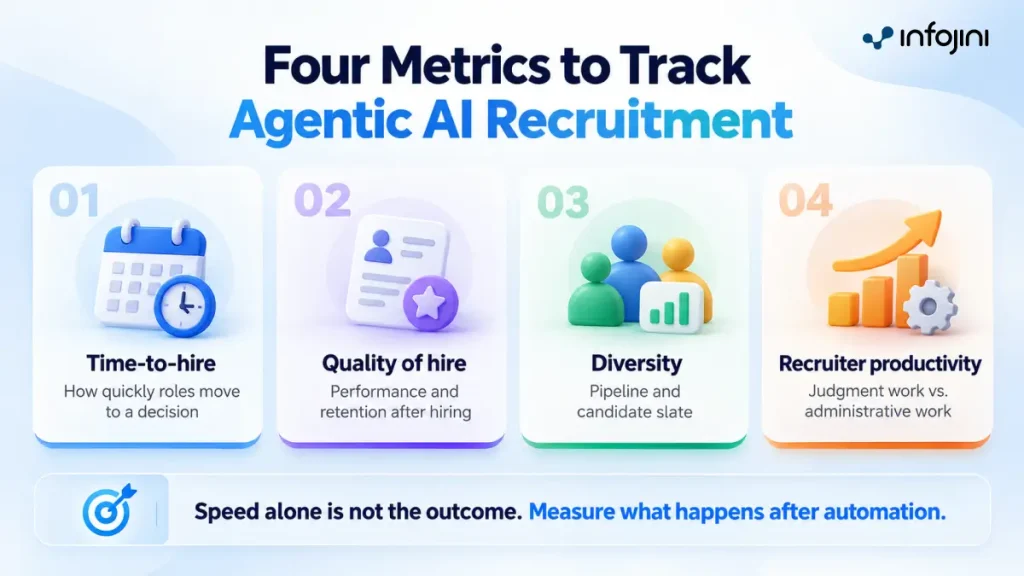
This is also the most direct way to understand how AI in recruitment for staffing improves hiring efficiency and outcomes. Time savings are helpful, but they are not meaningful unless they produce some result in the form of better recruits, quicker decisions, greater retention, or reduced administration.
If a vendor can’t show a plan for measuring at least three of those four, the pitch is selling automation with an agentic label on it.
How HR Professionals Can Implement This
Nothing like this ever happens through one big-bang effort, and all the organizations that have pulled it off seem to go through the same three phases.
| Phase 1 | Pilot is where you want to start because there is the most activity and the least complexity so that mistakes are low. |
| Phase 2 | Scale the implementation to other recruitment workflows, using the same ATS fields, assessment formats, and approval processes to maintain consistent governance as adoption grows. |
| Phase 3 | Measure the first two implementation efforts against the four criteria mentioned above. If time-to-hire was shortened without any improvement in quality of hire, that’s a good enough reason for investigation, not additional AI. |
Behind all three phases, there are three essential criteria that need to be satisfied simultaneously.
Three non-negotiables for agentic AI in recruitment
- Governance: Keep a human in the loop for every decision that affects a real candidate’s outcome, not a rubber stamp, but a genuine review. This matters directly to legal exposure under frameworks.
- Transparency: Tell candidates upfront where AI is involved in evaluating them and giving them a way to request human review. Not because a regulation requires it everywhere yet, but because it’s the fastest available fix for the trust gap already sitting inside your own funnel data.
- Integration: Treat this as an ATS and HRIS project as much as a recruiting one. An agent that can’t read clean data from your systems of record will make confident, fast, wrong decisions, which is worse than a slow, honest process. And invest in recruiters directly: Reviewing an agent’s output critically is a different skill from running a search yourself, and most organizations are underinvesting in exactly that transition.
The Future of Agentic AI in Recruitment
Autonomy is not the end goal. It is the point at which recruitment starts to become more adaptive. For years, hiring has been built around fixed job descriptions, predefined filters, and a rigid sequence of steps. That works when the talent market stays predictable. It doesn’t happen when skills change quickly, and the best candidate does not necessarily have the most impressive resume.
What follows will most likely be an even greater emphasis on skills, as opposed to qualifications and roles. Recruiters no longer have to consider how a certain individual reached a particular position; instead, they should examine what this person was able to accomplish and what he or she is capable of achieving. AI can assist here, yet its importance consists of providing better data to recruiters rather than making hiring decisions for them.
How the recruiter’s role will change
The recruiter’s role will change along with it. Less time will go into searching databases, moving candidates between stages, and chasing calendars. More time will go into understanding what a hiring manager really needs, questioning AI recommendations, talking to candidates, and making the calls that require context.
And the systems themselves should get better with experience. If an organization can connect its hiring data with what happens after people are hired, it can start asking better questions. Which sourcing channels produce people who stay? Which skills correlate with strong performance? Which candidates were rejected early but went on to succeed elsewhere?
Conclusion
Recruitment doesn’t need another tool that makes the same process run a little faster. It needs systems that can take more of the work off a recruiter’s plate without taking judgment out of their hands.
That is where autonomous AI starts to matter. The winners won’t be the companies that automate everything. They’ll be the ones that know what AI should handle, what people should own, and where human oversight and accountability need to remain as AI takes on more of the recruiting workflow.
Frequently Asked Questions
What's the real difference between AI automation and agentic AI in recruitment?
Automation speeds up a task a person is still directing, like filtering resumes, sending a scheduling email. Agentic AI is given a goal instead of a task and figures out its own steps to get there: sourcing, reaching out, screening, and booking interviews, with a person reviewing the outcome. The practical difference for a hiring team is how much of the process runs without someone actively steering it.
Does using Agentic AI in recruitment actually improve hiring efficiency, or just add more tools?
It depends on where you look. The evidence for faster sourcing and a lighter administrative load is solid. What’s much weaker is proof that AI has improved quality of hire, the metric that actually matters. A lot of teams have added AI and gotten faster without getting better.
Is AI recruitment biased, and can candidates trust it?
Most candidates don’t trust it. There are only a few applicants who believe that AI gives them a fair evaluation, despite the increasing trend of AI-influenced hiring process. Automation does not eliminate bias; instead, it transfers and hides it. NYC’s Local Law 144 is there because of this fact.
What does the future of agentic AI in recruitment look like beyond 2026?
Reduced resume filtering; more skill evaluation. HR personnel do less administrative sifting and more judgment-based decision-making and relationship building. And at some point, in the future, systems that evaluate based on long-term results, not just who was hired but who succeeded.