 Digital Transformation
 Data Engineering
 Implementation
 Staffing Services


The enterprise data warehouse was built for a simpler world. Data came from fewer systems, which were mostly structured, and reporting happened as per schedule. That model worked for decades. But that is much harder to defend today, especially after AI arrived on the scene. Enterprise data now comes from SaaS platforms, applications, APIs, devices, documents, and AI systems. Teams expect faster answers, broader datasets, and trusted business contexts.

So, the question has changed. It is no longer “Which data warehouse should we use?” but “What kind of data platform do we need to run the business?” That transition explains why Snowflake went from being a simple cloud data warehouse to becoming an entire Snowflake data platform. Snowflake operates on analytics, data sharing, applications, and AI.
Key Takeaways
- Snowflake has evolved beyond its original cloud data warehouse role.
- Modern data platforms need interoperability, governance, and support for AI workloads.
- Apache Iceberg and Horizon Catalog are central to Snowflake’s interoperability strategy.
- AI is making it mandatory to have governed and contextualized enterprise data.
- Data modernization should focus on business agility, not migration for its own sake.
From Traditional Data Warehouse to Snowflake Data Warehouse
To understand Snowflake’s current role is crucial to look at how the platform evolved. The legacy-style data warehouse was an information management solution based on the principle of a controlled repository of structured corporate data. Companies pulled information from operational systems, transformed it according to a certain schema, and loaded it into the warehouse to support reporting and analysis. This was considered sensible since business intelligence was the main goal. However, this approach had a structural limitation: the infrastructure was built for predictable workloads.
Where the Traditional Model Started to Strain
The traditional data warehouses were created for an altogether different time. When data used to be more structured, there were fewer sources, and scalability involved adding more infrastructure. In today’s world, organizations have to cope with increasing amounts of both semi-structured and unstructured data, more cloud-based applications, and constantly fluctuating loads. This makes data pipelines and engineering much more challenging. Meanwhile, analytics evolved from traditional periodic reporting to fast and continuous decision making. Finally, the arrival of AI increased demands even further, by requiring not just the abundance of data, but also the proper data that has to be relevant, contextualized, secure, and governed.
As these pressures grew, organizations needed infrastructure that could handle changing workloads and growing volumes of data without limitations of physical infrastructure. This created a different approach to building and scaling cloud data warehouses.
The Cloud Changed the Economics of Data Infrastructure
The cloud data warehouse represented the first major break from the traditional model. Instead of treating infrastructure as a fixed asset, organizations could consume computing resources as needed. Storage could scale independently. New environments could be provisioned faster. Teams no longer had to size physical infrastructure years in advance.
Snowflake Data Cloud Architecture report became a prominent example of this cloud-native model. Its architecture separated storage from compute, which allowed organizations to scale processing independently from the underlying data. That seemingly simple change had a significant business impact. Different teams could work against the same data without necessarily competing for the same computing resources.
An analytics team could run reporting workloads while data scientists worked on models. A development team could create its own environment without building another physical warehouse. An increase in workload temporarily can be handled without creating any permanent infrastructure. This is one of the reasons why the Snowflake data warehouse was important for organizations.
When the Warehouse Become a Platform
The snowflake data warehouse was the starting point, not the end of the story. The architecture that made Snowflake successful as a cloud data warehouse became the foundation for something broader. It became a platform where data engineering, analytics, applications, sharing and AI workloads can operate around the same governed data estate.
Snowflake’s Real Shift: From Warehouse to Data Platform
What makes the Snowflake data warehouse interesting is not a particular feature but a problem that previous data warehouses have never fixed. Businesses should be capable of using their data in different environments without constantly copying or migrating it to different systems or platforms. It’s a much bigger issue than just data warehousing.
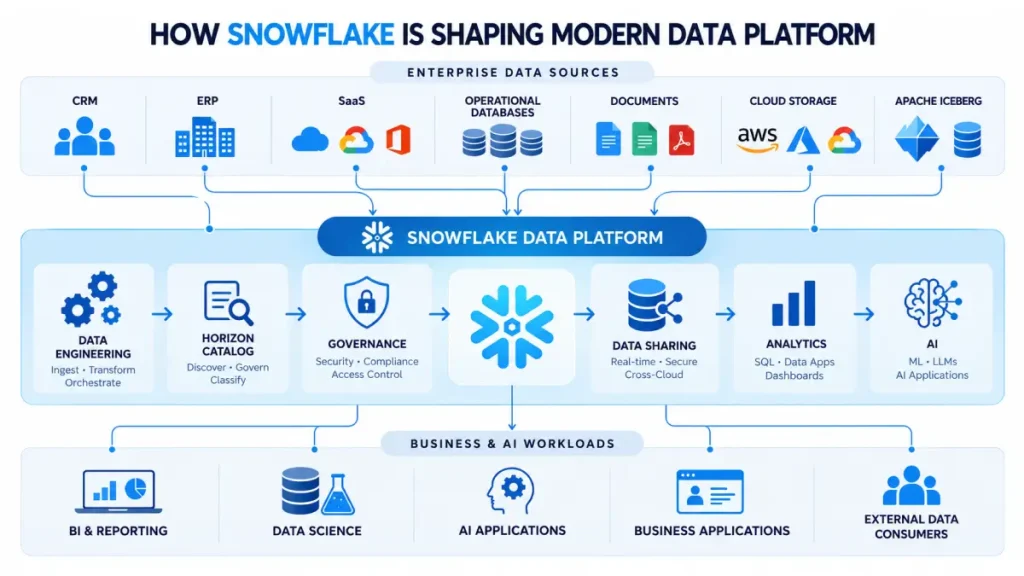
Snowflake’s evolution toward this model can be seen in its work around Apache Iceberg, Horizon Catalog, data sharing, data engineering, and AI. At Snowflake Summit 2026, the company announced capabilities designed to let enterprises work with a governed copy of data across Snowflake, external data lakes, and open systems, reducing the need to move or duplicate data. The platform is no longer asking enterprises to put everything inside one proprietary box. Snowflake is becoming more of a layer that allows companies to discover, manage, and interact with data regardless of where it resides. This is what distinguishes the modern data platform discussion from the old data warehousing discussion.
Interoperability: Where Data Can Live
Consider a retail enterprise. Customer information is available in CRM systems. Financial information is in ERP applications. Product data is stored in operational databases. Documents reside in object storage. Analytics teams may use different tools from data science teams. Acquired businesses may operate entirely in different cloud environments. A Snowflake data warehouse architecture can consolidate some of this information. But a modern data platform needs to connect the entire picture.
For years, enterprises have tried to centralize data. The problem is that centralization can create another kind of lock-in. There has been extensive investment in cloud storage, data lakes, analytics engines, and other data technologies. Enterprises cannot be expected to replace their entire data estate every time new technology emerges. This is why open formats such as Apache Iceberg have become strategically important. It gives enterprises flexibility over where data is stored and which engines can work with it.
Snowflake has been pushing very hard in that direction. The 2026 announcement about Horizon Catalog and Iceberg are especially noteworthy, as they indicate that Snowflake’s services go beyond just managing the data stored inside Snowflake. They have been expanding access to external Iceberg environments and enabling external engines to work with governed data through open interfaces.
In August 2026, Snowflake also introduced a preview allowing externally managed Apache Iceberg tables to be accessed through Horizon Catalog by engines including Spark, Trino, DuckDB and PyIceberg, with Snowflake role-based access controls applied consistently.
Governance: How Data Remains Controlled
Governance primarily meant controlling who could access a database. That definition is no longer sufficient. Modern governance must answer broader questions:
- Who owns this data?
- Where did it come from?
- Who has accessed it?
- Can this dataset be used for a particular AI application?
- Which version of the data produced this answer?
- What sensitive information is present?
- What happens when an AI agent accesses the same information?
These are operational questions, not documentation processes. The way Snowflake is now doing this involves governance being part of its platform. Horizon Catalog brings capabilities such as data discovery, lineage, data quality, sensitive-data protection and AI governance into a common governance layer.
This is especially relevant for enterprises in regulated industries. Healthcare organizations, financial institutions, government agencies and large enterprises cannot treat AI experimentation as a reason to relax existing controls. If anything, AI increases the need for stronger governance because the number of systems and users interacting with enterprise data is growing. The modern data platform therefore has to make secure access easier, not merely more restrictive.
Snowflake and the AI-Ready Data Platform
AI has changed the definition of “good data infrastructure.” For traditional analytics, an organization could tolerate a certain amount of delay. A daily dashboard does not necessarily require second-by-second data. But AI applications are less forgiving.
An AI assistant answering a customer-service question may need current customer information. An agent evaluating a transaction may need access to multiple systems. An internal AI tool may need to understand policies, financial records, and operational context before producing an answer. The model is only one part of that system.
It is all about how good, accessible, and governable the data is.
This is why Snowflake is addressing the problem by embedding AI into its database platform rather than developing AI as an entirely different platform itself. One such effort is its data engineering releases for 2026, which include AI in pipeline building and workflow execution within Snowflake and open Lakehouse platforms.
How Snowflake Is Evolving the Data Platform for AI
This is a significant strategic shift. The old pattern was:
Data → move data → prepare data → export data → build AI application
The emerging pattern is closer to:
Data platform → governed data → AI and analytics workloads
Reducing unnecessary copies and handoffs makes it easier to maintain consistency, security, and context. That does not mean every AI workload should run inside Snowflake. It means the data platform becomes an active part of the AI architecture rather than a passive storage layer. For enterprise technology leaders, that distinction is becoming critical.
Data Sharing: How Data Moves Across Organizational Boundaries
When enterprises are being merged, new business units are introduced, software deployed, or when third-party vendor collaboration is in progress, data integration takes months to accomplish. This involves restructuring data pipelines, re-mapping of the schemas, and implementing the security policy as standardizing the reporting process.
But this process can be simplified using Snowflake. Not only does it enable data to be shared in a governed manner, it also eliminates the need to create multiple copies of the data per every usage scenario. Data becomes a business asset that can be accessed and shared without constant duplication. It is a role far closer to a modern data platform than a conventional warehouse.
What Difference Does a Modern Data Platform Make for Enterprise?
Transitioning to a modern data platform doesn’t mean that you have to stop using your existing data warehouses all of a sudden. Large-scale organizations possess sizable investments and workloads along with applications that make such a move unfeasible.
The right strategy here will be determining where an organization’s current infrastructure prevents them from achieving their goals. Is that slow data delivery, workloads fighting with each other, duplicate data, lack of governance, or artificial intelligence projects held back because of poorly handled data? Identifying these challenges is more useful than simply comparing Snowflake data warehouse with a traditional warehouse.
The goal of modernization is not migration for its own sake. It is a greater business agility.
The Future of Enterprise Data Is Platform-Led
The data warehouse is not going away. Its role is changing. As enterprises work with more clouds, applications, open formats, and AI systems, they need a data platform that can bring those pieces together without forcing teams to keep moving and duplicating data.
That is where Snowflake’s evolution matters. It has moved beyond its roots as a cloud data warehouse into data engineering, data sharing, interoperability, governance, and AI. Its latest releases around Iceberg and AI show that this expansion is still underway. Snowflake’s latest 2026 platform releases.
The bigger change is simple: the warehouse is no longer the whole data strategy. The platform around it is.
For technology leaders, modernizing the enterprise data platform should not mean replacing one system with another. It should mean making data easier to use today while keeping the Snowflake data warehouse architecture flexible enough for what comes next.
Frequently Asked Questions
Is Snowflake still a data warehouse?
Yes. That hasn’t changed. What has changed is everything built around the warehouse. Snowflake now covers data engineering, analytics, sharing, governance, interoperability, and AI as well. So, if someone still thinks of Snowflake as only the place where a company runs SQL queries, they’re missing a big part of the platform.
Why does interoperability matter for enterprise data?
Because moving data around gets painful pretty quickly at enterprise scale. A company might have data in Snowflake, an Iceberg environment, cloud storage and other platforms at the same time. They don’t want to rebuild pipelines or create another copy every time they need to use that data somewhere else. That’s where interoperability starts to matter.
Why does AI need a different approach to enterprise data?
Why does AI need a different approach to enterprise data?
When does it actually make sense to modernize a data warehouse?
When the existing setup starts getting in the way. Maybe teams are maintaining too many pipelines; data is being copied across systems, workloads are competing for resources, or new AI projects can’t get the data they need. Those are practical reasons to look at modernization. Replacing a warehouse simply because there is a newer platform available isn’t one.