 Digital Transformation
 Data Engineering
 Implementation
 Staffing Services


A recruiter can move 100 candidates through an ATS in a day and still have a hiring process that is painfully slow. The resumes are screened. Emails go out automatically. Interview slots are suggested. Candidate records are updated without anyone touching them. Yet the overall process can still slow down when work gets stuck between stages. The problem was never the recruiter’s data entry.

This is where the debate about the recruitment process automation should start being more practical. Organizations have been very adept at automating individual recruitment processes. However, it is important to evaluate whether automation is improving the efficiency of the overall process or simply making individual steps faster.
This has become even more relevant now, since AI is making recruitment automation move beyond triggers and templates. Recruiting teams are beginning to use systems that can interpret job requirements, search candidate pools, recommend matches, draft outreach, and move work between stages. Technology is getting better at doing the work. Therefore, recruitment leaders should now get better at deciding which work is worth automating and which one is not.
Recruitment Automation has Moved Beyond Saving Clicks
At its simplest, recruitment process automation means using software to handle repeatable work that would otherwise require a recruiter to do it manually. Think about what happens around a single open position.
A job description has to be prepared. Candidates need to be found and screened. Messages have to be sent. Interviews need to be coordinated. Profiles need updates. Follow-ups have to happen. Hiring managers need reminders. Candidates need status updates.
None of these activities are particularly difficult. But together they consume a surprising amount of a recruiter’s week.
That is why automation fits in the recruitment process so naturally. According to LinkedIn’s study on Future of Recruiting in 2025, 37% of companies had integrated or experimented with generative AI, compared to 27% last year. Professionals working in recruiting who have adopted generative AI have seen their workload decrease by 20%.
That is useful. But workload reduction alone does not tell a business whether the hiring process has improved. A recruiter who saves 2 hours of screening resumes has gained capacity. What happens with that capacity is a more important question.
If those two hours are spent talking to more qualified candidates, or to fine-tuning the process with the hiring manager or developing a better pool of candidates, automation has delivered value. Whereas, if that time was used to generate more requisitions and administrative duties, the company has mostly created a faster treadmill.
Where Automation in Recruitment Helps
Some parts of hiring are almost tailor-made for automation.
1. Candidate communication
It shouldn’t be the responsibility of the recruiter to remember whether certain applicants need updates on their status, whether someone has asked for confirmation about an interview, or if there are candidates sitting idle for a week now. The process can be automated to remind recruiters when they need to intervene in a conversation.
2. Interview scheduling
The back-and-forth involved in finding a suitable interview time is rarely where recruiting expertise adds much value. Automating it removes friction for everyone involved.
3. Repetitive recruitment tasks
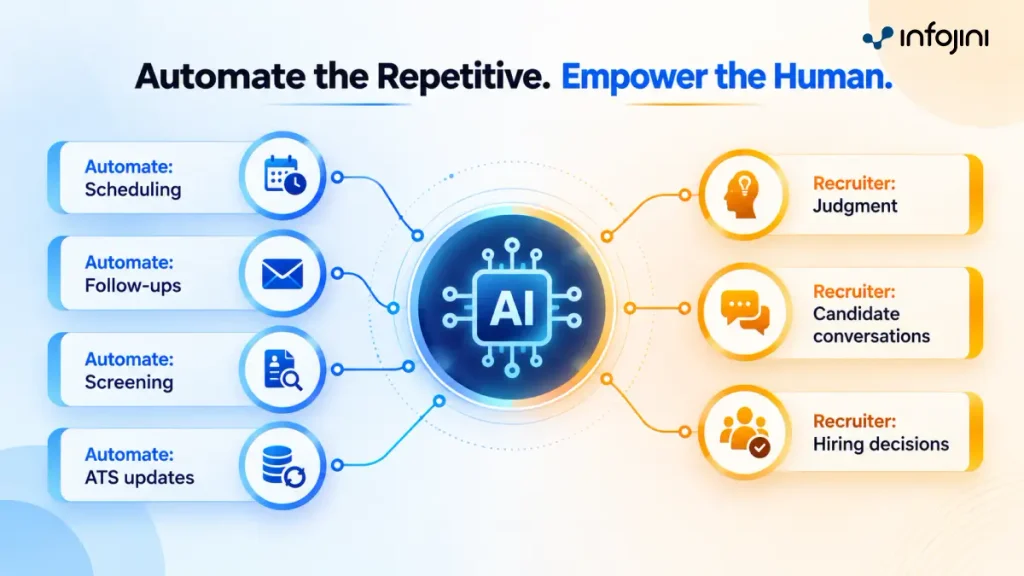
The same applies to repetitive ATS work, application acknowledgments, interview reminders, basic candidate screening, and routine sourcing tasks. This can be automated.
4. Seeing patterns in the process
There is also a less visible benefit. Automation can help a recruiter see things that may otherwise be difficult to catch when they are busy with day-to-day work. A certain trend in the hiring process can be easy to miss when all the information is spread across spreadsheets and email clients.
The Real Test is Not Speed, But Quality
This is where many recruitment automation programs have become difficult to evaluate. Speed is easy to measure. How quickly was a resume screened? How many messages were sent? How many interviews were scheduled? How long did it take to move a candidate from one stage to another? Useful numbers, certainly. But they are activity measures. The business cares about what happened afterward.
What matters is whether qualified candidates reached the hiring manager sooner, whether the interview to submission ratio improved, whether recruiters spent fewer hours filling a position, whether candidate drop-off fell, and ultimately, whether the company made better hires.
LinkedIn’s research points to an interesting gap here: 89% of talent acquisition professionals say quality of hire will become increasingly important, yet only 25% feel highly confident in their organization’s ability to measure it effectively.
That should change how organizations judge automation. A recruitment team does not have reasons to celebrate if their system managed to screen 10,000 applications but did not make their shortlist better. Similarly, a recruitment company cannot take it for granted that decreasing the workload of their recruiters is always good for the bottom line. If faster processing produces more submissions but no improvement in interviews, placements or redeployment, the additional volume may not be worth much.
The better question is simple: what became better because we automated it?
Automation Does Not Always Remove the Bottleneck
Imagine a traditional hiring scenario. Eight hundred people apply for a software engineering position in a company. Using an automated screening tool, one manages to narrow the pool down to 60 applicants in several minutes. One may think it was successful. However, the manager of the hiring department wants to hire only five candidates and spend four days reviewing the shortlist.
The same thing happens with interview schedules. A company may automate calendar coordination while its interview approval process still requires three people to respond to an email. Or it may automate candidate sourcing while the job description itself is vague enough to attract the wrong people.
This is why AI in recruitment for staffing should begin with the hiring workflow, not the software. Find the point where work repeatedly gets stuck. Then ask why. Sometimes the answer is manual effort. Sometimes it is poor data. Sometimes nobody has agreed on what a good candidate looks like. Sometimes the recruiter is waiting for a hiring manager. Sometimes there are simply too many approval steps.
Only some of those problems need automation.
Data Quality Decides Whether Automation Works
There is another issue that tends to receive less attention than technology itself: the quality of the recruiting data. An automated system can process a badly structured candidate database much faster than a recruiter can. That does not make the database better. Old job titles, duplicate profiles, incomplete candidate histories, inconsistent skills data, and outdated candidate preferences can all influence recommendations and search results.
The same problem appears in skills matching. If a company says it wants a “senior data engineer” but has never agreed on the skills, experience, and outcomes that define that role; automation has less to no ground to work with. Although it can produce a proper ranked list, that list can still be wrong.
This is one of the reasons why the current shift toward skills-based hiring matters. Automation becomes more useful when recruiters have better evidence about what a role requires and what a candidate has demonstrated. The technology is only as useful as the hiring logic behind it.
What Stays with the Recruiter?
Not every part of recruitment should be turned into a workflow.
I. A candidate with an unconventional career path
A rules-based system may see a missing qualification or an unfamiliar job title and move on. A recruiter may notice that the person has spent the last five years doing work that closely matches the role, despite having taken a different route to get there. That judgment is difficult to reduce to a checklist.
II. Candidate conversations
A recruiter may need to explain why a process has changed, understand why someone is hesitant about a role, discuss compensation expectations or decide whether a candidate’s concerns can realistically be addressed.
III. Hiring managers also need human pushback
If a manager asks for an unrealistic combination of skills, the answer cannot simply be to build a better search query. A good recruiter challenges the requirement, brings market evidence into the conversation, and helps redefine what the team needs.
Those interactions are part of the value of recruitment. They are not administrative leftovers waiting to be automated.
Deloitte’s 2026 Global Human Capital Trends research makes a similar point at the organizational level: companies that redesign work around human-AI collaboration are better positioned to capture value than those that simply take a technology-first approach. Its research also found that organizations taking a tech-focused approach were 1.6 times more likely to fall short of expected AI returns compared with those taking a human-centric approach.
For recruiting, that means deciding where technology should act and where a person should remain accountable.
The Next Step is Not “Automate Everything”
More important is the transition from automation to what is called Agentic AI that can perform several interconnected tasks. Rather than send an email following an event, agentic AI can understand a need, sourcing relevant candidates, comparing evidence, preparing to contact them, and learning from the input of the recruiters.
That is a meaningful change. But it also raises the cost of getting the workflow wrong. A simple automation usually comes up with a single mistake if it is configured badly. A system operating across several recruiting steps can spread the same mistake much further. That makes human intervention a very crucial step.
SHRM’s 2026 research, based on responses from 1,908 HR professionals, shows how quickly AI is entering HR while measurement still lags: recruiting is among the leading areas of AI use, yet many organizations still do not have formal ways to measure the success of their AI investments.
For recruitment leaders, this is a useful warning. Do not begin with the question, “Where can we put AI?” Begin with, “Where are recruiters losing time, candidates losing patience or hiring teams losing good people?”
How to Approach Recruitment Process Automation
A sensible starting point is one workflow rather than the entire recruitment operation.
Take interview schedules. Measure how much recruiter time it consumes, how long candidates typically wait and where delays occur. Automate the predictable parts. Keep exceptions with a person. Then measure the result.
Do the same with candidate follow-ups, resume screening or ATS administration.
The important thing is to establish a baseline before changing the process.
For a staffing organization, the measures may include recruiter hours per placement, time-to-submit, qualified submissions per role, interview-to-submission ratio and redeployment rate.
For an internal talent acquisition team, candidate drop-off, time-to-fill and quality of hire may matter more.
There is no universal automation score. The right metric depends on where the business is losing value.
A Better Definition of Recruitment Automation
What should the purpose of recruiting automation be then? It should not serve the purpose of eliminating recruiters. The point of recruiting automation is to take out those processes which do not need much thinking but demand consistency, leaving room for those things which depend on experience and dialogue. This distinction becomes increasingly important as AI technology finds its way into the recruiting process.
The winning recruitment teams will probably not be the ones with the longest list of automated tasks. They will be the ones that understand their process well enough to know which tasks should disappear, which decisions need better information, and which conversations should never be handed off to a machine.
That is also where the benefits of automating the recruitment process become measurable: less administrative drag, faster movement through the right stages, better use of recruiter time, and ultimately, a hiring process that produces stronger outcomes. Automation should make recruitment easier to run. It should not make recruitment less human.
Frequently Asked Questions
What is recruitment automation?
The process of recruitment automation uses software and AI to streamline repetitive recruiting tasks like screening and searching for candidates, scheduling interviews, ATS updates, and follow-up. The goal of automation is to minimize manual efforts while keeping the hiring decisions for human.
What are the advantages of automating the recruiting process?
The key advantages are minimizing administrative burden, increasing speed of hiring processes, boosting consistency, minimizing delays of candidates, and buying time for recruiters to interact with candidates.
What processes in recruitment should companies automate first?
They should begin with a predictable, high-volume process that currently serves as a bottleneck. Scheduling, routine communication, ATS updates, and preliminary screening are good segments to start with.
Can recruitment automation substitute recruiters?
Recruitment automation cannot eliminate the need for human decision-making and accountability. It may just minimize human intervention in routine processes, leaving decisions and interactions between candidates, and hiring managers intact.