 Digital Transformation
 Data Engineering
 Implementation
 Staffing Services


For most of the last three years, enterprise AI conversations centered on a single question – how do we get more people using it. That question is now settled. Now the question all C-Suite leaders are wrestling with is different and considerably harder. How do we get AI to do the work itself, not merely assist with it? That distinction is the entire story of agentic AI for enterprise.

A generative model can draft an email, summarize a contract, or answer a question, but it still needs a person to decide what to do next. On the contrary, an agentic system works differently. You give it a goal, and it can figure out the steps. Agentic AI can keep a task moving on its own, using the tools and data it has access to and bringing a person in when necessary.
That changes the conversation for companies. If software is making decisions and taking actions without someone directing every step, businesses must be clear about what the system is allowed to access, who takes responsibility for what it does, and where safeguards are needed. Software is no longer limited to responding to a person’s request; it can now take that request and carry the work forward.
The Risk That Organizations Should Be Counting
Organizations are already treating this as a capital allocation decision rather than an IT initiative, and that instinct is correct. But the data emerging through 2026 tells a more complicated story. The enterprises moving fastest are not automatically the ones winning, and the real risk sitting underneath this technology has very little to do with what the models can or cannot do.
That risk is worth naming plainly at the outset, because it will shape every decision. Autonomy is a liability until an organization has earned the right to grant it. A model that drafts a memo and gets the tone wrong costs a rewrite. A model is given login, workflow and authority to act; but when this model makes a mistake, the cost will be high. It will affect customer relationships, regulatory filing, and financial statements.
The enterprises approaching this correctly are not the ones asking how quickly they can deploy an agent. They are the ones asking how much authority a given agent has earned and build the systems to answer that question with evidence rather than intuition.
What Agentic AI in Enterprise Actually Changes
It is worth being precise about terms, because “agentic AI” has become loose shorthand for almost anything with a chat window attached to it.
A useful working definition of agentic AI for enterprise purposes has three parts.
- First, the system is given an objective rather than a single instruction. For example, “reconcile this month’s vendor invoices” is an objective, while “summarize this invoice” is a single instruction.
- Second, it has genuine access to tools. An agent can take action instead of just telling someone what should happen next. It might pull something from a database, use an internal API, change a record, or start another process.
- Third, it can work through multiple steps toward the objective without needing someone to give it a new prompt each time. People still have a role, though. When the system is being used in production, it makes sense to have a person step in where a bad call could cost the company money or be difficult to reverse.
There is still a place for humans in all of this. In situations where the system is actively in use on the production floor, it makes sense that there should be a human who can intervene when there is a risk of making a wrong move that will cost the business dearly.
Agentic AI Enterprise Use Cases
The practical question for an enterprise is, where can an agent take over a piece of work without creating a new problem somewhere else? That is a better starting point than trying to find a use case just because it happens to involve AI.
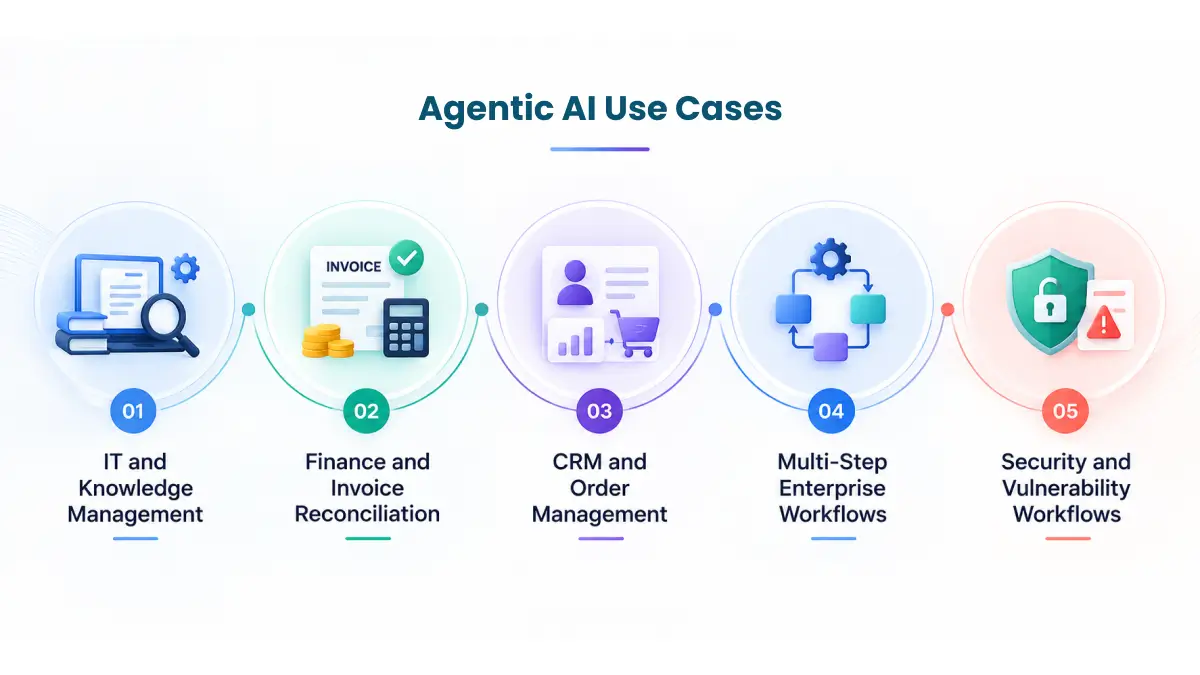
I. IT and Knowledge Management
This is where major adoption is happening today. An agent can work with internal information, look up what it needs, and move a request through the next steps instead of leaving the employee to do each part manually. The difference is small on paper, but important in practice. The system is doing some of the work, rather than just helping someone find an answer.
II. Finance and Invoice Reconciliation
Vendor invoices are a good example of a task that involves more than one action. The goal might be to reconcile the month’s invoices, which means working with the relevant records and systems along the way. An agent can handle the routine parts of that process and leave a person free to deal with something that does not match or needs a judgment call.
III. CRM and Order Management
A sales agent associated with the CRM system is capable of doing more than just pulling up a record from the system. They have the capacity of updating a record, altering an order, or performing any other activity based on the flow of work defined. However, once an agent gains access to the system, permission issues become equally relevant.
IV. Multi-Step Enterprise Workflows
Some of the better opportunities are hiding in processes that involve a string of small actions. An agent does not have to wait for someone to tell them what to do after every step. It can continue through the workflow using the tools available to it, with a person brought in when the next decision carries too much risk to leave entirely to the system.
V. Security and Vulnerability Workflows
Security is another area where an agent may need to gather information, work across different tools, and move an issue through several stages. But this is also where giving an agent too much freedom can create a serious problem. Access needs to be limited; its actions need to be visible, and there needs to be a clear point where a human can take control.
The Data Behind the Moment
The commercial case for paying attention is not in dispute. According to Keyhole Software’s 2026 market analysis, the enterprise agentic AI market was worth around $3.67 billion in 2025 and could reach $24.5 billion by 2030, growing at a CAGR of more than 46%. This growth also reflects a change in how companies are approaching technology. Tech leaders are moving beyond small pilot projects and making longer-term decisions about the platforms, infrastructure, and capabilities they will need. Usage is moving just as quickly on paper.
So far, most of the adoption has been in IT and knowledge management. Technology, media, and telecom, along with healthcare, are also moving ahead quickly. If you put those trends together, it becomes harder to describe Agentic AI as something companies are only experimenting with. It has started moving beyond the proof-of-concept phase. Within roughly eighteen months, it has already started making its way into production across a large share of major enterprises.
The Gap Between Adoption and Value
AI adoption is accelerating, but measurable business value is still lagging. As McKinsey reports, only around one in ten organizations report having scaled agentic AI within any single business function. The pattern is clear; companies are experimenting with AI at scale, but relatively few are turning those experiments into sustained financial returns. That is why the CFO’s question matters: What value will this AI investment create, and how will we measure it?
Gartner forecasts that more than 40% of agentic AI projects could be cancelled by the end of 2027, largely because of three avoidable problems:
- Costs exceeding the original business case
- Unclear definitions of value
- Inadequate risk controls
The important point is that these are not primarily technology problems. They are business, financial, and governance problems. These need to be addressed before AI is given access to production data, business processes, or customers.
Why Projects Actually Fail
The uncomfortable reality behind the cancellation forecast is that much of what is marketed as “agentic AI” may not be genuinely autonomous. Many products labeled as AI agents are essentially chatbots, assistants, or automation scripts repackaged as agents, a practice increasingly referred to as “agent washing.” The bigger issue, however, is not model capability. Projects are failing because organizations lack clear business goals, governance, ownership, and operational discipline.
Picking the model is probably an easy part. The harder part starts when the agent gets access to company systems. Who is responsible for it? What can it actually access? Who checks what it has done, and who steps in if it gets something wrong? These things tend to get overlooked when a project is still a pilot. They matter a lot more once the agent is working with real data and making changes on its own.
What Enterprises Actually Need to Build
Every enterprise preparing to deploy agentic AI on a meaningful scale is really building four things at once, whether or not the project plan names them that way. Here is an agentic AI for enterprise workflow automation process that can help your business.
1. Identity and Access for Machines, Not Just People
An agent that has the capability of checking the CRM, updating the order, or transferring money needs the same discipline as regards to its permissions as a new employee would. Least privilege, task-based access, reviewed periodically, and revocable instantly if anything goes wrong. Most enterprise identity systems were never designed with a non-human actor in mind and retrofitting them is proving to be the least glamorous, but most necessary line item in every serious agentic rollout underway right now.
2. Graduated Autonomy, Not an On-Off Switch
The organizations getting genuine value from agentic systems are not handing full authority to an agent on day one. They scope it narrowly to prove it holds up under real conditions, and only then widen what it is trusted to do without a person checking every step. A verification gate belongs wherever a wrong decision would be expensive, irreversible, or hard to explain to a regulator or a customer.
3. Observability from the Start, Not After an Incident
An autonomous system needs to be able to show what it did and why it did it. It should also be possible to understand how it might have behaved if the circumstances were slightly different. Without that visibility, it is difficult for C-Suit leaders to stand behind the system when something goes wrong. Audit trails, decision logs, and the ability to roll back an action are not just compliance requirements here. They are what helps a company understand and defend a decision made by an agent.
4. A Named Owner and a Real ROI Baseline Before Launch
This is the single most common gap behind the cancellation numbers cited earlier. A pilot nobody owns, with no financial target attached, will always look successful in a demo and will always struggle to justify its own renewal a year later. The enterprises handling these well run agentic projects the way they would run any capital project. A defined owner, a phase-gated budget, and a checkpoint where finance signs off before the next increase in autonomy is unlocked.
None of this is a technology roadmap in the conventional sense. It is closer to a governance model with a technology component attached to it, which is precisely why the companies best positioned to win here are not always the ones with the most advanced model access. They are the ones whose operating discipline was already strong before AI entered the picture.
The Operating Model and Talent Shift
Agentic AI can change more than the way a task gets done. It can change how the work itself is organized. McKinsey’s research found that high-performing companies are nearly three times more likely to redesign workflows around AI rather than simply adding AI tools to existing processes. That is where the bigger shift starts. Once an agent is taking care of parts of a process, companies have to decide which steps still need people, which can be automated, and who is responsible when something goes wrong. It also changes the skills they need.
Prompt writing is only a small part of the picture; what matters more is being able to understand the business process, connect it to the right technology, and judge where autonomy makes sense. And because agents can access systems and act on their own, security and governance cannot be left to the IT team after deployment. They have to be part of the operating model from the beginning. For the C-suite, that makes agentic AI less of a technology decision and more of an operating decision: where the company wants to use autonomy, how much it is willing to allow, and what controls need to be in place before it does.
Ready to Put Agentic AI to Work?
The challenge is no longer figuring out whether AI agents can work. It is figuring out where they can create measurable value in your enterprise and how to deploy them without taking on unnecessary risk. If you are evaluating an agentic AI initiative, Infojini can help you identify the right use cases, design the required architecture and governance, and move from a controlled pilot to production with a clear business case.
Frequently Asked Questions
What is agentic AI for enterprise?
Agentic AI for enterprise is meant to take on the work itself, rather than just help a person get through it. An enterprise agent can start with a goal, work out the steps it needs to take, use the tools and data available to it, and keep going until the task is finished, with a person stepping in only when needed. The real difference is that the agent can take action instead of stopping at an answer.
What are the biggest risks of agentic AI in an enterprise?
The risk increases as the agent gets more authority. An agent with access to business systems can affect customer relationships, financial records, regulatory processes, and other parts of the business. That makes permissions, human checkpoints, monitoring, and clear ownership important before an agent is allowed to act on its own.
How should an enterprise control AI agent autonomy?
An enterprise should not treat autonomy as an all-or-nothing decision. Start with a narrow scope, see how the agent performs under real conditions, and expand its authority when the evidence supports it. A human checkpoint should remain where a wrong decision would be expensive, difficult to reverse, or difficult to explain.
How can a company measure the ROI of agentic AI?
Start with the business outcome, not the agent. Define what the project is expected to improve and put a financial target against it before deployment. Give someone ownership of the result, establish a baseline, and review the numbers before increasing the agent’s budget or autonomy. A successful demo is not the same thing as a business case.
What does an enterprise need before deploying AI agents at scale?
It needs more than a capable model. The basics include controlled access for the agent, a clear limit on what it can do, monitoring and audit trails, and someone accountable for its decisions. Just as important, the business needs to know why the agent is being deployed and what measurable result would justify keeping it in production.