 Digital Transformation
 Data Engineering
 Implementation
 Staffing Services


Roadmap to implement AI to your system does not begin with buying a tool. It begins with deciding what the business needs AI to achieve, and in what sequence.
Most enterprises do not struggle because AI lacks the potential but because they make the move from interest to execution without any clear sequencing. A roadmap helps to connect with your business goals, data readiness, governance, and calculation at the right time to make sure your time and budget don’t go in the wrong direction.
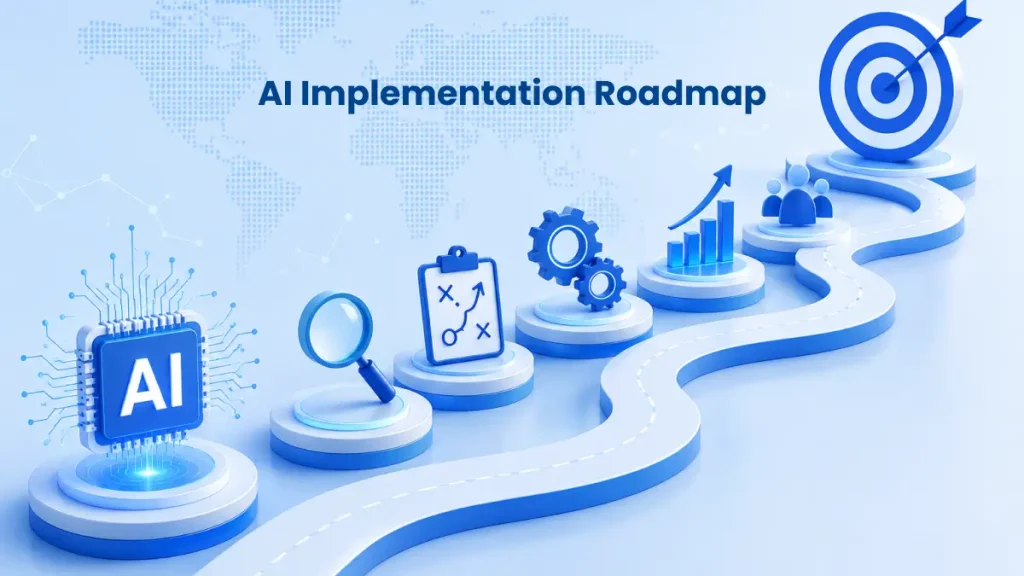
An AI strategy roadmap is a phased plan that enables a business to successfully move from AI interest to measurable execution. The plan should define the problem, review the readiness, prioritize one strong use case, and create a realistic AI pilot. In this guide, we will discuss that AI adoption is not the end goal, but enterprises need to adopt it in a way that it is useful, manageable, and worth scaling.
Key Takeaways
- Buying AI tools was never the hard part. Sequencing the work is what separates a working system from a stranded pilot.
- Most “AI problems” trace back to data problems nobody wanted to deal with first. Fix the data pipeline before picking up the platform, not after.
- Pick one narrow, high-value use case over a sweeping rollout. Small wins build the executive trust that makes scaling possible later.
- Governance isn’t paperwork that should be done in the end. It’s what keeps a system trustworthy as it evolves, and it needs an owner from day one.
- The right implementation partner brings more than technical skills. They understand the business problem well enough to keep a pilot from becoming an expensive dead end.
Why Most AI Implementations Fail
As RAND reports, more than 80 percent of AI projects fail, which is twice the failure rate of IT projects that don’t involve AI, and the difference usually isn’t the technology.
Most AI projects that stall aren’t victims of bad technology; they’re victims of a shortcut. Somebody skipped the unglamorous work (getting the data right, setting up governance, sorting out operations) and jumped straight to running a pilot. If you’re the one who must sign off on this kind of spend, it pays to know the usual failure points ahead of time, rather than finding out after the budget’s gone and someone’s asking what happened to it.
| Challenge | Why It Happens | How to Prevent It |
|---|---|---|
| No clear business objective | Excitement about the technology usually comes first, the actual problem second. Hard to prove ROI on a goal nobody wrote down. | Pick a real business challenge, define what success looks like in numbers, tie it to a broader goal. |
| Poor data readiness | Nobody wants to hear this, but most AI problems are data problems wearing a disguise. | Get honest about data quality early. Set governance rules. Clean it up before, not during. |
| Choosing the wrong use case | Two failure modes here: automating something nobody cares about or chasing something so complex it eats the whole budget. | Go after what’s actually feasible and actually matters, not what sounds impressive in a meeting. |
| Pilot-to-production gap | The demo works. Then it hits real infrastructure, like integration, monitoring, and security. | Build the roadmap for production from day one, not as an afterthought once the pilot succeeds. |
| Lack of change management | People don’t resist AI, generally. They resist confusion, thin training, and leadership that talks about a big game and disappears. | Loop in stakeholders early, explain the why, train actual roles, and keep leadership visibly involved. |
| Weak governance and ongoing monitoring | If there is no owner for security or compliance, nobody will notice when the model begins to drift, until it’s a problem. | Set up a governance framework with real ownership, regular check-ins, and compliance baked in, not bolted on. |
What Is an AI Implementation Roadmap and Why Does It Matter?
The roadmap is a strategy that enables an organization to use AI successfully and strategically. The roadmap specifies the activities that should be done, timelines, and roles that need to be fulfilled to make the process of implementing AI successful.
Why Businesses Need an AI Strategy Roadmap
That is because if you simply get advanced technology installed into the process, without any planning, it will lead to friction. Therefore, your enterprise needs a structured path to make sure that the investment you are making guarantees a tangible result.
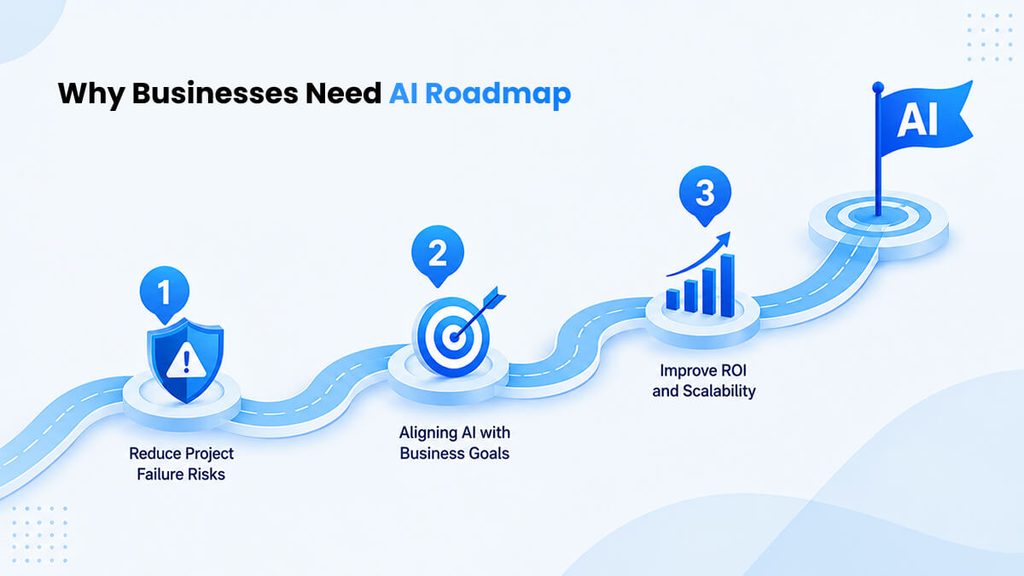
1. Reduce Project Failure Risks
With a roadmap, you will be able to avoid any haphazard AI integration in the process. You can avoid a blown budget and unused software. A properly structured roadmap points out the potential bottlenecks much before, and decision makers can establish proactive risk management protocols. By mapping out the entire process, much before the actual implementation happens, you can avoid the risk of expensive technical failures.
2. Aligning AI with Business Goals
The process of implementing AI within the enterprise should align with your business goals. A roadmap will help you understand which deployment is addressing specific operational challenges. This will maintain the integration of AI in solving real problems.
3. Improve ROI and Scalability
A successful POC is nothing if it can’t grow. The best roadmap is the foundation of AI in the application. It creates a clear process of scaling the infrastructure such that the initial investment is geared towards continuous improvement, giving a definite return on investment for your enterprise. Planning beforehand for integration, maintenance, and operational growth is always better to improve ROI and avoid any expensive reworks later.
The 6-Phase of AI Implementation Roadmap
A roadmap that actually holds up isn’t a list of components sitting side by side; it’s a sequence. Each phase produces a decision that the next phase depends on, and skipping one just moves the failure further downstream. Here’s what that progression looks like in practice.
1. Business Case
What happens: Someone has to name the actual problem AI is solving and not “we need AI,” but “claims processing takes six days, and it’s costing us renewals.”
What decision gets made: Whether this is worth pursuing at all, and what “worth it” means in numbers such as the cost saved, time recovered, and revenue protected.
What can go wrong: Teams skip this and back into a justification after the pilot’s already built, which is how projects end up unable to explain their own ROI.
What success looks like: A one-paragraph business case that a non-technical executive could read and immediately understand why this matters and what it’s worth.
2. Readiness
What happens: An honest assessment of what the organization has in terms of data quality, technology infrastructure, and internal skill sets compared to what the initiative is assuming the organization has.
What decision gets made: The major decision that is taken is whether to move ahead with the project or delay the preparation process or scale back the ambition of the initiative to meet reality.
What can go wrong: No one wants to give out the bad news, and so the audit does not occur. The problems come up later when they are much more costly to address.
What success looks like: An honest inventory that reveals clearly what is useable, what needs to be developed, and what is a deal-breaker.
3. Use-Case Prioritization
What happens: Candidate use cases are ranked by feasibility, business value, risk, and the visibility of the potential win.
What decision gets made: Which single use case gets the pilot budget first, what is important, and which ones get deliberately shelved.
What can go wrong: If you are chasing the most technically interesting problem instead of the one that moves a number. Or you are trying to do three use cases at once and diluting all of them. These can lead to issues which will hard to solve.
What success looks like: One narrowly scoped use case with a defined owner, a defined metric, and a realistic timeline.
4. Data & Infrastructure
What happens: Fragmented, siloed data gets consolidated into pipelines, storage, access controls that a model can learn from.
What decision gets made: Build vs. buy for infrastructure, and how much technical debt gets addressed now versus deferred.
What can go wrong: Skipping straight to model selection because infrastructure work doesn’t demo well. This is where most “AI problems” turn out to have been data problems all along.
What success looks like: Reliable and governed data flowing into a system built to scale past the pilot, not just support it.
5. Build & Pilot
What happens: The solution is built using an off-the-shelf platform, custom development, or a hybrid approach. It is then tested on a limited scope under real operating conditions.
What decision gets made: You need to agree on what success looks like before the pilot starts. This prevents the results from being reinterpreted later just to justify moving forward.
What can go wrong: Human oversight gets skipped because the AI-assisted build felt fast and confident. A single unchecked error at this stage can propagate everything the model touches.
What success looks like: A working pilot with results measured against the metric defined back in Phase 1. Not a demo that merely looks impressive in a meeting.
6. Production, Governance & Scale
What happens: The pilot becomes part of the real business process. At this point, someone will have to own it. Someone needs to keep an eye on it, and there needs to be a clear process for handling mistakes, risks, and compliance issues.
What decision gets made: Decide who is responsible for the system, what gets monitored, how often it gets reviewed, and when the team should retrain, change, or roll it back.
What can go wrong: Assuming a successful pilot will automatically work in production. It won’t. Data changes, users behave differently, and models can start producing inconsistent results. If nobody owns those problems, the system slowly becomes something people stop trusting.
What success looks like: Everyone knows who owns the system, what they need to watch, and what to do when something goes wrong. Governance becomes part of running the system, not a box to tick before launch.
Challenges in AI Implementation
Even the best plan can have obstrucles. You need to be aware of these hurdles can help you overcome issues in the long run.
- Poor data quality: If the foundation of your data is not strong, then the AI implemented in the system will give you biased and incorrect output.
- Lack of human talent: If you think that automating everything will lead to minimum human intervention, then you are wrong. You will have to find experience with data scientists and engineers and a competent in-house team, who can point out the glitch much before the damage is done.
- Friction with the existing system: Integrating modern neural networks in your legacy system may lead to severe technical conflicts and eventually delay your projects.
Best Practices for AI Implementation
To avoid any conflict or challenges of post deployment, here are the things that you need to keep in mind.
- Start small with proven value: You need to start small. Integrate AI into a narrowly defined pilot project. Secure the victory at a smaller scale so that you can keep the momentum and gain executive trust before scaling.
- Foster cross-functional teams: Include IT specialists, department managers, and end-users to make sure that the final project comes out very practical and impactful for your business.
- Prioritize governance: An AI governance framework is one of the most important aspects. You need to create a strict oversight committee to monitor data privacy, algorithm fairness, and compliance through the lifecycle of the project.
- Train heavily: True transformation is required for human adaptation. Provide extensive, ongoing training to ensure your workforce is empowered.
How to Choose the Right AI Implementation Partner
The partner you pick can make or break your AI initiative just as much as the technology itself. Technical chops matter, obviously, but they’re table stakes. What separates a good partner from the wrong one is whether they understand your business goals, your industry’s specific headaches, and the systems you’re already running, not just AI in the abstract.
At Infojini, we start with your AI strategy roadmap and don’t stop until it’s running in production. That’s the gap most vendors leave you to figure out on your own. Our approach is business first, always. We help you find the use cases actually worth building, not just the ones that sound good on a pitch. From there, it’s about wiring solutions into the systems you already run, building out an AI adoption roadmap that holds up as you scale, and putting an AI governance framework around all of it so nothing drifts once it’s live. Your team isn’t handed a finished product and left to figure out the rest, ours works alongside you at every stage.
Conclusion
AI has more or less passed the experimentation phase; it’s a business priority now. But picking the right technology was never the hard part. The challenging part is everything around it. A solid roadmap gives you that structure: It aligns AI work with actual business objectives, gets your data and infrastructure ready, puts an AI governance framework in place, and lets you scale without crossing your fingers. Go in phases, and you cut down on risk while giving ROI room to actually show up.
Infojini can help you build and run a roadmap to implement AI that will suit your business needs. Strategy, architecture, deployment, governance, optimization: our team works across all of it to turn AI investment into results you can point to.
Frequently Asked Questions
Q. What is an AI implementation roadmap?
A. It’s a phased approach in which an organization moves from “we are interested in AI” to something which works and produces outcomes. The sequence here is very important: Rather than beginning with deciding on the type of tool to purchase, one begins with understanding the problem, preparing the data, identifying which use case to pursue first, and then putting in the governance layer. Without following this sequence, one ends up with a pilot project that never turns into anything else but a pilot.
Q. Why do most AI implementations stall after a successful pilot?
A. Since the answer to one question is sufficient for a pilot: “Is this possible at all?”, production raises tougher questions and keeps asking them: Does this model still work with new data, with a tenfold increase in use, with a regulatory body demanding explanation of how that decision was made, with the one person who knew the system having left the company? In most cases, a team makes something that works and stops there, without adding the measurement, accountability, and governance needed for a real-world system to live in reality. It’s this gap that sinks the ship, not the technology.
Q. How long does an AI roadmap take to show results?
A. Depends heavily on the use case, but the roadmap’s built to produce early wins, not just a payoff at the finish line. Pick one narrow, high-impact use case instead of trying to roll AI out everywhere at once, and you can prove value during the pilot itself, which gives you something concrete to show leadership and use to justify going further, instead of gambling a year of budget before finding out whether any of it worked.
Q. What role does data readiness play in AI implementation?
A. It’s usually the deciding factor. Fragmented, siloed, or inconsistent data limits model accuracy no matter how strong the underlying platform is. That’s why the roadmap places data infrastructure, like consolidating information into secure, centralized pipelines is done before technology selection, not after it.
Q. What should an AI governance framework actually cover?
A. At minimum, clear ownership of AI decisions, accountability structures, risk management protocols, ongoing model monitoring, and security and compliance controls. Without this in place from the outset, AI systems become hard to trust or maintain as they evolve. Governance isn’t a compliance afterthought; it’s part of what makes a system production ready.
Q. How do I choose the right AI implementation partner?
A. A true partner must have an understanding of your business goals and industry limitations in addition to knowing how the model is architected. That’s the approach at Infojini. We do business first: identifying high-impact use cases, deploying scalable technology, and implementing governance frameworks side-by-side with you.