Digital Transformation
 Data Engineering
 Implementation
 Staffing Services


Workforce planning is getting increasingly complicated due to issues like fluctuating workload, skill shortages, and uncertainty of the job tenure. A project may require extra staff for a short period of time. Again, there can be higher workforce demand in a certain season, and the workload may temporarily increase. The challenge is deciding how much staffing capacity is required without making each and every need permanent.
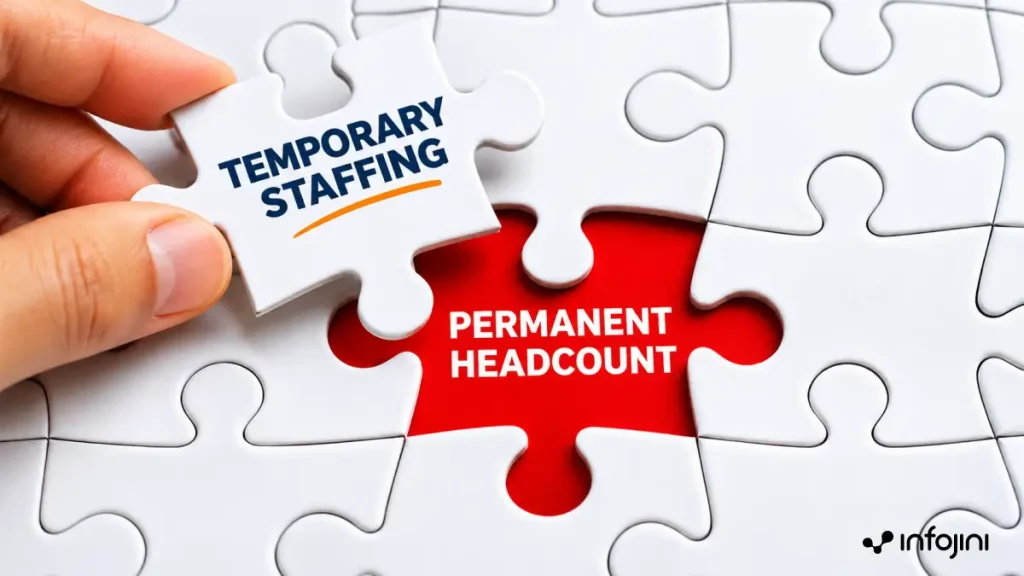
This is where temporary employment plays an important role in planning the workforce. Businesses can bring in temporary workers to handle extra needs to get specific skills or keep things running smoothly. It is not a replacement for hiring permanent employees; it is just another choice for companies when they need more help, for a short time.
The continued use of flexible talent reflects this changing workforce environment: the American Staffing Association reported that temporary and contract staffing employment in September 2026 was 5.8% higher than 2025.
What is Temporary Staffing?
Temporary staffing refers to an employment arrangement where an employer hires an employee during a specified period to satisfy an organizational requirement. Temporary employees could be employed for a few weeks, months, or even throughout the duration of a particular project. In most instances, temporary employees are provided by a third party that hires the employees on behalf of the employing organization. This third party could handle payrolls, employment issues, and other employment matters for the organization.
An organization could require extra warehouse staff prior to a busy season, technology experts during a major implementation, or administrative personnel due to an exceptionally busy time. The most common reason why organizations use temporary employment is that they have the need for extra help for a particular period as opposed to increasing their permanent staff. Since temporary employment may include assignments lasting a few weeks up to several months or even more, it is necessary to differentiate contentigent staffing from short-term staffing.
Temporary Staffing vs. Short-Term Staffing
| Comparison Factor | Temporary Staffing | Short-Term Staffing |
|---|---|---|
| Meaning | Emphasizes employment arrangements. | Emphasizes duration of employment. |
| Typical duration | Can range from a few days to several months, and in some arrangements up to a year. | Usually refers to a shorter assignment, such as days, weeks, or a few months, depending on the business requirement. |
| Common business needs | Seasonal demand, employee absence, project work, workload fluctuations, and temporary capacity gaps. | Urgent workload spikes, short projects, events, seasonal peaks, or immediate replacement needs. |
| Workforce flexibility | Provides flexibility to increase or reduce workforce without adding permanent headcount. | Particularly useful when workforce requirements are expected to change quickly or end soon. |
| Best suited for | Organizations that need qualified workers for a defined but non-permanent period. | Organizations facing a clearly defined, immediate, and short-duration staffing requirement. |
Why Temporary Staffing Matters in Workforce Planning
Workforce planning does not just involve determining how many employees an organization should have. The timing of need, the qualifications necessary, and whether the need will be sustained are factors that the organization’s leadership must consider. A heavy workload for six months might require a different response compared to a situation whereby the company will require a specific job to be done continuously.
This flexibility is particularly useful when business conditions are changing or when leadership does not yet have enough information to make a permanent hiring decision. Current staffing data also reflects the continued use of this workforce model. The American Staffing Association reported that U.S. staffing employment increased 0.6% in the second quarter of 2026, while temporary and contract employee payroll rose 3.8%.
Where Temporary Employment Fits Best
Using temporary staff can be a choice for companies that need more capacity but are not ready to hire on a permanent basis. There may be different reasons why a company is experiencing the necessity for extra staff, which can range from seasonality to project-related reasons or absence of employees. In such cases, using temporary staff allows companies to sustain their operations while being flexible in their further planning. Common situations include:
- Seasonal demand: Some organizations such as retail stores and other businesses might require more staff during peak demand season than other parts of the year.
- Project work: Technology firms might require developers, testers, analysts, or support personnel during the time of platform implementation or any other specific project.
- Absence of employees: Sometimes, there can be instances where due to extended leave, sudden resignation, or delay in permanent hiring, some teams might lack adequate manpower. In such cases, temporary employees can help sustain the workforce until the issue gets sorted out.
- Uncertainty about demand: If a company anticipates increased demand and is unsure whether it would remain that way or not, in such situations, temporary employment can be used to maintain the workforce until the management makes up its mind.
Benefits of Temporary Staffing
Temporary staffing enables organizations to have more flexibility, greater speed in accessing skills, and extra capacity when there is a need for changes in the workforce. Understanding the advantages of contract hiting can help organizations determine when this workforce model is a suitable option. The following are some of the advantages of temporary hiring.
1. Flexibility without immediate permanent headcount
Temporary employees provide firms with the opportunity to increase their number of employees during peak periods without having to permanently add to their number of employees. This may be helpful where there is an anticipation that the firm’s labor requirements will be changing in the future.
2. Faster response to workforce gaps
Temporary staff may be helpful in situations where there is a vacancy in the organization due to unforeseen reasons such as the resignation of an employee or on account of the recruitment process taking a lot of time.
3. Access to skills for a defined need
There are organizations that temporarily require some technical, financial, or operational skills without necessarily having a long-term requirement for these skills. Temporary staff enables organizations to access these skills where needed. According to MBO Partners’ 2025 Client of Choice Report, companies are expanding their use of independent talent to increase workforce flexibility and agility and to access hard-to-find specialized skills.
4. Improved assistance during heavy workload
Temporary staff is also beneficial to maintain the balance of increased workloads for certain periods of time. In such a case, instead of hiring a permanent workforce it is beneficial to add temporary employees till the workload goes down.
Temporary Staffing is not a Replacement for Permanent Hiring
The benefits of temporary staffing make it an important part of workforce planning. However, these benefits will not justify the use of temporary employment for all hiring needs. In most cases, organizations will need to hire on a temporary basis where the requirement of staff is only temporary in nature. If roles have remained open for temporary employment for many years, then it is a permanent staffing role.
The managers have to assess whether it is indeed a short-term need, the period during which the position has existed, as well as whether a permanent employee or an internal training program would fit the requirement better. The ideal strategy for the workforce will not depend on choosing between short-term or long-term employment. Instead, the kind of employment will depend on the nature of the work.
Temporary Staffing Can Help When Hiring Remains Difficult
Hiring challenges can make workforce planning harder, particularly when critical roles remain open. SHRM’s 2026 Talent Trends research found that nearly 70% of HR professionals continue to face challenges recruiting for full-time positions.
Temporary candidates will not eliminate the shortage in the talent pool, but it will allow the work to continue while the permanent search is ongoing. Additionally, it will reduce the stress that current employees may face by having to carry additional responsibility for a long time.
How to Include Temporary Staffing in a Workforce Plan
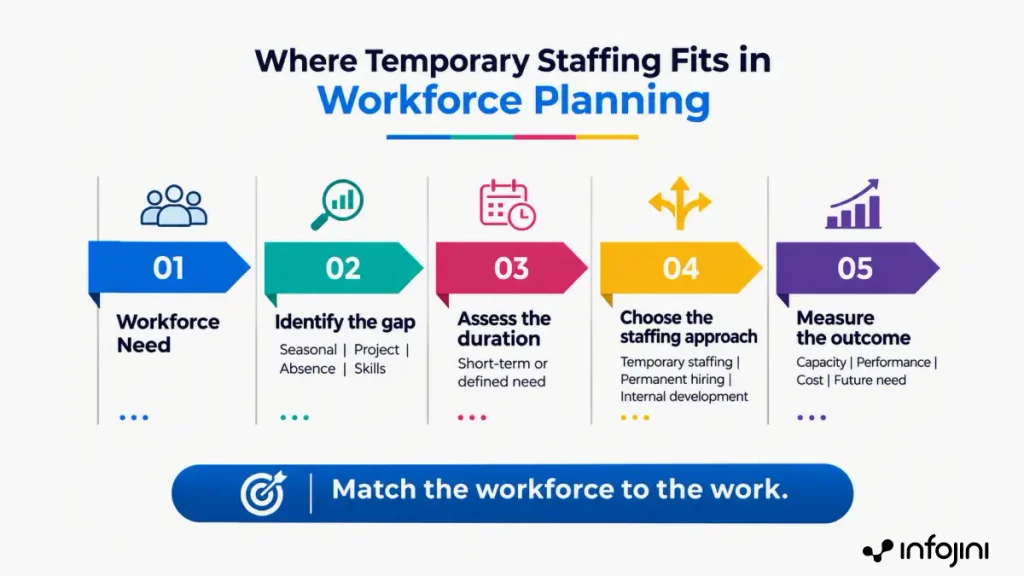
Temporary employment is most effective when incorporated in the workforce planning instead of using it as a reaction to the problem of staff shortage. Organizations can add temporary workers into their workforce planning strategy in the following ways:
1. Identify where temporary capacity may be needed
First, consider the areas where there is potential for changes in staff needs. Factors such as seasonality, large projects, expansion, staff absence, and regular staff shortages are indicative of where temporary workers can be helpful.
2. Separate temporary capacity needs from permanent headcount
A rise in the amount of work may not mean a rise in the manpower too. For example, when an organization is forced to employ ten employees for four months because of any project, it is just a temporary matter, and no increase in permanent manpower is required.
3. Define the skills and scope of the role
Clearly define the skill set, experience, responsibilities, and deliverables needed prior to hiring temporary employees. Having a clear requirement allows you to hire qualified employees that meet the specific business requirements.
4. Set the timeframe and working requirements
Identify the exact time when the extra employees will be needed, the duration of their work, and whether there are any particular shift or location requirements for this position. With this information in hand, the hiring process becomes much easier.
5. Plan the budget and staffing model
Include an approximate temporary employment cost within the annual hiring budget instead of viewing it as an unanticipated cost. It would be necessary to determine the most appropriate way of satisfying this requirement either through temporary employees, contractors, internal redeployment, or even permanent employment.
6. Monitor the arrangement and reassess the need
Monitor if the extra workforce meets the operational demands and review the need considering changing circumstances. Should the need become continuous, the organization might have to rethink if a permanent job position or any other temporary staffing solution for the workforce would suit better.
Choosing the Right Temporary Staffing Partner
A good staffing company goes beyond the ability to provide qualified professionals according to the job description to comprehending everything that is involved in the job, for instance, the skills required, the period of employment, and the working environment.
Your temporary staffing partner needs to meet the following criteria:
- Industry knowledge: They need to know about your industry, position, and labor market.
- Verification of candidate: They must be capable of verifying the skill set, qualifications, past work history, and references of the candidates.
- Quick response: The best staffing agency will always deliver on time, even when you experience sudden fluctuations in demand.
- Compliance: They will always be responsible for processing all employment documents.
- Transparent cost and service discussion: It is necessary to a clear and transparent discussion on cost and service terms.
Measuring Whether Temporary Staffing is Working
The staffing approach should reflect the reason for hiring temporary staff. The success of a project can be measured by completion time; on the other hand, customer support can be assessed by response time and the amount of backlog. Cost is an important consideration here, but it is important to look at the cost in relation to the benefits derived from the temporary staff.
It is important that the organization considers its history of contingent staffing requirements. In case an organization requires temporary staff annually, there may be some patterns here. It could mean a seasonal need, but there could be a case of permanent staff requirement as well.
Strategic Importance of Temporary Employment
Temporary staffing is not only a way to fill vacant positions quickly but also can be seen as a tool helping the company to adapt to changing demand and use competences, when needed, without making decisions on hiring people permanently at once.
The important thing here is the proper match of the employment approach and type of the job. The combination of contingent staffing with the usual recruitment and succession planning should be considered the best way of its usage, and not vice versa.
Conclusion
Workforce planning does not simply determine how many people need to be hired; rather, it ensures that the proper capacity is in place when it is needed, without setting up a structure that would become hard to modify. That is what makes temporary employment necessary.
In response to seasonal requirements, project work, interim replacement, unpredictable demands, or skills requirement, temporary employment may enable firms to make decisions without binding themselves for too long to a workforce decision. The strengths of temporary employment are thus much more to do with decision-making than with quick hiring.
Contract staffing is of value to organizations experiencing fluctuating requirements and persisting recruitment difficulties. The challenge consists of using temporary employment with a business case in mind and workforce planning beyond the current problem.
Frequently Asked Questions
What impact does temporary employment have on workforce planning?
Temporary employment provides an alternative option to organizations to address workforce capacity needs without making any additional headcount demand permanent. It may be part of the workforce plan based on demand due to seasonal factors, project work, employees’ absences, or unpredictable demand in the future.
What issues should be considered by organizations prior to employing temporary workers?
What issues should be considered by organizations prior to employing temporary workers?
What might be some problems with contract staffing?
Problems with contract staffing might arise from unclear role descriptions and responsibilities or insufficient training and management of temporary workers. Higher expenses or the need to conduct another hiring process in case of extending the period of temporary need could become other organizational issues associated with temporary employment.
How can one know whether contract staffing is cost-effective?
Alongside costs, organizations need to take into account the outcome of business that contract staffing is meant to bring. For instance, one could compare the cost of staffing to such things as successful project completion, reduction of backlog, improvement in customer service or even operation continuation in absence of regular employees.