Digital Transformation
 Data Engineering
 Implementation
 Staffing Services


Employee retention has become a growing concern as workplace engagement continues to weaken. According to the findings of Gallup’s State of the Global Workplace 2026 report, the level of employee engagement decreased to the lowest since 2020, while manager engagement decreased from 27% to 22% in just one year. Although low engagement is not always directly linked to resignations, it indicates problems related to workload, career opportunities, and pay. As a result, the task of retaining experienced and important employees becomes challenging for organizations.

This is the reason why employee retention strategy should include addressing the problems that lead to the intention of quitting, not merely finding replacements. There are many aspects that can be enhanced to retain employees; for instance, employee-manager relationships, career opportunities, flexibility, recognition, and others. The current paper discusses 15 employee retention techniques and shows how they can be prioritized based on their influence and difficulty.
Key Takeaways
- Explore 15 practical employee retention strategies.
- Identify what is driving employee attrition.
- Prioritize strategies based on impact and effort.
- Build a structured approach to retaining talent.
Before You Act, Identify Why Employees Are Leaving
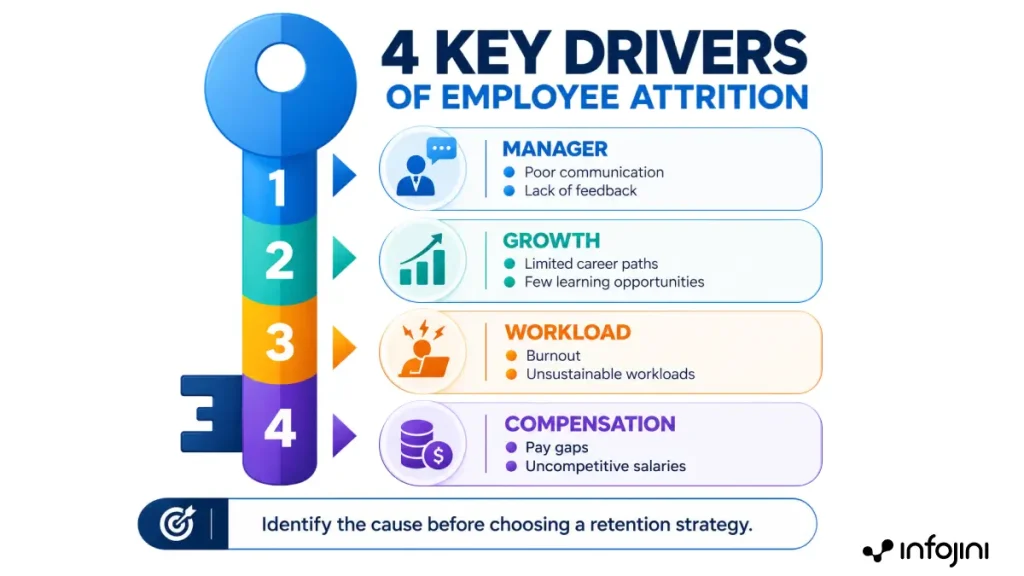
Do not begin with an incentive. Before choosing retention strategies for employees, get the last 24 months’ exits. Split them according to team, manager, length of employment, and pay scale. Patterns will show up quickly; for example, the engineering department loses people, or the sales department empties out right after bonus payouts.
Exit interviews are honest, but they happen only after the damage is done. Current employees can tell you what is draining them, and you can still fix the issue. Diagnose first and then choose your employee retention methods.
15 Effective Retention Strategies
You don’t need all 15 employee retention techniques at the same time. But make sure that you use them according to your requirements. The first five usually carry the most weight.
1. Fix the employee-manager relationship first
Employees join organizations but quit managers. It’s a cliché, because it is repetitive. Gallup’s latest study shows that the gap between manager and employee communication is increasing. For this, you need to train your managers on the basic principles, like how to set expectations for their team members, how to conduct individual meetings, and how to provide feedback. Measure their team’s retention as part of their own performance. A strong manager is the biggest retention tool you own.
2. Pay fairly and check often
Money might not be the only reason why employees leave, yet it is one of the crucial ones. Benchmark your jobs annually against the market. Watch out for instance where newly hired personnel are being paid more than existing ones. In cases where there is a shortage in the budget, try to compensate using bonuses and non-cash compensation.
3. Show a career path people can see
If your employee is unable to visualize their next two moves within your company, then they will look for it in another company. Set the skill sets and expectations at each level and discuss every six months. Clear expectations give an easy flow of work where employees get the opportunity to shine, and employers can make the most of their employees’ skills.
4. Open the door to internal moves
Many firms make it easier to leave than to switch teams. Organizations should publish openings internally before going external. Give employees the freedom to consider a change within the organization. AI-enabled skills mapping can be helpful here by aligning an individual’s capabilities to available positions. Every internal move is an exit you didn’t have to pay for.
5. Treat the first 90 days as retention work
Retention starts when the offer is accepted. A point Robert Half makes well. Contact the new employee before the first day. Get the computer, access, and first-week plan ready. Get the buddy and mentor assigned. Early departures are typically the tale of a bad beginning. A disorganized first month is difficult to make up for.
6. Offer flexibility that is real
A flexible work policy is nothing if people are afraid to exercise it. If one is working from home and their manager questions it or treats them as less committed, then the policy is useless. Flexibility needs to be made normal. Brief managers about expectations and monitor whether their team members are utilizing flexible policies. There will always be jobs that have to be done from the office. In this case, use flexible timing. Allow workers to trade shift times among themselves, and the rosters should be published far in advance.
7. Retention interviews
Ask your best people three questions. What keeps you here? What would make you leave? What would you change? Do it twice a year, separate from performance reviews, anonymously, and act visibly on at least one thing you hear. Executives should run the first round themselves. A stay interview that leads to nothing is worse than none.
8. Recognize individual work specifically
A great job compliment is forgotten after a break. The problem that was solved, the individual that was helped, or the migration at night that went unnoticed, should be recognized. It is important for the recognition to be extensive to ensure that the exceptional people are not the only ones who receive it. Peer recognition can be more effective at times.
9. Manage workload before burnout
Workload burnout is a planning problem. You need to watch for overtime, on-call load, and unused leave. If a team has been “temporarily stretched” for three quarters, it’s not temporary. Hire more people, reduce the workload, or change the schedule. Defend capacity as diligently as you defend uptime.
10. Invest in learning that leads somewhere
Training that ends with a certificate and no new work, frustrates people. Connect learning to real assignments. A support engineer who completes cloud security training should get a related project in the next quarter. Give people time to learn. Learning is retained only when it opens a door.
11. Build trust and psychological safety
Teams that can’t disagree openly lose their best thinkers first. Leaders set the tone. Admit mistakes in public. Thank the people who raise bad news early. Trust also needs consistency: decisions explained or promises kept. People stay where they can be truthful upfront.
12. Plan the workforce ahead
Replacements are difficult and expensive. Before starting, discover which jobs are the most important when unfilled and who could replace those jobs. Also determine the amount of time needed to replace them. Ensure that there is succession planning for such positions and maintain a warm bench of external recruits. Then the departure of an expert will just become a minor disturbance.
13. Personalize plans for critical talent
Your top 5% employees do not want the same thing. Take senior cloud security engineers with Kubernetes and Terraform skills. They may want an architecture track, a conference budget, and fewer incident pages. Their co-workers might require a team to guide them. Take some time to sit together and write down their goals and review them quarterly. Rewards that work for everyone will not necessarily suit all.
14. Use people data, and use it carefully
There are some firms that use predictive models to identify employees with a probability of leaving the firm. The predictive model uses factors such as experience, level of salary vis-à-vis the market, manager change, and mobility, among others. When this is done properly, it will show where to begin the retention conversation. Therefore, restrict access to a few individuals and never confuse a score with an opinion on a person. Let your employees know what you are monitoring and why.
15. Hold leaders accountable
Everything above fails without ownership. Put retention targets on every leader’s scorecard. Review regretted attrition in the same meeting as revenue. Ask each leader what they learned from their last resignations. Reward the ones who build teams people don’t want to leave. What the board reviews every quarter gets fixed.
Where to Start and Which Retention Strategies Pay Off Fastest
There are 15 techniques that will be competing for management time, so the strategies to retain employees should be prioritized based on effort and likely impact. This table outlines the effectiveness of these strategies by answering two questions: How much effort is involved in each technique? How much effort is expected to save on reducing attrition? Start with those strategies that involve less effort and have a higher impact. The rankings provided here are simply a guideline, not research results.
| Strategy | Effort | Impact | Priority |
|---|---|---|---|
| Retention interviews | Low | High | Quick win |
| Manager training | Medium | High | Core fix |
| Pay benchmarking | Medium | High | Core fix |
| Onboarding redesign | Medium | Medium | Core fix |
| Internal mobility | High | High | Longer build |
| People analytics | High | Medium | Longer build |
What Should Be the Phase-Wise Action Plan?
Nobody can launch all 15 employee retention strategies at one go. The table above shows which strategies to prioritize. The plan below turns that into a schedule.
It divides the project into three phases. Each phase has a goal, a list of actions, and something that you have to deliver to your team at the end of the phase. Start with Phase 1 without skipping any.
Phase 1: Diagnose
Assess the past two years of employee turnover. Speak to the managers and recent hires first regarding retention. Everyone needs to see that you are listening and that something has changed from what they have said, even if it’s small.
Phase 2: Fix the basics
Benchmark compensation for key roles. Other steps include building your onboarding program and beginning manager training. Identify the two to three teams with the highest regrettable attrition and focus on them. Establish a baseline for turnover, one-year attrition, engagement, and internal fill rate.
Phase 3: Create structure
Advertise the positions internally, build career frameworks for those affected by the situation, and integrate retention into leader scorecards. Analyze the data and figure out what to expand or contract. These steps create a more structured approach to retaining talent.
Conclusion
A strong employee retention strategy starts with understanding why people leave, not simply adding another retention initiative. Identify the issues that are driving attrition, focus on the strategies that address those issues, and track whether the changes are making a difference.
Retention is built through everyday decisions: how managers lead, how employees are recognized, how growth opportunities are created, and how consistently an organization follows through on what it promises. When those things are done well, employees have fewer reasons to look elsewhere and more reasons to stay.
Frequently Asked Questions
What is the most effective employee retention strategy?
Quality of the managers. People rarely quit the company itself. They quit the person they report to every day, or the way that person runs the team. Training them helps, but so does cutting down the extra work piled on them. Get that right, and a lot of the other fixes get easier.
How much time does it take for retention measures to show result?
It varies according to the measures that you implement. For example, engagement is always the first thing to be affected – sometimes even within a few months of any visible measure. Resignations take longer to drop, since some people had made up their minds before you changed anything. For a team of fifty, two quarters is a fair wait. For a company of five thousand, give it at least a year before you decide whether it worked.
How much does it cost to lose an employee?
That covers the job posting, the hours your managers spend interviewing, and the weeks before the new hire is useful. For senior and technical people, it’s much higher. A lead engineer who leaves takes years of context about your systems with them, and a replacement doesn’t arrive with it. Meanwhile, their teammates cover the gap, usually without extra pay or thanks.
Can AI help with retaining talent?
Yes. It can help with some of it. AI is good at going through exit data and finding patterns, like a team where people keep leaving after the same stage of tenure. It can also match someone’s skills to an open role in another department they’d never have looked at. It can’t tell a manager what to say to someone who’s unhappy, though. That conversation is still theirs.