 Digital Transformation
 Data Engineering
 Implementation
 Staffing Services


Recruiters do a lot of work with regards to job openings, addressing client needs, and catering to different requirements to screen out suitable candidates for filling the vacancies. They also take care of tasks like reading resumes, verifying data, tracking application processes, and scheduling interviews. All this work becomes a burden when the number of vacancies increases.
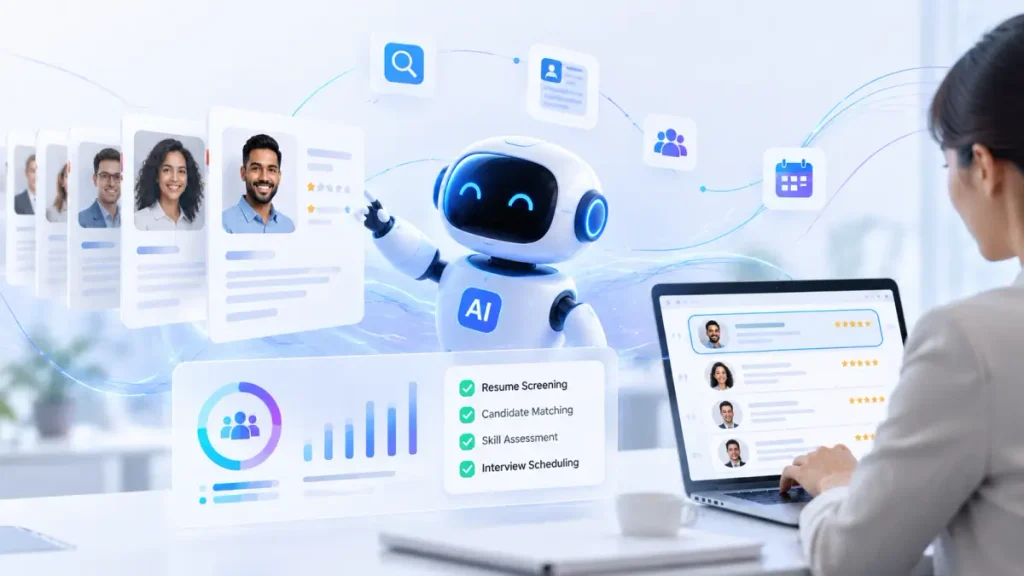
But, AI in recruitment is transforming the process in some ways. The use of artificial intelligence helps recruiters in performing various activities such as finding candidates and communicating with them, resume screening, and matching candidates with jobs using the data available through Application Tracking System (ATS). This doesn’t imply that the AI will perform everything.
Key Takeaways
- AI can speed up recruiting, but speed alone doesn’t guarantee better placements.
- Clean ATS data is the foundation for useful automation recruiting.
- AI matching works best when it’s configured around each client’s hiring needs.
- Recruiters still need to review AI recommendations and make the final call.
- AI can handle repetitive work while recruiters focus more on candidates and clients.
- Bias, data quality, transparency, and compliance cannot be treated as afterthoughts.
- Measure AI by fill rates, time-to-fill, and redeployment, not just hours saved.
- The future isn’t a recruiter vs. AI. It’s recruiters using AI to do more of the work that matters.
What is AI Recruiting?
Recruiting through AI refers to the application of AI technology to assist recruiters in locating, screening, matching, engaging, and managing candidates. The application of AI in recruiting will help automate the repetitive process, identify trends in recruiting data, and make decision-making easier.
AI recruiting software sits on top of the already existing ATS solutions that staffing firms utilize. While in a traditional ATS you will have clear-cut rules such as “if a CV includes keyword X, then move it to folder Y,” AI works with data patterns to rank candidates based on how well they match a position, find sources of successful hiring, and determine which candidate is most likely to make it to an interview stage.
This capability of AI, however, brings its own problems. AI learns from the data provided to it, including those patterns of data that nobody intended to teach it. This is why oversight has become so important. And with staffing, where the same AI is supposed to serve multiple clients with their definition of a “good” candidate, this task becomes even more complex.
Benefits of AI in Recruitment: What Does It Bring to the Table
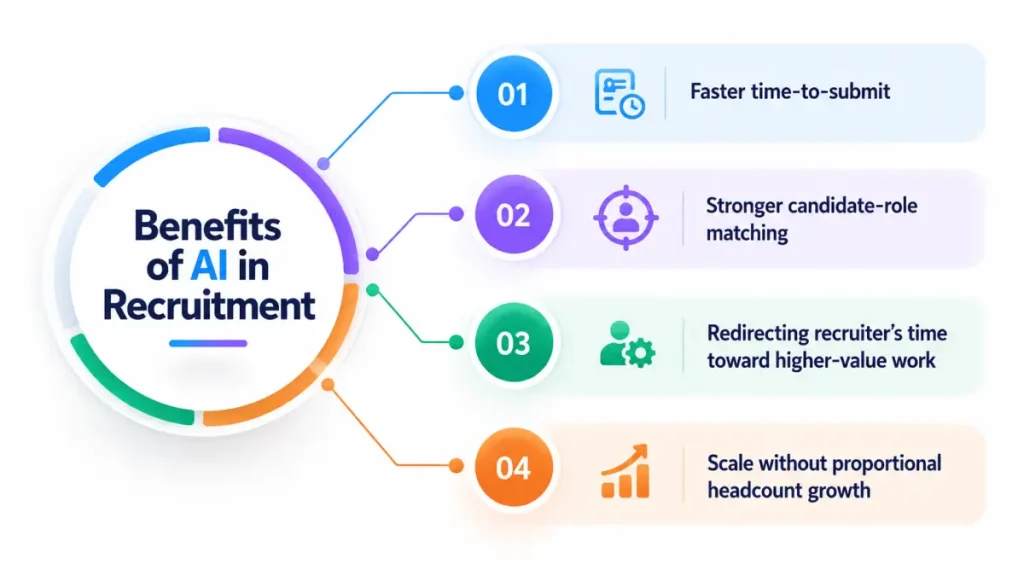
The advantages of AI-driven recruiting in staffing are important to discuss separately since the conflation of these is how most organizations misjudge how fast AI can transform their metrics.
1. Faster time-to-submit
Resume screening and initial candidate ranking that used to take hours now takes minutes, and staffing firms competing to be first with a qualified submission is a genuine competitive edge. Bullhorn’s 2026 data found that among firms growing revenue by more than 25%, 78% had AI tools embedded in their ATS, compared with just 51% of firms whose revenue was declining. Speed at the top of the funnel correlates with winning the placement, not just filling it faster.
2. Stronger candidate-role matching
Recruiters use advanced AI recruiting platforms today, which do not simply match resumes based on keywords. They consider skill adjacency, certification records and placement patterns from similarly structured previous positions – and come up with a shortlist that will better withstand a closer look by a hiring manager than a keyword-based one would.
3. Redirecting recruiter’s time toward higher-value work
There are many responsibilities that recruiters have, including resume review, matching candidates to vacant positions, interview scheduling, and others. Most of these responsibilities can be done with the help of AI. Consequently, recruiters will have enough time to get to know the client better, talk to candidates, and evaluate aspects that might not appear on resumes. AI takes care of all repetitive tasks, whereas the recruiter specializes in more complex aspects of hiring.
4. Scale without proportional headcount growth
As requisition volumes rise, AI recruiting platforms let firms absorb more submissions and more open roles without adding recruiters at the same rate. This matters directly to margin in a business where the headcount is the single biggest cost line.
Top Use Cases of AI in Recruitment for Staffing Firms
AI is present throughout the entire hiring process, but there are a few key use cases that are responsible for delivering most of the current value. AI in talent acquisition may be used to support various steps within the hiring process, such as candidate discovery and selection.
I. Resume screening and candidate ranking
This remains the highest-volume and lowest-risk application. AI tools can process thousands of resumes and return a job-fit-scored shortlist in minutes. This is exactly the kind of pattern-matching task suited to automation, provided that the underlying data feeding the model is clean, which isn’t always a safe assumption in a decade-old ATS.
II. Sourcing and candidate outreach
AI solutions can scan the organization’s database and external social networking sites to find potential passive candidates that the recruiter would never have identified manually. It can also generate the very first email message to reach out to them. This becomes extremely important in cases of competitive or specialized job openings.
III. Interview and submission scheduling
Coordinating interviews between recruiters, candidates, and hiring managers can consume a disproportionate amount of administrative time. AI scheduling tools can connect calendars, send reminders, and handle routine coordination without making hiring decisions.
IV. Skills and credential verification
For verticals where certifications, licensing or specific technical assessments are mandatory, AI-powered verification software standardizes the procedure and eliminates the client-side risk of losing a candidate late in the placement process
V. Predictive analytics on placement quality
Rather than forecasting who’s likely to get an interview, the more useful version of this looks backward at retention and redeployment data to identify which candidate profiles, sourcing channels, and client fits are held over time. That’s a harder, slower use case to build well, and it’s exactly the one many enterprises fail at.
VI. AI-assisted bias detection in screening
AI tools can flag language in job postings that discourage certain applicant groups and surface irregular patterns in who gets screened out. When used well, this use case can support a more defensible, standardized evaluation. It requires ongoing human review to actually catch bias rather than just relocating it.
VII. Candidate communication and engagement
Automated notifications and FAQ responses keep candidates informed about where they stand, especially during the days when recruiters may not have a meaningful update. That matters because a poor candidate experience can lead someone to drop out, accept another offer, or hesitate to work with the same staffing firm again.
Challenges and Risks of Using AI in Recruiting
AI recruitment does offer an important competitive edge, yet there are several risks associated with such technology that won’t disappear just by choosing a credible vendor. Now we are going to analyze the risks and challenges of applying AI to recruiting.
Algorithmic bias
AI picks up patterns from past hiring data. If that data carries bias, the model can carry it forward too, only now it comes with a score or ranking that can make the decision look objective. Staffing firms sit closer to that exposure than most in-house teams, since their AI tools are making hiring recommendations on a client’s behalf, at scale.
Lack of transparency
A recruiter can’t always tell why an AI tool ranked one candidate above another. That becomes awkward when a client asks for an explanation. If the vendor can’t give the recruiter a clear answer, the recruiter has little to work with.
Erosion of the human relationship
Recruiting has always been a people’s business. Automating every candidate’s touchpoint can make the process feel cold, and some candidates will simply drop out rather than chase an automated system. Staffing firms have more to lose here because relationships are a big part of what they bring to the table.
Data quality and inaccuracy
Most ATS databases aren’t exactly clean. There are duplicate profiles, old records, inconsistent job titles and skills entered differently by different recruiters. AI won’t fix that mess. It can just turn bad data into recommendations that look convincing.
Legal and compliance exposure
The rules around AI in hiring are changing, and they aren’t the same everywhere. That makes compliance an important consideration for staffing firms using AI in their recruiting workflows. Legal and compliance teams should be part of the rollout from the start, not brought in after something goes wrong.
Candidate signal is getting weaker
Candidates are using AI to rewrite resumes, tailor applications, and prepare for interviews. So, a great-looking resume doesn’t always tell recruiters very much anymore. Firms that rely too heavily on resume screening may end up sorting through more noise, not less.
Best Practices for Implementing AI in Recruiting
Adopting AI in staffing well requires more structure than flipping a tool on and waiting for the metrics to move.
1. Start where the bottleneck is, and not where automation is easiest
High-volume, high-turnover roles are the obvious place to begin, but only after confirming that screening speed, like client approval delays, was the real constraint. Automating the wrong stage produces a faster process with the same outcomes.
2. Clean the data before the model goes live
First, perform an audit of the ATS, then ensure consistency in job titles and skill tagging, as well as elimination of any duplicates. Improved quality of data would be the most impactful move a company could undertake prior to implementing AI, but the one most overlooked.
3. Configure per client relationship, not as one generic layer
A staffing firm isn’t hiring one organization; it’s running submissions across dozens of clients with different definitions of a strong candidate. A matching model tuned for a fast-moving startup client will misfire on a risk-averse enterprise client that weights certifications more heavily. Deploy one AI engine across the whole book of business, and it gets tuned, in practice, to an average client that doesn’t exist for anyone. The extra setup work of configuring client relationships is what separates a tool that improves submission quality everywhere from one that just increases volume while account managers scramble to explain a client’s falling interview-to-offer ratio.
4. Keep human oversight built into every AI-generated recommendation
Recruiters must validate the lists provided by AI, not automatically approve them. These decisions about candidates who do not fit into all of the boxes but are undoubtedly the correct candidate to choose are precisely why AI suggestions need to have an override option.
5. Track the metrics that correlate with revenue
Hours saved and resumes processed may look good on paper, but they don’t necessarily mean better business results. Track fill rate, submissions per job, time to fill, and redeployment rate instead. If a contractor isn’t getting placed again, a fast first placement may not have been a good match after all.
The Future of AI in Recruiting: What Changes After 2026
As per Bullhorn’s report, AI will become a normal part of how staffing firms work. Screening, sourcing, scheduling, outreach, and reporting will continue to get more automated. But that won’t mean every recruiter will use AI in the same way. Some firms will use it to cut admin work. Others will build it deeper into sourcing, matching, and client delivery.
Data will matter more as this happens. A firm with years of messy ATS records can’t expect a new AI tool to fix everything overnight. The firms that sort out their data and processes first will have a much easier time getting useful results. Recruiters will still have the final say on many important decisions. A system can find a candidate who looks right on paper. It can’t always tell you why that person will work well with a particular client or whether a candidate is likely to stay. That’s probably where AI in staffing is heading: more automation around the recruiter, not the recruiter being taken out of the process.
Is AI Right for Your Staffing Firm?
AI makes sense for a staffing firm managing high application volumes, struggling with time-to-fill, facing recruiter burnout, or planning to scale without proportional headcount growth. But readiness isn’t just a data and infrastructure question. The more useful question before adopting AI isn’t “is our data ready?”; it’s “are our people ready for these changes.” Firms that deploy AI without preparing recruiters for a more consultative, relationship-driven version of the role often find that efficiency gains on paper never translate into stronger placements or client relationships on the ground.
AI-based recruiting solutions for staffing companies are not something you can easily plug-and-play, and the revenue numbers clearly show that doing nothing about that problem isn’t a viable option either. The firms getting results have figured out their actual bottleneck before implementing AI. They’ve cleaned their data, configured the solution around each client relationship, kept human judgment in the process, and measured outcomes that connect to revenue. Technology is no longer a differentiator in staffing. Knowing precisely where to trust it, and where a recruiter’s judgment still has to lead, is.
Frequently Asked Questions
What is AI recruiting and how is it different from a traditional applicant tracking system?
In contrast with an ATS that is programmed with certain fixed rules, the AI recruitment process utilizes machine learning and natural language processing techniques to assign a score to each candidate according to his or her likely suitability, learn from placement history, and continuously evolve, whereas an ATS operates with predefined logic (e.g., sending a resume to a certain department if it contains some particular keyword).
Will AI Replace Recruiters?
No. AI will be able to take care of all the mundane and highly transactional aspects of recruiting, such as screening, prioritizing, scheduling, initial contact, etc., but recruiting is not primarily about processing people through a system. The clients are looking for insight from the recruiter on industry trends, salaries, and candidate behavior, which can’t be delivered by a dashboard. The candidates are looking for understanding. Those conversations require judgment and context that current AI systems aren’t built to deliver, and the gray areas that define most real placements, a candidate with strong potential who doesn’t check every box, a client whose expectations need recalibrating, still come down to human read, not a model’s confidence score.
How is AI in staffing different from AI in general corporate recruiting?
The main difference is who the AI is recruiting for. In corporate recruiting, AI typically supports one employer’s hiring process, with one company’s workforce needs, hiring criteria, and processes to work within. Staffing firms, on the other hand, run AI recruiting across dozens of client relationships at once, each with a different definition of a strong candidate. A matching model tuned well for one client can misfire on another, so AI in staffing needs to be configured around each client’s relationship rather than deployed as a single generic layer. That makes client-specific requirements and recruiter judgment much more central to how AI is used in staffing.
What should a staffing firm look for when evaluating AI-powered recruiting software?
Beyond matching accuracy, evaluate whether the vendor can explain what its model optimizes for in terms a recruiter could repeat to a client, whether it integrates cleanly with the existing ATS so recruiters aren’t routing around it, and whether it supports per-client configuration rather than one generic scoring model across an entire book of business. Data readiness matters as much as the tool itself. Plugging AI recruiting software into an inconsistent, duplicate-filled ATS tends to produce confident-looking results built on an unreliable foundation.