 Digital Transformation
 Data Engineering
 Implementation
 Staffing Services


AI-first is not a feature rollout, it is an operating model shift. It is a structural redesign of how your enterprise builds, secures, governs, and runs digital capabilities.
Microsoft’s cloud stack has quietly evolved into an integrated platform for this shift, where Azure becomes the AI runtime and infrastructure backbone, Fabric becomes the data operating layer, Entra becomes identity and policy control for humans and agents, and Copilot and enterprise AI agents become the interface through which work gets done.
The enterprises that win in 2026 and beyond will do three things well:
- Modernize their data estate so AI has trustworthy context
- Standardize their AI runtime so models, tools, and agents are governed centrally
- Treat security as continuous verification (identity, data access, and compute trust)
This blog explains how Microsoft’s cloud stack must be reimagined, not as products, but as an AI operating model.
Why the AI-first Enterprise is Demanding New Cloud Strategy
Every technology wave comes with a familiar mistake: Leaders treat it as an extension of existing strategy rather than a redesign.
AI-first is not the next step after cloud migration, it is the beginning of a different conversation altogether. It is about how decisions are made, how processes move, how risk is managed, and how quickly digital capabilities turn into measurable outcomes.
The AI-first enterprise cloud strategy of the last decade focused on migration, resilience, cost, and modernization. The cloud strategy of the next decade will be measured by how rapidly you can create “systems of intelligence” that move beyond insights into action. Microsoft has signaled this shift clearly in its Ignite 2025 Azure direction, not through marketing language, but through the way it is aligning infrastructure, data, security, and Copilot experiences into a single AI enterprise platform.
To put it straight: If your cloud stack isn’t redesigned for AI, your AI investments will remain fragmented, expensive, and increasingly risky.
What Actually Changes When an Enterprise Becomes AI-First
AI-first is often described in terms of productivity tools and automation. That framing is incomplete. The deeper change is that AI introduces systems that are probabilistic rather than deterministic. Meaning the enterprise must build architectures that assume uncertainty and require validation. It also introduces new operational expectations, because models must be evaluated, monitored, and updated much like products.
AI-first also moves the enterprise from application-centric thinking to agent-centric execution. Instead of users navigating systems to get work done, they increasingly direct agents through intent and natural language. Microsoft’s 2025 roadmap strongly reinforces this shift, as its platform is being shaped toward agentic AI, where systems don’t just assist, they act within defined boundaries.
This is why cloud stack strategy matters again. It is no longer an infrastructure decision. It is a governance and operating model decision.
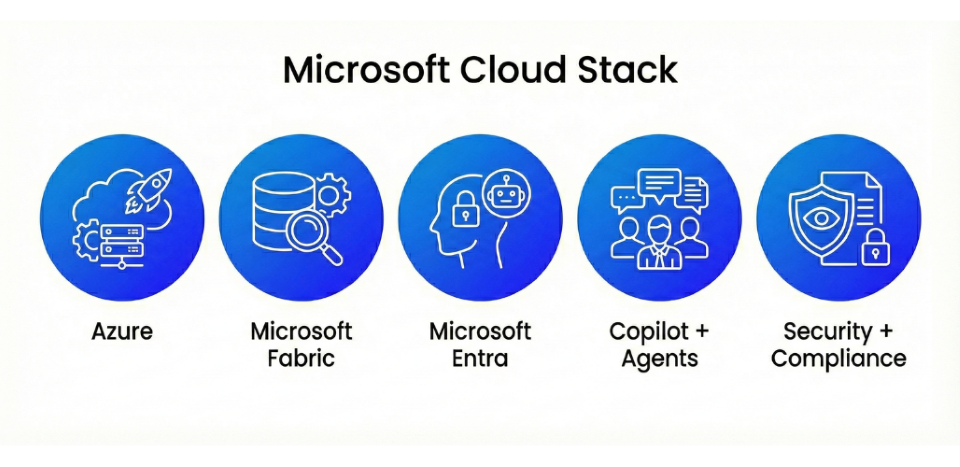
Reimagining the Stack: Microsoft Cloud as an AI Operating Model
Most organizations still view Microsoft’s cloud components as separate products: Azure for compute, Microsoft 365 for productivity, Fabric for analytics, Entra for identity, and Security for compliance. That separation is a legacy interpretation.
In an AI-first enterprise, the cloud strategy must be treated as a fundamentally different operating model, where each layer enables AI to function safely, consistently, and at scale.
In this model:
- Azure becomes the runtime where models and agents are hosted, orchestrated, and monitored.
- Fabric becomes the data backbone that creates trusted context and governance continuity.
- Entra identity governance for AI agents becomes the policy boundary that governs both humans and non-human actors such as agents and service identities.
- Copilot becomes the interface through which work is executed, not just explained.
Microsoft’s own 2025 narrative suggests this integrated direction is not optional. It is where the platform is going. However, a common mistake is to treat Microsoft’s cloud offerings as separate products. The AI-first enterprise must see them as layers of a single operating model.
The stack, reimagined:
- Azure = AI infrastructure + runtime + orchestration
- Microsoft Fabric = Unified data foundation and governance-ready analytics layer
- Microsoft Entra = Identity, permissions, and policy enforcement for humans and agents
- Copilot + Agents = New enterprise interface for work and workflow execution
- Security + Compliance = Continuous verification and risk containment
Microsoft Ignite 2025 announcements positioned Azure explicitly as the “intelligent cloud” foundation for this integrated model.
Azure AI Runtime and Governance: The New Core of Enterprise Execution
Azure is no longer simply a place to host applications. In an AI-first enterprise, Azure becomes the standardized runtime that manages the lifecycle of AI systems. This includes not only deploying models, but also controlling inference pathways, managing grounding sources, enforcing policy, and monitoring outcomes.
The New Azure Priorities for Enterprises:
1) Multi-model and multi-tool orchestration
Your enterprise will not rely on one model. You will use multiple models for different tasks, cost profiles, and risk tolerances. Microsoft’s agentic AI direction and Foundry-related announcements at Ignite 2025 reflect this reality.
2) AI governance and lifecycle controls
Model deployment should resemble software release discipline:
- Controlled promotion between environments
- Policy enforcement
- Logging and audit
- Drift monitoring
- Red-teaming and evaluation
3) Compute architecture that supports AI economics
GPU strategy, inference cost controls, and workload placement are now board-level cost levers, not just technical decisions.
Microsoft Fabric as the AI Data Foundation: Context, Trust, and Governance at Scale
AI is only as reliable as the context you provide it. This is why the enterprise data estate is no longer a reporting concern, it is an AI trust concern. If your data is fragmented, inconsistent, and governed differently in every system, then your AI outputs will reflect those inconsistencies with confidence, speed, and authority. That combination is dangerous.
The significance of Microsoft Fabric data foundation for AI is that it pushes toward a unified data operating layer where ingestion, analytics, security, and governance can converge. Its 2025 feature evolution shows Microsoft is not treating Fabric as an add-on analytics tool, it is developing it as a core platform layer designed for AI-assisted analytics, enterprise-grade permissions, and scalable governance patterns. Fabric’s November 2025 feature summary highlights improvements around Copilot experiences, real-time exploration, OneLake permissions, and extensibility, exactly the areas that matter when AI is consuming enterprise data continuously.
Why Fabric Matters in the AI-first Enterprise:
1) Unified data + governance makes AI reliable
When data estates are scattered across systems, AI outputs become inconsistent. Fabric’s “OneLake” approach improves discoverability and simplifies policy enforcement.
2) AI becomes accessible to more roles but will still be governed
AI-driven exploration features are valuable only if security models and access controls remain consistent.
3) Fabric reduces “context fragmentation”
If Copilots and agents are grounded in different data sources with different definitions, you don’t get enterprise intelligence, you get enterprise confusion.
Entra as the Identity Control Plane: Managing Humans and Agents with Equal Discipline
The AI-first enterprise must treat identity as the most critical governance layer in the stack. This is not a future concept, it is a present architectural requirement. As agents begin to act on behalf of people, identity systems must govern both the person and the non-human actor executing tasks under delegated authority.
Entra’s role in this stack is foundational because it moves identity from authentication into continuous policy enforcement. This includes conditional access, least privilege controls, and strong auditability that can trace AI actions back to business accountability. The reason this is escalating quickly is that Microsoft’s 2025 roadmap expands role-based Copilot offerings and deeper agent functionality, meaning that more workflows will be initiated through natural language and executed through automated systems.
The question for leadership is not “can Copilot do this,” but “should Copilot be allowed to do this, under what conditions, and how will we prove it was done correctly.” Entra becomes the enforcement mechanism for those decisions.
Copilot and Enterprise Agents: Work Becomes Intent-Driven, Not Application-Driven
The biggest strategic value of Copilot is not in generating text. It is in turning intent into workflow execution across the enterprise. When Copilot becomes the interface to business systems, it essentially becomes the front door to how work flows, across HR, finance, sales, operations, and IT.
Microsoft’s expansion of role-based Copilot capabilities and agent-first direction is significant because it suggests a new paradigm: Work begins with human intent, is carried out through orchestrated software actions, and is governed through policy boundaries across identity, data, and security layers. The 2025 release wave plans reinforce how Microsoft is evolving Copilot beyond assistance toward structured role-based capability.
This creates a leadership imperative: Copilot cannot be treated as a productivity experiment. It must be treated as a governed interface layer. Without that governance, organizations will inadvertently create shadow AI workflows, inconsistent business logic, and untraceable decisions.
Security for the AI-First Stack: Trust Must Be Verified Continuously
AI introduces a different set of security risks than traditional applications. The enterprise threat model now includes not only breaches and downtime, but influence attacks, data leakage through prompts, and incorrect execution triggered by manipulated instructions. The question is not just whether your data is protected, it is whether your AI systems can be manipulated into exposing it or acting incorrectly.
AI changes security priorities. The biggest risks are no longer only exfiltration, they are influence, misuse, and silent failures.
Modern AI threat categories:
- Prompt injection (agents manipulated by malicious instructions)
- Data leakage through ungoverned grounding sources
- Privilege escalation when agents inherit excessive permissions
- Model misalignment or unwanted behavior in sensitive workflows
- Shadow AI and untracked AI tools used across teams
This is where confidential computing becomes a strategic capability, particularly for regulated industries and multi-tenant solutions.
The Governance Layer Most Enterprises Miss: AI Requires Operational Accountability
The majority of enterprises underestimate how governance must evolve when AI becomes embedded into workflows. Traditional governance models assume software behaves predictably and outcomes are controlled by explicit rules. AI does not operate that way.
- Its outputs must be evaluated,
- Its failure modes must be understood, and
- Its decisions must be traceable to accountable owners.
AI governance is not simply about compliance or ethical guidelines. It is about operational discipline.
- Who approves model changes,
- Who monitors drift,
- How incidents are handled, and
- How audit logs are maintained.
Microsoft’s agentic direction at Ignite 2025 makes this even more pressing, because agentic AI is designed to act, not merely inform.
Enterprises that scale AI responsibly will be those that standardize governance as an operational capability, similar to DevOps or security operations, not as a policy function.
The Architecture Blueprint: How the AI-First Microsoft Stack Fits Together?
The simplest way to understand this shift is to stop thinking in products and start thinking in layers. At the base, you need data and identity.
- Fabric becomes the unified data foundation where governance is consistent and context is accessible.
- Entra becomes the identity and policy engine that defines who or what has permission to act.
- Azure becomes the AI runtime where models and agents are deployed, evaluated, and monitored.
- Copilot becomes the interface layer where intent becomes execution, but only within boundaries enforced by identity, data permissions, and security controls.
- Security and compliance become continuous verification rather than periodic reviews, reinforced by features such as confidential computing for sensitive workloads.
This blueprint is not complex for complexity’s sake. It is the architecture required to build AI systems that are scalable, governable, and economically sustainable.
Make the most of Microsoft Cloud Stack with Infojini
AI Economics: Where Enterprises Lose Money?
AI-first strategy without economic discipline becomes cost expansion without value creation. The reason many AI programs overrun budgets is not because AI is inherently expensive, but because enterprises deploy it without standardizing runtime and data foundations. When you have model sprawl, fragmented data pipelines, and inconsistent governance, your costs multiply through duplication, rework, and operational overhead.
The three cost drivers:
- Inference and GPU (compute spend is the new cloud bill shock)
- Data movement (fragmented data multiplies cost and latency)
- Operational overhead (if governance is manual, scale becomes impossible)
On the other hand, one of the most underestimated cost drivers is data movement. When AI systems rely on data scattered across multiple environments, every query becomes slower and more expensive. Fabric’s unified approach, combined with governance improvements seen throughout 2025, is partly a response to this cost reality.
The other hidden cost is operational inefficiency. If AI governance remains manual, your adoption rate will outpace your ability to manage risk. That’s when enterprises either pause AI initiatives or accept uncontrolled risk exposure. Neither is desirable. AI economics must therefore be treated as both a cost strategy and a control strategy.
Practical Modernization: How to Move from Cloud-Enabled to AI-First
Most enterprises do not need to restart their cloud transformation. They need to upgrade it.
Here is a realistic path:
Step 1: Define your AI Operating Model
Clarify:
- Which business workflows are AI candidates
- Who owns the outcomes
- How risk is managed
- How models are evaluated and monitored
Step 2: Consolidate Data Foundations
Prioritize unification:
- Reduce duplicate datasets
- Implement shared definitions
- Enforce governance consistency
- Make data discoverable and trusted
Step 3: Standardize the AI Runtime
Avoid “model sprawl.” Create a controlled AI platform on Azure:
- Standardized model hosting
- Approved tools and connectors
- Consistent logging and audit
Step 4: Expand with Role-Based Agents
Use role-based Copilot offerings as a structured adoption route rather than random experimentation. Microsoft’s release wave plans provide a roadmap of what these role-focused capabilities are evolving toward.
Step 5: Harden Security and Trust
Use confidential compute for sensitive workloads and build governance into the architecture, not as a policy document.
The Bottom Line: Microsoft Cloud is Becoming the Enterprise AI Platform
The Microsoft cloud stack for AI first enterprise is no longer merely infrastructure plus productivity. It is becoming an end-to-end enterprise AI platform that spans data, governance, identity, security, runtime, and experience.
Fabric’s rapid feature evolution strengthens the data foundation required for trusted AI, particularly around governance and AI-assisted exploration. Entra’s growing strategic role reflects the reality that identity and policy are now the control plane for humans and agents. Copilot’s evolution into role-based execution signals that enterprise work itself is changing shape.
The enterprises that win will not be those who “use AI.” They will be those who rebuild their cloud stack into an AI operating model, disciplined, secure, and designed for scale.