Digital Transformation
 Data Engineering
 Implementation
 Staffing Services


Enterprises invest in data platforms, analytics, and AI to make faster decisions, improve operations, and uncover new opportunities. Yet, when teams rely on conflicting reports, duplicate data pipelines, and inconsistent business definitions, those investments become harder to scale. An AI system may process information in seconds, but it cannot deliver dependable results if the underlying data is unreliable or lacks context.
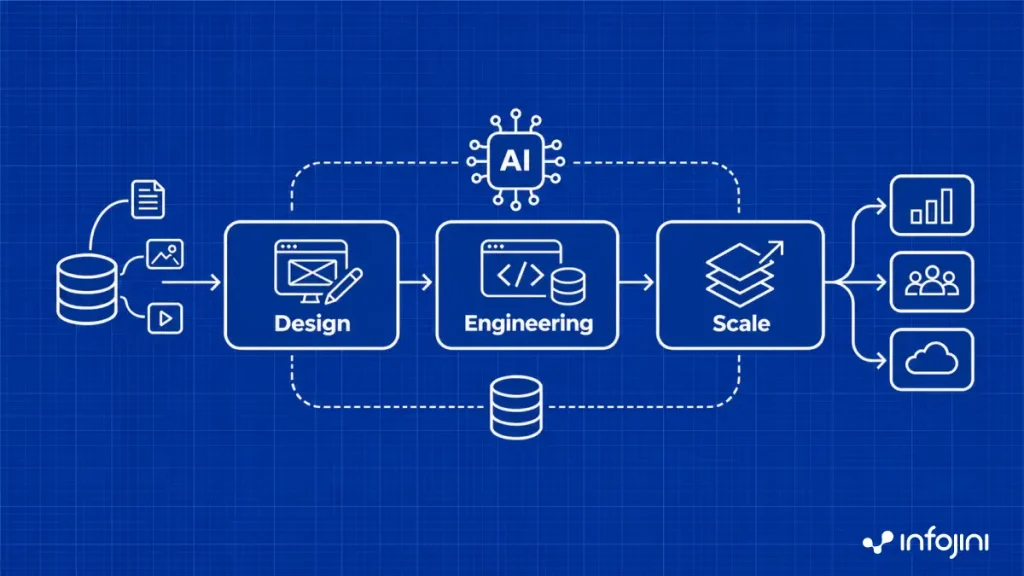
AI-ready data products help address these challenges by packaging data with the metadata, quality controls, and governance needed for reliable, repeated use. By treating data as a product built around specific business needs, enterprises can reduce duplication, improve consistency, and create a stronger foundation for AI. This guide explores the types of data products, their lifecycle, and the engineering practices needed to build and scale them.
What is a Data Product?
A data product is a curated, documented, and managed data resource that is intended for use in certain business activities. An organization can, for example, collect customer data from the CRM, billing, and customer care systems. Consequently, sales, finance, and customer support teams can access an integrated view of customers without having to extract the data.
However, a data product is more than just data provided as a dataset or report. It has a specific purpose, owners, quality standards, and a defined access method. For this reason, the same data can be utilized by different users for solving various business tasks. Google Cloud’s overview of data products further explains how data products can be organized, governed, and shared to support different enterprise consumers.
What Makes Data Products AI-Ready?
While clean and precise data is important for enterprise, data also requires context, consistency, definition, and access control. AI systems will also require knowledge of what data means, if it is up to date, where it comes from, and if there is authorization to use the data.
For instance, a customer database containing dates of purchases, transaction amounts, and account numbers of customers can pose some problems for the AI system if it lacks clear metadata or field definitions. The AI system could confuse dates of orders and deliveries and take gross amounts as net amounts.
AI-ready data products solve these problems in the following ways:
- Discoverability: Catalogs, searchable descriptions, and business labeling enable consumers and AI to discover data that matters.
- Interpretability: Uniform schemas, business dictionaries, and semantics enable machines to understand the meaning of different fields and metrics.
- Trust: Lineage, provenance, quality scores, and history of validation assure that data is trustworthy.
- Safe access: Permissions, privacy requirements, consent rules, and sensitivity classification allow for safe access.
- Operational reliability: Targeted freshness, versioning, monitoring, and deprecation enable avoiding unexpected failures.
Types of Data Products
The kind of data products needed by an enterprise depends on its business process, architecture, and consumers. Real-world taxonomy includes the following categories.
- Source-related products: Data that represents one operational source, for example, SAP finance transactions and Salesforce accounts.
- Aggregated products: A combination of related sources that provides one view.
- Analytical products: These products assist with decision-making and reporting and include revenue marts, performance dashboards, and financial KPIs.
- Operational products: Provides relevant information at the right time within the workflow, such as availability of stock and risk scores of the transaction.
- AI/ML products: Includes machine learning features, predictions, recommendations, or churn scores using authorized interfaces.
- Semantic products: Business definitions of concepts including active customer, net revenue, and customer churn.
- Composite products: A combination of other products that help achieve outcomes.
Some of these categories overlap. For example, a health product may include customer data, semantic definition, and machine learning prediction. The important decision is not which label to assign. It is whether the product serves a clear purpose and provides the right level of reliability, context, and access for its consumers.
Data Product Use Cases Across the Enterprise
A data product example is a customer profile which combines information available in the CRM system, the billing system, and the customer service system to aid decision making. Other similar data products could be used for detecting fraud, tracking the supply chain, budgeting, and managing staff.
1. Customer Overview
Sales teams and customer service departments usually use different CRM, billing, and support systems to understand customer needs. Customer overview data products unify the information into a single view for each customer.
Business benefits: Saving time on merging customer records, improved personalization, and better customer retention capabilities.
2. Fraud Detection
Payment departments and fraud detection tools require timely access to transaction history, customer behavior, and relevant fraud factors. Fraud-risk data products provide this information in a unified way.
Business benefits: Faster fraud detection, effective investigation, and minimized financial loss.
3. Supply Chain Visibility
The procurement and operations teams require information about the supplier’s performance, inventory management, shipments, and demand forecast. The supply chain data product provides an integrated source that allows teams to plan for potential disruption and changing demand.
Business benefits: Less unexpected stockouts, improved inventory management, and less disruption to supply chain operations.
4. Clinical Care Analysis
Healthcare companies store patient details like appointments, treatments, and outcomes in several different systems. A clinical care data product collects approved data for analysis by the healthcare team.
Business benefits: More effective outcomes analysis and resource allocation.
5. Financial Performance
Financial teams may find it difficult to compare performance due to differences in the way departments define revenue, costs, and profit margins. A financial data product will bring transactional, budget, and forecast information together by applying common financial definitions.
Business value: Time savings in report reconciliation, improved consistency in financial comparison, and informed budgeting and forecasting.
6. Workforce Planning
HR teams require accurate information on staffing, staff turnover, and engagement to plan their workforce requirements. A workforce data product will consolidate necessary HR data for authorized analysis while keeping personal data safe.
Business value: Improved allocation of the workforce, early detection of potential retention problems, and better workforce planning.
Across these use cases, data products help organizations reduce repetitive data preparation and put reliable information to work toward specific business outcomes.
Understanding the Data Product Lifecycle
The data product lifecycle covers the work required to take a product from an initial business need through production use, continuous improvement, and eventual retirement.
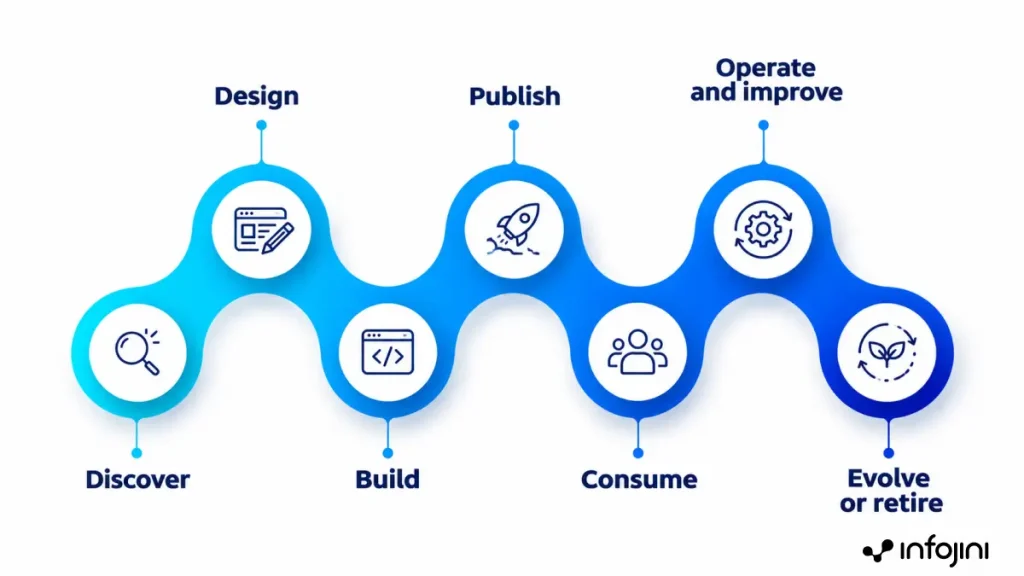
- Discover: Identify the business problem, intended consumers, available sources, and measurable success criteria.
- Design: Establish the product definition, data contract, ownership, semantics, quality rules, permissions, and service expectations.
- Build: Develop transformations, pipelines, interfaces, metadata, automated tests, and monitoring.
- Publish: Register the product in the catalog and provide documentation and approved access methods.
- Consume: Enable authorized users, applications, and AI systems to find and use the product.
- Operate and improve: Monitor freshness, quality, adoption, incidents, costs, and consumer feedback.
- Evolve or retire: Introduce compatible versions, communicate breaking changes, migrate consumers, or retire assets that no longer deliver value.
This lifecycle prevents teams from treating deployment as the finish line. A product remains useful only when its quality, relevance, and operational performance meet changing business needs.
Engineering Data Products: The Enterprise Blueprint
Data product engineering entails much more than just linking sources and creating a data transformation pipeline. The engineering perspective needs to consider issues of reuse, quality, context, access, and maintenance.
1. Start With a Data Contract
The data contract is essentially an agreement that is made between the providers of data and the consumers. The following details need to be included in the agreement: who owns the data, its purposes, schema, definition, frequency of updates, quality levels, access restrictions, and version controls.
As an illustration, when it comes to the finance product, daily update is needed, reconciliation from the source of transactions, and definition of net revenue. These expectations help consumers understand what they can rely on.
2. Design for Reuse
Create products based on stable business elements like customers, orders, products, patients, or assets. Rather than having a separate pipeline for each dashboard, create products that work for multiple use cases.
Defining semantics is also critical. If different groups within the organization calculate churn and revenue differently, aggregation of those results will give you wrong answers. Having a reusable definition helps avoid repetition.
3. Build Quality into the Pipeline
Quality control must be done through the entire process of development and manufacturing. The engineers should confirm changes in schemas, quantity of data, freshness of the data, business logic, referential integrity, source reconciliation, and surprises.
Automated tests will help identify any problem before it gets to its end consumer. Monitoring can help identify any problem in production, figure out why such a problem occurred, and how it affects production.
4. Package Context with the Data
Each product should have its business definition, purpose, owner, lineages, quality outcome, sensitivity level, access control, limitations, and support documentation.
Metadata is particularly critical for AI. For the model or agent to do its job right, it must have sufficient metadata beyond just the field names to properly interpret values and check whether the usage request is valid.
5. Publish Through Governed Interfaces
Diverse consumers will need varied means of access. SQL views or warehouse tables will serve the analysts well, REST/GraphQL APIs will work for applications, and event streams can feed the workflow. Feature stores will enable machine learning and authorized access, and MCP interfaces will allow the AI agents to have access to the pertinent information.
The publishing process must include catalog registration, role-based access, documentation, and an operational runbook. The interface will make the consumption easy without bypassing any enterprise controls.
Governance: Making Data Products Trusted at Scale
Effective governance is achieved by integrating governance within the product itself, rather than considering governance as an additional approval process. Clarity in ownership, access, quality, and accountability needs to be there throughout the lifecycle of the product.
Domain ownership, data contract documentation, impact analysis and lineage, quality certification, privacy management, access control, audit trail, and version management are some of the elements that need to be included in an enterprise governance model. Monitoring usage and costs allows organizations to measure if their products still deserve investment in operations.
These governance practices also align with the NIST AI Risk Management Framework, which provides guidance on identifying and managing risks associated with AI systems throughout their lifecycle. This becomes especially relevant in situations where AI agents extract information or trigger workflows. Access needs to be governed through permissions, and actions need to be audited. The availability of the product does not necessarily imply that everyone has permission to work with its data in every situation.
Common Data Product Mistakes to Avoid
Even very well-resourced initiatives may be hard-pressed when there is no product mentality. Be aware of these common pitfalls:
- Assuming that all datasets or dashboards are data products.
- Developing without a dedicated owner, known consumer, or desired impact.
- Waiting for data agreements to develop in response to technical integration issues.
- Deploying data assets without accompanying business metadata, lineage, and quality standards.
- Developing duplicative customer, product, or financial products across multiple departments.
- Developing exclusively for BI without considering use by operations and AI.
- Tracking completion of development pipelines rather than usage and business impact.
- Scalability of the technology platform ahead of ownership and operations.
Solving these problems early will help companies develop products that consumers can trust and reuse.
Conclusion: Data Products Are the Path to Trusted Enterprise AI
AI for enterprise requires data that is trustworthy, definable, governed, and prepared for analysis. AI-ready data products embody all of these features, helping businesses to increase their use, avoid duplication, and create better foundations for their AI initiatives.
The next task is to find high-value data products and create a repeatable methodology for engineering and governance.
Frequently asked questions
What is an AI-ready data product?
An AI-ready data product is a reusable, governed data asset packaged with business context, metadata, lineage, quality controls, and access policies. These capabilities help people, applications, and AI systems discover, interpret, and use the data appropriately
What are the types of data products?
Common types include source-aligned, aggregate, analytical, operational, AI/ML, semantic, and composite data products. Each serves different consumers and business needs, from reporting and operational workflows to machine learning and AI applications.
What is the data product lifecycle?
The data product lifecycle typically includes discovery, design, build, publish, consume, operate and improve, and evolve or retire. It covers the full process of creating, maintaining, and eventually decommissioning a data product.
How do you engineer data products?
Engineering data products involves defining a data contract, designing reusable structures, implementing automated quality checks, packaging business context and lineage, and publishing through governed interfaces. Continuous monitoring and clear ownership keep products reliable as business requirements change.