 Digital Transformation
 Data Engineering
 Implementation
 Staffing Services


For years, the process of turning data into business insights followed a familiar pattern. The data team gathered the data, the analyst cleaned up the data, the BI tools generated the dashboard, and decision makers acted based on the dashboards. That model is changing.
AI for data analytics is making it possible to ask questions in plain language, uncover patterns without manually building every query, generating forecasts, and investigating issues across multiple data sources. The newer shift toward AI agents takes this further. This means that the agent does not have to wait for the question to be asked but can start investigating an issue, provide insights, and, in a controlled environment, act on the insights.
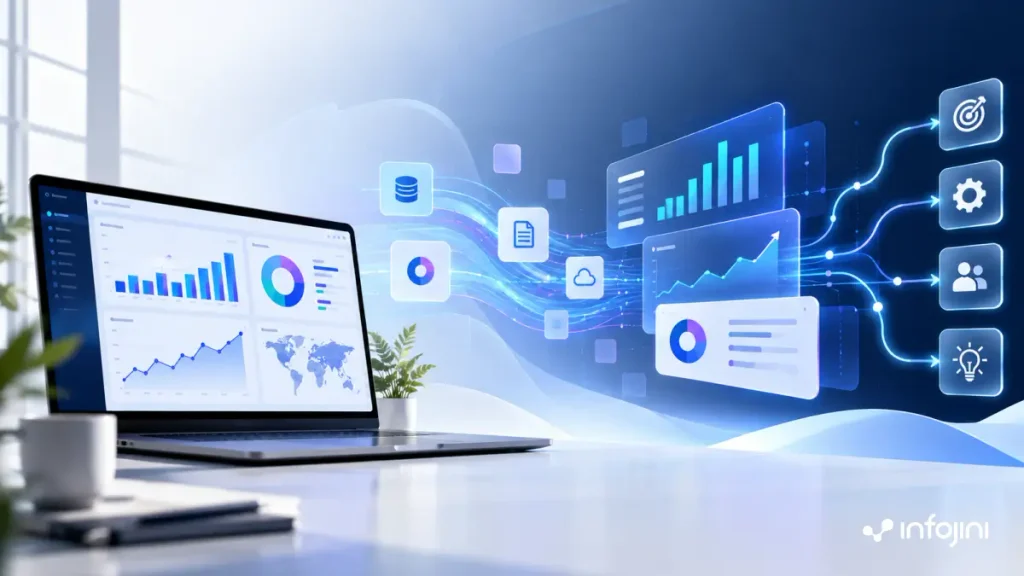
This is not to say that dashboards are going away. They remain useful for trusted metrics and recurring reporting. The relationship between AI and data analytics is changing, however, because AI can now help teams investigate what sits behind the numbers. But the bigger question is becoming: what happens after the dashboard shows you something important?
Key Takeaways
- AI-driven data analytics has evolved from being dashboard focused to allowing teams to explore trends, identify patterns, and explain changes in business metrics.
- Agentic analytics takes this to the next level where AI agents can undertake several steps of analytics in one process with little human involvement.
- The real power of agentic analytics lies in linking insights to action and turning data findings into the next business workflow as opposed to simply generating reports.
- This will require proper data and governance where analysts move away from reporting to validation and interpretation of data findings.
The Dashboard Era
Traditional BI was founded on a very basic principle: provide people with accurate information about the business and let them decide what to do with it. The standard process was like this:
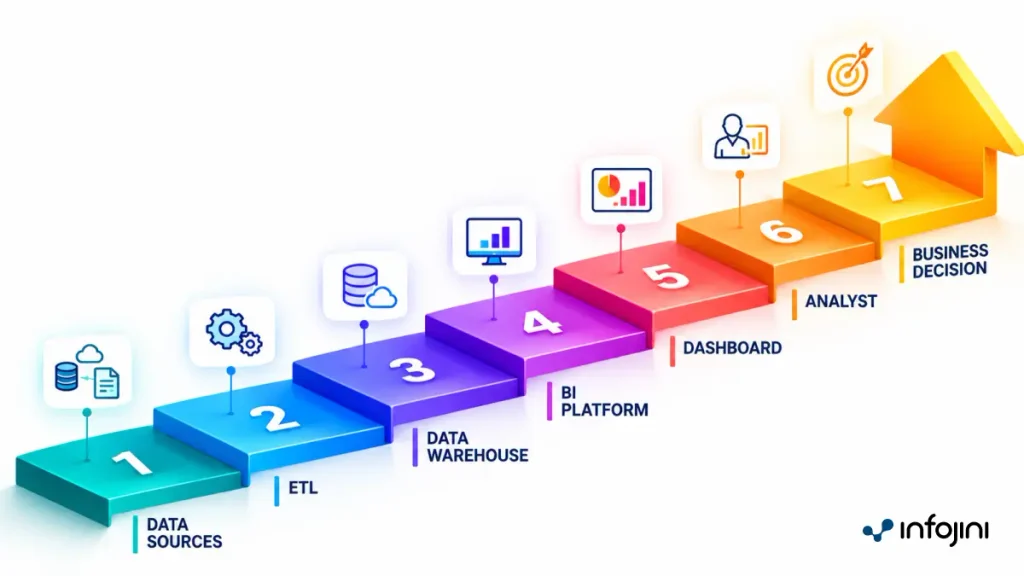
Data sources → ETL → data warehouse → BI platform → dashboard → analyst → business decision
This process was appropriate for structured and repetitive tasks. For example, a finance team could track revenue against targets. Sales leaders could monitor pipelines. Operations teams could see inventory levels. Executives could review a standard set of KPIs every Monday morning.
The strength of the dashboard model was not just convenience. It brought consistency. Organizations could define what “revenue,” “customer,” or “active account” meant and give different teams a common set of metrics. The weakness was what happened when someone asked a question outside the predefined report.
An analyst had to get information from various sources, create SQL scripts, clean the data, analyze the pattern found, create an appropriate visualization, and finally explain it. This could typically take hours or even days.
AI for data analysis changes this interaction. Instead of beginning with the dashboard and working backwards, a decision maker can simply ask: Why did our sales decrease in the Northeast last month? The system would be increasingly capable of finding the right data, conducting the analysis, and providing the answer.
Microsoft’s 2026 Data Formulator release illustrates this direction. Its AI agents can work across connected enterprise data, prepare data, explore analyses, generate visualizations, and maintain context across an analytical workflow.
The Shift to Agentic Analytics
The first wave of AI in analytics focused heavily on making data easier to access. Users could type a question instead of writing SQL. AI could summarize a dashboard, explain a trend, or generate a chart. Useful? Absolutely. But there was still a person sitting between the insight and the action.
Agentic analytics pushes that boundary. The difference is subtle but important:
AI-assisted analytics: “Here is the answer to your question.”
Agentic analytics: “I investigated the question, checked the relevant data, identified the likely cause and can take the next approved step.”
Gartner’s February 2026 Market Guide notes that organizations are moving from exploratory use of AI agents toward early-scale deployment, although ROI, trust, governance and cost remain significant concerns.
The major analytics platforms are moving in the same direction. Tableau introduced Agentic Analytics Platform in May 2026, explicitly positioning the shift as a move from people viewing dashboards toward AI helping move from insights to action.
So, this is no longer simply a question of adding a chatbot to a BI dashboard. The underlying analytics workflow is being redesigned.
Market Snapshot in 2026
The clearest sign of change is the level of attention AI agents are receiving from enterprise technology leaders. Gartner predicts that 40% of enterprise applications will include task-specific AI agents by the end of 2026, compared with less than 5% in 2025. These agents are designed to perform complex, end-to-end tasks rather than simply respond to a prompt.
Analytics is becoming one of the areas where that transition is particularly visible. Gartner’s February 2026 Market Guide shows that organizations are starting to move beyond experimenting with AI agents in analytics and toward putting them into early-stage production use. There is also a growing emphasis on what sits underneath the agent.
That is an important reality check. The market is not simply moving toward “more AI.” It is moving toward AI that can work with enterprise data reliably enough to participate in real workflows.
Core Capabilities of Autonomous Analytics Agents
What can an analytics agent actually do? The answer depends on the platform and the level of autonomy an organization is willing to provide, but the capabilities are increasingly covering the entire analytical workflow.
Data access and preparation
Agents can access governed data sources, discover relevant tables/datasets, and even help in preparing the data necessary for the analysis. This is especially valuable in situations where data exists in different warehouses, databases, BI tools, and operational applications.
Microsoft’s Data Formulator, for instance, offers governed access to data from databases, warehouses, BI tools, object stores and local file systems, and its agents can assist with data preparation and exploration.
Query and code generation
AI can generate SQL, Python, or other analytical logic based on a natural-language request. That does not eliminate the need for technical expertise. Someone still needs to validate whether the query reflects the business question correctly. But it can remove much of the repetitive work involved in getting a query run for the first analysis.
Insight generation
This is when AI-enabled data analytics becomes fascinating. For example, an AI application can search for abnormalities, shifts in patterns, unusual segments, or relationships, which might need a human analyst to find. The goal isn’t simply to produce another chart. It is to help answer the next question: “Why did this happen?”
Visualization and explanation
AI can also turn analytical results into charts, summaries, and narratives. This makes data analysis using AI more accessible to business users who may understand the business problem but not SQL, Python, or BI tooling.
Microsoft’s current research platform, for example, allows users to work with agents that inspect data, generate charts and explain findings while maintaining the analytical context.
Action and workflow integration
This is the biggest difference between traditional analytics and agentic analytics. An insight can become the trigger for a workflow. Imagine an operations agent detecting that inventory for a high-demand product is falling below a threshold. Instead of simply displaying the problem on a dashboard, the system could alert the relevant team, check open purchase orders, and wherever appropriate, it can initiate an approved workflow.
This is where AI in data analytics starts becoming operational rather than purely informational.
Real-World Use Cases
The strongest use cases are not necessarily the flashiest ones. They are situations where people repeatedly investigate data and then take predictable business action.
Finance
The finance department can use AI predictive analytics for forecasting, variance, and anomaly detection. Rather than simply stating that revenue was lower than the forecast, the agent can analyze the variances among regions, products, and customers. Month-end processes are another potential area where agents can help connect data checks, reconciliations and exception handling.
Sales and marketing
Sales teams create massive amounts of behavioral and transactional data. AI for data analytics can be used to track changes in conversion rates, lead scoring, customer behavior, and signs of churn.
AI Sentiment analysis is another common example of application. Customer feedback, support discussions, and survey answers can be mined to detect emerging themes, which would be hard to uncover through a manual approach.
Operations and supply chain
Operations are particularly well suited to AI-powered data analytics because conditions change continuously. An agent can monitor demand, inventory, supplier performance, or logistics data and flag exceptions as they emerge. The important shift is from “the dashboard says there is a problem” to “the system identified the problem and started investigating it.”
Product and engineering
Product teams can use AI to analyze usage patterns, feature adoption, customer behavior, and experiment results. An agent could compare product usage before and after a release, identify segments with unusual behavior, and prepare an explanation for the product team. The analyst still provides judgment. AI simply handles more of the investigative work.
Challenges and Risks
The promise is significant, but autonomous analytics is not a free pass around the problems data teams have dealt with for years.
1. Poor data still produces poor analysis
AI does not solve any inconsistencies, lack of information or outdated processes on its own. In many cases, an agent makes the challenge even more difficult to spot by providing a convincing answer.
2. Governance becomes more complicated
A human analyst can be given access to a specific dashboard. An agent may need access to several systems to investigate a question. That raises difficult questions around identity, permissions, auditability, and action authority.
3. Accuracy matters more when AI can act
A wrong chart is inconvenient. A wrong automated action can be expensive. This is why organizations need validation, approval controls, and clearly defined boundaries before allowing agents to execute business processes.
4. The economics are still evolving
Agentic analytics can reduce manual effort, but agents also consume compute and can perform many more queries than a human analyst would. Gartner’s 2026 research specifically identifies cost control as one of the challenges organizations face as agentic analytics moves toward scale.
What This Means for Roles and Skills
The rise of AI does not make analysts irrelevant. It changes where their time is spent. As data analytics and AI become more closely connected, the analyst’s role is shifting toward validation, interpretation, and business judgment.
- Analysts may spend less time building repetitive dashboards and more time defining analytical questions, validating AI-generated results, interpreting business context, and designing workflows.
- Data engineers will increasingly need to think about the infrastructure that allows AI systems to work safely with enterprise data: pipelines, metadata, semantic models, access controls and data quality.
- Business users, meanwhile, are likely to interact with analytics more directly.
Different roles may no longer know exactly which dashboard to open. Instead, they may know what question to ask, how to evaluate the answer, and when the AI output should not be trusted without human review.
From Dashboards to Autonomous Agents
The evolution of data analytics can be summarized in three stages.
| Past | Humans collected information, opened dashboards, and interpreted the results. |
| Present | AI helps people query, analyze, explain, and investigate data faster. |
| Emerging | AI agents can investigate questions independently and, within governed boundaries, initiate actions based on what they find. |
That does not make the dashboard obsolete. It changes its role. Dashboards remain useful for trusted metrics, monitoring, and shared visibility. But they are increasingly becoming one part of a larger analytical environment, where people and AI work together.
The true power of AI in data analytics is not replacing reports with chat interfaces. The power lies in reducing the gap between data, insights, and action. In 2026, that’s how the discussion will progress from reactive analytics to proactive AI-based analytics that could help to explore what matters next.
Frequently Asked Questions
Will AI replace dashboards and traditional BI tools?
No, dashboards are still valuable for monitoring KPIs, analyzing performance, and providing consistency in the numbers for the team. What has really changed is that teams are not constrained by what the dashboard can show them. When a certain metric falls off, AI can be leveraged to analyze the reason behind it, examine other related data, and uncover the factors which might have caused the fall-off.
What makes agentic analytics different from using AI for data analysis?
The key difference between these two concepts is the degree of automation. In the case of AI-driven data analysis, a user will put a question, and the system will give a chart, summary, or answer the question asked. Agentic analytics can do more: it can define what data should be analyzed, do a series of analysis steps, and continue investigating data without user participation. Whether it can act upon the results depends on the access control set by the organization.
Is AI for data analytics reliable enough for enterprise use?
Yes, but that is so only when such a process runs inside a trustworthy data and governance framework. Artificial intelligence does not solve problems with inaccurate data, ambiguous business definition, or poor access control policies. When it comes to business applications, organizations require trustworthy data, proper permissions, validation processes, and control over what the artificial intelligence solution can and cannot do.
Where can businesses get the most value from AI-powered data analytics?
Opportunities usually arise in tasks where there is extensive data investigation going on and are repetitive in nature. It can be used by the finance department for predictive analysis and anomaly detection, sales department for changes in customer/pipeline behavior, operations department for inventory/supplier/demand monitoring. But the real opportunity arises when there is some kind of relationship between the analysis and workflow involved, say like recognizing a problem, determining its root cause, and proceeding to the next step.