Digital Transformation
 Data Engineering
 Implementation
 Staffing Services


A company can adopt new technology, streamline critical operations, and implement AI, but still struggle to improve business performance. The issue is not always with technology. The deeper problem is with the belief that implementing new technology will inevitably transform the way the organization operates. According to Gartner’s study conducted in 2026, only 22% of organizations have successfully scaled AI across multiple business units or adopted an AI-first approach. The survey covered 1,303 respondents between January and April 2026.

That is the essence of the transformation paradox: an enterprise can become technologically advanced without transforming its basic way of operation. Therefore, digital transformation should not be measured by the number of systems implemented or processes introduced. Instead, its success should be measured based on whether those systems and processes improved the way the organization worked. And for enterprise executives, understanding why digital transformation fails matters more than choosing which technologies to introduce, especially when the existing investments are not delivering the expected business results.
The Misdiagnosis: Why Leaders Blame the Wrong Thing
Concluding why a digital transformation failed is very easy: the technology was not suitable, the budget was insufficient, the legacy system was too complicated, or the organization had no digital capabilities. However, these are not necessarily the reasons why the transformation failed to create business value.
For example, consider an organization that installed the data platform to improve decision-making. The platform functions perfectly well, collecting all the information from different platforms. Nevertheless, the business continues using spreadsheets, departments disagree on what information is valid, and meetings with management use manually prepared reports. This is the problem that happens when organizations automate inefficient processes, introduce AI without integrating it into daily operations, or adopt cloud technology without improving how they serve customers.
The answer is to begin by rephrasing the question that leaders ask themselves when evaluating a technology investment. Rather than assessing how well the implementation went, leaders must determine if the technology altered the business process it was meant to improve.
Evidence confirms the broad perspective. According to McKinsey in the context of digital transformation, leadership, workforce readiness, and employee empowerment, communication and technology form essential elements for success. On the other hand, Gartner attributes transformation failures to governance issues and weak leadership.
The Real Failure Point: Technology Changes, Behavior Does Not
Digital transformation requires people to learn new technology and question the current way of operations. The procurement team can apply predictive analytics and not depend solely on the past purchase history. The customer service department may have to reconfigure the escalation process based on customer information. And business leaders must ensure that different departments work toward shared business outcomes rather than pursuing their goals in isolation. Each transformation involves choices regarding how work will be done, who will be responsible for what, and what current practices have to be changed. These decisions are often where transformation becomes difficult.
When Old Habits Undermine New Systems
Employees can comprehend the system and yet continue using an established process. The manager can embrace automation and yet reward employees for adhering to outdated processes. Different departments can cooperate on one digital platform and yet remain responsible for the outcomes of their own departments. Gradually, two ways of operation emerge within the organization: the digital process and the old way of operation.
Technology Creates Capability, Behavior Determines Value
The new platform can offer information to the company, but the company needs to start making use of that information in a different way. Automation increases speed, but a redesign of the process is required to realize this benefit. AI can give suggestions, but a human must decide when to accept or refuse them.
Why Pilot Success Does Not Guarantee Enterprise-wide Adoption
This dichotomy also helps explain why something that works in a pilot will not necessarily work at the enterprise level. A small group can overcome integration problems, resolve difficulties informally, and get their questions addressed by the people in charge of the pilot. However, scaling the solution across the enterprise requires adapting workflows, integrating systems, and changing how teams work together.
A Framework: The Four Gaps That Break Transformation
Failures of digital transformation usually do not arise from a single root cause; more often, it takes multiple gaps that reinforce each other to cause failure. A company can have a very strong strategy but an inadequate operating model. Another example of a failure can be encouraging adoption of new processes but lacking the governance to maintain the change. The four gaps can describe how such a failure arises.
1. The Strategy Gap
The digital transformation strategy is a mismatch between digital investments and strategic priorities within an organization, making it impossible to assess whether any benefits are generated from the investment.
2. The Operating-model Gap
Technology is implemented in an operating model that was developed based on the old business paradigm, constraining its ability to enhance business performance.
3. The Adoption Gap
Digital transformation adoption remains limited when employees have new digital tools at their disposal but do not use them in their routine activities due to either habitual reluctance or the absence of proper guidance.
4. The Governance Gap
There is a lack of clarity concerning ownership, decision-making, risks, and accountability for digital investments and implementation initiatives.
The awareness of these four gaps can allow leaders to look at more than just the question of whether the project succeeded in delivery but whether it made any changes to the business.
What Failed Transformations Teaches an Enterprise
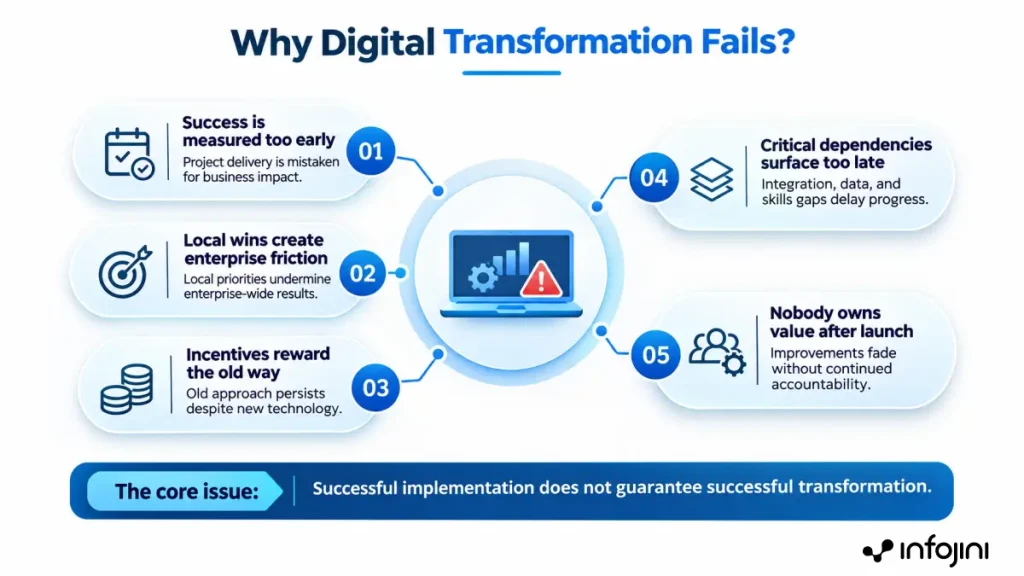
Digital transformation rarely fails during implementation. It fails when the business starts to operate after deployment. And here is what failed transformation teaches us.
- Analytics without decision making: The enhanced dashboard is of no value if there is continued debate on the accuracy of the data or the meaning of the metrics.
- Automation without reengineering: The automation of an ineffective process is merely a faster version of the same ineffectiveness.
- AI without scaling: An AI pilot may prove that a solution works in a limited setting, but scaling the solution throughout the company will take more effort.
The common mistake here is confusing implementation with impact. Systems can be launched on time without affecting business performance. Leaders must go beyond implementation deadlines and ask themselves the tough question: How does the digital transformation drive the enterprise towards betterment, and what business goals should it be enabling?
What Resilient Enterprises Do Differently
Resilient organizations recognize that the implementation of a new system is only the first step to achieve a transformation. The value created by a transformation lies in its ability to provide better decisions, change processes, and sustain gains. For this to happen, executives need to look at transformation from a business standpoint.
1. Connecting Investment to Business Outcomes
Any effective software needs to have the capability to solve a particular business problem or achieve any kind of strategy that the company desires. Whether it is an improvement in service, efficiency enhancement, or even resiliency, it is critical for the management to measure success before implementation. Otherwise, delivery milestones become a measure of success.
2. Redesigning How the Business Operates
New technology is not an answer to processes that have been designed on faulty assumptions. Resilient companies re-examine all these processes with technical solutions, while implementing the technology.
3. Making Adoption Part of Leadership
Applying the tool and training employees does not necessarily lead to behavioral change. It is important for the manager to recognize the real difficulties that prevent employees from using the new approach and ensure that the expectations of the management match the desired change in approach.
4. Establishing Digital Transformation Governance That Enables Progress
Transformation involves proper ownership, fast decision-making, and controls according to the risks involved. Poor governance leads to poor decision-making and undue risks, but excessive governance leads to delay and lack of innovation. The objective here is to give the teams proper directions.
5. Measuring Whether Improvements Will Last
Achievements in the early stages do not indicate that the transformation is successful; leaders need to ensure that performance improvements continue even after the implementation teams leave and that the enterprise can cope with changes in the business environment.
These principles are also supported by McKinsey’s research on the factors for a successful digital transformation, which is a study of the organizational behaviors that contribute to successful transformation. One key lesson from their research is that success is not determined only by spending on technology but also through leadership commitment and changes in employee capabilities.
For enterprise leaders, the implication is clear: transformation must be managed as a lasting change in business performance, not a finite technology project.
The Leadership Mandate
Digital transformation doesn’t just fail due to shortcomings of the technology; it fails because it confuses implementation with progress and investment with success. As discussed above, this blog demonstrates true success hinges on the alignment of strategy, operating model, employee adoption, and governance toward meaningful outcomes. This is the role of leadership: to make sure that any digital effort not only increases capability but makes a difference in performance.