Digital Transformation
 Data Engineering
 Implementation
 Staffing Services


Enterprise data modernization enhances data accessibility, scalability, and analysis. But agentic AI needs more. To function, an AI agent requires current data, business context, explicit permissions, and reliable connections to the systems where actions are performed.
However, the relationship is reciprocal. Modern data makes agentic AI possible. Agentic AI makes the modernization process faster. Agents can help with dependency analysis, validation of migration, and data quality investigations, giving engineering teams a way to tackle complex modernization efforts more quickly.
The goal is not simply to move data faster or to consolidate on platforms. The goal is to create a data layer that allows AI to comprehend data, make decisions within its parameters, and take action on those decisions.” The importance of enterprise data in real time, with business context and access control for agentic AI, has been highlighted by research from Google Cloud and IBM.
Out-of-date information may influence the decision and actions of the AI agent in case it is embedded in real-life operations. While a human would be able to identify the link between two systems which call the same feature of the client using different terms, an agent would need to know that the relationship exists. In the same way, while a human would have the opportunity to ask whether some unexpected outcome of the computation is valid before taking any action, an agent should have the necessary guidelines as well as permissions.
Key Takeaways
- Agentic AI needs more than accessible data. It needs context, governance, and reliable system connections.
- Data modernization strategy is moving from access to action. Modern data environments increasingly support AI-driven workflows.
- Agentic AI can accelerate modernization. Agents can handle analysis, dependency mapping, and migration validation.
- Modernization creates the foundation for scalable AI. Better data architecture makes AI adoption more practical and controlled.
What Is Data Modernization?
Data modernization means replacing or updating older data systems, so an organization can work with its data more easily and reliably. This can include moving data from legacy systems to modern platforms, connecting data that sits in different places, improving how it is managed, and making it easier for teams and applications to access and use. The goal is not simply to move data to a newer system, but to create a data environment that can support the way the business operates today.
Data Modernization Has Entered its Next Phase
Enterprise data modernization has moved through three broad phases:
| Phase 1 | Infrastructure: Organizations moved workloads away from aging on-premises environments. Data warehouses were replaced or used alongside cloud platforms. Pipelines were rebuilt, and storage became more scalable. |
| Phase 2 | Access: Enterprises focused on making data more accessible and consistent across analytics teams, applications, and business users. |
| Phase 3 | Action: Agentic AI introduces the next requirement. An agent does not just need to retrieve information. It may need to use that information to determine the next step in a process. |
Consider the procurement process. In this case, the agent will be able to go through the purchase requisition, evaluate the data supplied by the vendor, compare it with the policy, identify the exception, and finally approve it. It will not happen if the data of the supplier is unorganized, policies are buried in the documents, authorization requirements are unknown, and interaction of the agent with the system is impossible.
The limitation is not necessarily the AI model. The limitation is the environment around it. That is why enterprise data modernization needs to be viewed differently as agentic AI moves into production.
How Agentic AI Accelerates Modernization Itself
There is yet another aspect of this relationship that needs to be considered. While agentic AI relies on data modernization, it can also facilitate the process of modernization. Large data environments comprise thousands of dependencies that are hard to identify manually. A pipeline may feed several reports. A database table may be used for multiple applications.
How agents can support modernization
Understanding the environment is often one of the slowest parts of modernization. Agents can assist with that work.
1. Examine metadata and dependencies
The agent could inspect metadata and dependencies, assist in the mapping of relationships among different data sources, identify possible quality problems, compare different schemas, document the transformation logic, create migration scripts, and identify inconsistencies that should be reviewed by the engineer. The agent could help with migration validation through schema comparison, validate the transformed data based on certain rules, and identify any inconsistency that needs to be reviewed by the engineer.
2. Support engineering analysis
The useful agent is closer to an experienced engineering assistant that can investigate large volumes of information quickly, perform repetitive analysis, and surface exceptions. Humans can remain responsible for decisions that handle security or compliance consequences.
3. Apply agentic data management
As agents take on more data-related work, organizations can use AI-driven automation to handle parts of data management that would otherwise require significant manual effort. Gartner has identified agentic data management as a 2026 trend, describing it as the use of AI-driven automation to streamline key data management processes and allow data teams to spend more time on strategic work.
4. Let engineers focus on judgment
Instead of the engineers conducting an analysis of each of the dependencies and data quality problems, the agents can conduct the initial level of analysis for which the engineers can use their time to verify, make architectural decisions, and handle exceptions.
How Agentic AI Extends the Benefits of Data Modernization
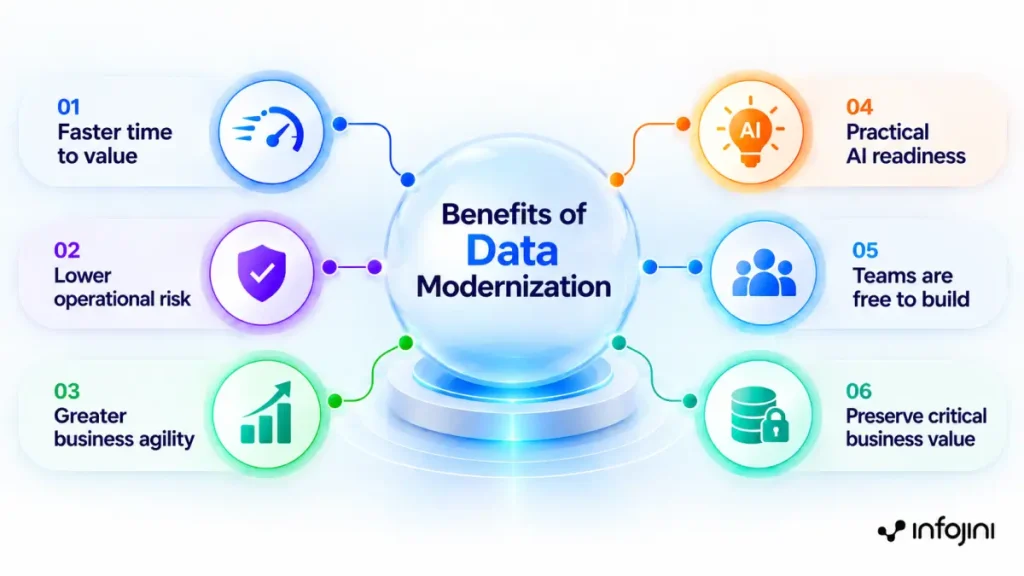
Faster time to value
Data modernization reduces some of the friction that holds back teams. As more data becomes available, connected, and usable, the team will then be in a position to utilize their data rather than spending many months navigating old technology. This is where agentic AI comes in as it assists in performing some of the subsequent processes such as data verification, identifying missing pieces, or advancing the process.
1. Lower operational risk
Historical data architectures tend to make it hard for people to understand dependencies between systems, data, and processes. As modernization is implemented, there will be more visibility in those dependencies. This is especially useful in scenarios where agents are added since they can now have access based on specific data, policies, and processes and not unlimited access.
2. Greater business agility
Business demands are evolving at a much faster rate than many data environments can accommodate. A state-of-the-art data platform will make it easy to incorporate new data sources, applications, and processes into the environment. The agentic AI will be able to leverage such integrations to respond to changes within the data environment and run processes automatically without data transfer.
3. Practical AI readiness
Even if a company has its data in the cloud, this does not guarantee that it is prepared for AI adoption. The data should still be trustworthy, available, understandable, and properly governed. This is the same set of requirements that will be necessary for agentic AI once it goes beyond answering questions.
4. Teams are free to build
Technical staff may spend a lot of their time looking for information, verifying it, resolving repeated problems, and handling processes that still require manual assistance. The use of better data structures can help with this problem. Tasks can be automated by agents as well, which will provide additional time to develop new projects.
5. Preserve critical business value
Modernization is not about discarding everything that has been collected over time. Significant business rules and process of knowledge may already be contained in legacy systems. Modernization, therefore, is the process of transferring this knowledge into a form that makes sense. Agentic AI can leverage this legacy knowledge while putting human decision-makers in charge.
What Agentic AI Changes in the Data Architecture
Historically, data architecture modernization was concerned only with information flow between systems and data storage locations. The notion of an agentic environment adds another dimension, which is how machines interpret data and what they can do with it. Thus, architecture has to cover more aspects than just data storage and transportation channels. Defining business entities matters. Metadata matters. Data lineage matters. Access control policies matter. Data and application relationships matter.
For instance the implementation of an insurance company for their claim management system. The person who handles the claims will need information related to the policy, customer, historical claims, pictures, correspondences, repair quotes, and so forth. The agent would have to access various sources containing some structured and unstructured data. The agent would have to know how these data sources are related to each other. A claim number would have to relate to a certain policy, while a policy would have to relate to certain rules. The repair estimate would have to be interpreted within this context. Moreover, the agent would have to know when it could act on its own and when a human intervention would be required.
Connecting data, systems, and actions
The agent-based architecture will also require interoperable information sharing between the different systems where the enterprise information is created, managed, and consumed. The modernization of the enterprise will have to extend beyond data warehousing or data lakes when an agent needs to communicate with the different operational systems and documents. Information interoperability enables agents to have access to all of the information and tools needed to execute their work, without introducing another level of disintegrated integration.
Visibility of how data and agent operations flow through the enterprise with another requirement for the agent-based architecture will be. Information lineage will allow users to trace the origin of information, whereas audit trails and observability will provide insight into what data was utilized by the agent, the action performed, and when. This will become even more crucial as the agent gains the ability to make changes in operational systems.
Latency is important too. An agent operating within a live business process might require data that represents the present condition of the business process, customer, or application, not data updated a few hours ago. The requirements for that might depend on the workflow and include real-time data access and event-driven pipelines.
In its 2026 research on AI governance, TDWI mentions context engineering and the emergence of the AI data foundation as significant trends in the evolution of architecture towards enterprise agentic systems. This means that the architecture should provide not just the knowledge of what the data represents, but what it means and what can be done with it.
Data Modernization Trends That Are Moving Toward Action
Several data modernization trends are converging around this shift.
- First, the trend is toward real-time data. Not all workloads require it, but agents working within live business processes certainly do.
- Second, there is the increasing relevance of unstructured data. The information contained within contracts, emails, documents, transcripts, and other types of unstructured data could contain business context, which would otherwise be analyzed separately from its business context.
- Third, the greater focus on semantics. It is necessary to have agreed upon meanings for data that would allow people and machines to interpret it in the same way within the enterprise.
- Fourth, the combination of governance with data access. As agents become enabled to take action, it is necessary for permissions and policy to travel with the data and the process.
- Fifth, there is AI-enabled data operations.
All of this seems to point towards the conclusion that the next generation of data platforms will be evaluated based not only on the capacity for storing large volumes of data, but also on the effectiveness of providing trusted information to people, applications and AI.
Conclusion
Agentic AI must not be considered an overlay to a data environment that you could place on an existing data infrastructure. If the data itself is disjointed, so will the agent be working with disjointed data. If the data is old, so does the agent. If business rules are vague, the agent lacks certainty in its actions. If the permissions are inconsistent, autonomous operations become unnecessarily risky. This is why data modernization and agentic AI cannot be approached separately.
It would not be necessary to overhaul all legacy applications or create a whole new data stack. In many cases, the right approach will involve selective data modernization and linking existing processes with further improvement in the data/governance layer and access to AI systems that need it.
These companies will not be the ones with the most advanced architecture. Instead, they will be the ones with the architecture that allows data to flow freely from storage through analysis to action without losing any control over the process. That is the point at which data modernization starts doing more than supporting the business. It starts helping the business move faster.
Frequently Asked Questions
Why does agentic AI need data modernization?
The agent can work with whatever data is provided by the enterprise data ecosystem. In situations where the data is scattered across different systems, without context or difficult to access, the agent needs to deal with those limitations. Modernizing data makes possible the development of the data, context, governance, and system integration needed for the implementation of the business process through the agent and not just answering.
Is a modern cloud data platform enough for agentic AI?
No. The transfer of information into the cloud is just one component of modernization. An agent might require many other things, including consistent business definitions, up-to-date data, data security, metadata, data lineage, and connections to operation systems. There might be a requirement for real-time access to data if there are workflow processes that depend on the up-to-date status of transactions or customers.
What needs to change in data architecture for agentic AI?
The architecture should go beyond mere storage and movement of data. The agents must be able to comprehend the relationships between data, access the relevant information, and work in prescribed boundaries. Therefore, semantics, metadata, interoperability, governance, observability, and controlled access become integral aspects of agent-friendly data architecture.
Can agentic AI help with enterprise data modernization?
Yes. Agents may be assigned some roles in modernizing the systems, for example, analyzing metadata, finding dependencies, schema comparison, detecting data quality problems, creating migration scripts, and validating migrated data according to expectations. This does not remove the need for engineers. It gives them a way to automate some of the investigation and repetitive work while keeping architecture decisions and exceptions under human review.