 Digital Transformation
 Data Engineering
 Implementation
 Staffing Services


Intelligent Enterprise Platforms: The Next Frontier of Digital Transformation
Synopsis: Intelligent enterprise platforms combine agentic AI, composable architecture, automation, and real-time decision intelligence. They help enterprises operate with self-learning systems, reduce technical debt, modernize legacy apps, and improve time-to-market. This guide explains how these platforms work, why they outperform traditional digital transformation, and what enterprise leaders need to implement them successfully.
Introduction
The enterprise technology landscape stands at an inflection point.
While approximately 90% of companies are currently navigating some form of digital transformation, organizations that will rule the next decade aren’t merely digitizing processes; they’re reshaping experiences at a granular level via intelligent, autonomous systems.
The era of intelligent enterprise platforms is upon us, where artificial intelligence, composable architectures, and agentic automation become a whole to enable self-learning, self-optimizing ecosystems that learn, adapt, and evolve without needing a human.
Why Traditional Digital Transformation is No Longer Enough
Every company is deep into digital transformation, but the outcomes vary. The gap between success and failure lies in how that transformation is being executed.
Technology is advancing at lightning speed, and teams evolving with it can see a clear shift in how they work and contribute. Those growing slower than the pace of change are steadily slipping behind, making it harder to stay competitive, agile, and future-ready. These companies are investing billions of dollars in cloud, RPA, and analytics, only to discover these tools were solving yesterday’s problems with yesterday’s thinking.
First-generation automation followed predefined rules. Second-generation AI responded to prompts. Third-generation intelligent platforms autonomously plan, execute, and refine workflows based on real-time conditions and learned patterns.
In the AI-enabled world — where we see noticeable leaps in computing power and business intelligence — the real opportunity lies in adopting platforms that don’t just execute tasks faster, but fundamentally change how businesses sense market shifts, forecast disruptions, make aware decisions, and orchestrate operations across the entire value chain.
Build Enterprise Systems that Think For You — Like You
Agentic AI Explained: The Force Behind Intelligent Platforms
Agentic AI are artificial intelligence systems that don’t just respond but initiate, coordinate, and optimize independently. They transform CRMs, ERPs, and HR systems from relatively static systems to dynamic ecosystems that can analyze data and make smart decisions without the involvement of human input.
What makes Agentic AI special? Its self-governing, autonomous nature. Traditional enterprise automation does an excellent job of performing structured, repetitive tasks; however, it breaks down when confronting scenarios outside predefined parameters.
Contrary to traditional automated systems, Agentic AI systems human judgment to handle dynamic workflows through contextual interpretation and real-time decision-making. They understand intent, adapt to changing circumstances, and coordinate multiple actions across systems to achieve specific business outcomes.
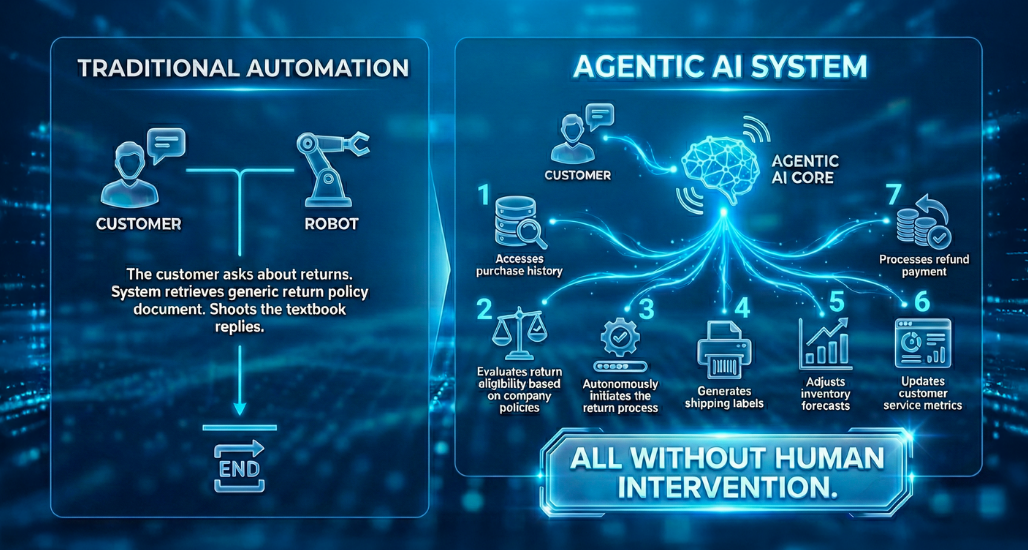
The architectural sophistication extends further. Modern agentic platforms organize AI agents by functional domains (IT, HR, finance, engineering), thus enabling enterprises to deploy highly specialized agents tailored to each department’s unique demands while maintaining a cohesive AI governance strategy across the organization.
What Is the Real Business Impact of Autonomous Intelligence?
Organizations implementing agentic workflows have accelerated business processes by 30% to 50% in areas ranging from finance and procurement to customer operations. These aren’t incremental improvements; they’re order-of-magnitude leaps that fundamentally alter competitive dynamics.
Consider how a multinational manufacturer recently deployed agentic compliance agents that continuously monitor shifting financial regulations in Europe, track evolving trade sanctions in Asia, and adjust healthcare compliance workflows in the United States simultaneously.
The agents automatically update communications, documentation, and approval processes in real time, mitigating risks before they materialize and enabling confident global operations without drowning in regulatory complexity.
The key is scale: what previously required teams of compliance specialists constantly researching regulations now happens automatically, with human experts focusing only on strategic interpretation and exceptional cases.
Composable Enterprise Architecture: Building Businesses That Never Become Outdated
If agentic AI gives your enterprise intelligence, composable architecture provides the flexibility to constantly reinvent how you operate.
Composable architecture applies the principles of modularity, autonomy, orchestration, and discovery to business systems. This lets organizations treat every part of the business as modular and reconfigurable, responding quickly to market shifts, economic changes, geopolitical pressures, regulatory updates, or other forces.
The core building block here is the Packaged Business Capability (PBC). A PBC is a software service built around a specific business function and designed to be understandable to business users while encapsulating technical components like data schemas, services, APIs, event channels, and user experiences.
In simple terms: Instead of buying a massive, monolithic ERP that’s hardwired together, you assemble your systems from independent, swappable modules, each handling a function like order management, inventory tracking, or customer onboarding.
The four architectural principles that make this work:
- Modularity: Business functions exist as self-contained, changeable components where changes to one section should not impact the entire system and lead it to fail, allowing each component to function independently
- Autonomy: Each module operates independently with its own logic and data, reducing bottlenecks and enabling parallel innovation across departments without waiting for central IT approval
- Orchestration: Components have a high level of orchestration readiness, allowing them to easily interact with other applications through open interfaces and can be arranged as needed to support business requirements
- Discovery: Organizations can easily identify and deploy new capabilities across the enterprise through searchable catalogs without extensive custom integration projects
Why Composability Matters: Real Business Advantages
- Faster time-to-market: Since teams are assembling business solutions based on pre-built items and not starting from scratch, there are fewer intrinsic bugs and problems can be resolved faster. What traditionally took 18 months to develop and deploy can now happen in weeks.
- Reduced vendor lock-in: Microservices and PBCs can be uncoupled completely when they no longer meet requirements and swapped with new services or features from different vendors, meaning you can choose integrations that better meet your requirements and ensure that each component is optimized for business needs.
- Financial impact: By 2025, financial companies adopting composable technology strategies are predicted to experience 30% higher revenue than their traditional-minded peers, reflecting the tangible business value of architectural flexibility.
- Operational agility: When a new regulation requires changes to how you process customer data, you update just the “data privacy” component rather than rearchitecting your entire system. When a competitor launches a new service model, you can quickly assemble existing capabilities in new ways to respond.
The Strategic Shift: From “Big Bang” to Continuous Evolution
Legacy enterprise resource planning systems and monolithic applications have become anchors rather than enablers. They’re expensive to maintain, difficult to modify, and create technology debt that compounds annually.
Composable architecture enables a fundamentally different approach:
- Start small: Implement pilot modules addressing high-impact pain points
- Prove value rapidly: Demonstrate ROI in weeks rather than years
- Expand incrementally: Add capabilities as business needs evolve rather than attempting enterprise-wide transformations that historically fail at alarming rates
- Iterate continuously: Replace underperforming components without disrupting the entire ecosystem
Strategic Implementation: How Should Enterprises Transition from Legacy Systems to Intelligent Platforms?
The shift toward intelligent enterprise platforms is existential. But implementation requires more than technology procurement.
The New ROI Equation: Self-Funding Transformation
By 2025, companies are focusing less on joining the AI hype and more on real-world opportunities that drive measurable value. CFOs expect proof that AI investments generate outcomes beyond mere cost savings. The winning approach: “Self-funding AI-led business reinvention.” Start with early efficiency wins and use the savings to finance broader transformation initiatives.
The Biggest Implementation Challenges for Intelligent Platforms and the Recommended Solutions
Enterprises adopting intelligent platforms from 2025–2027 face four non-negotiable hurdles separating successful deployments from perpetual pilots:
- Legacy system integration: LLM-powered middleware can translate COBOL, SAP ECC, Oracle EBS, or mainframe transactions into governed, version-controlled REST/gRPC endpoints, letting agentic workflows orchestrate existing investments while keeping compliance intact.
- Data quality and governance: A zero-trust data fabric ensures cryptographic lineage, real-time anomaly detection, and attribute-based access control so autonomous agents work only on verified, authorized data—eliminating hallucination risks and meeting EU AI Act, DORA, and SEC requirements.
- Evolving organizational capability: Leading enterprises are creating new roles: AI Orchestrators set guardrails, Autonomous System Auditors certify decision provenance, Process Intelligence Architects design multi-agent collaboration patterns, and Composable Business Designers translate strategy into reusable capability stacks.
- Executive confidence and regulatory trust: Observability platforms must provide real-time drill-down visibility into which agent acted, data snapshots, model versions, confidence scores, and post-decision deviations, without noise that obscures insight.
The Build vs. Buy vs. Compose Decision
Enterprises face critical decisions about platform development strategy. The emerging answer involves a “buy plus compose” model—leveraging the API economy and putting offerings together in a modular way, breaking down components into smaller services called microservices or packaged business capabilities.
The strategic approach:
- Buy proven foundations for commodity capabilities (security, authentication, basic workflows)
- Compose unique differentiation by combining PBCs in innovative ways aligned to your specific business model
- Build only what’s strategically differentiating and impossible to replicate through composition
- Maintain flexibility to swap components as better alternatives emerge
This delivers faster time-to-value while maintaining flexibility—avoiding the vendor lock-in that plagued previous enterprise software generations.
Critical Success Factors: What Separates Winners from Disappointments
Successful intelligent enterprise platform deployments share common characteristics while avoiding predictable failures.
Start with Proof, Not Grand Visions
Executives want tangible benefits quickly—without early proof points, investment and enthusiasm fade. One company attempted an enterprise-wide “AI assistant for every employee” campaign but found the scope too broad and progress too slow.
By pivoting to narrower initial wins—automating expense report processing, then contract review, then meeting scheduling—they built the confidence and funding necessary to pursue broader use cases. Each success funded the next, creating organizational momentum.
Design for Transparency from Day One
The “black box” problem isn’t a technical curiosity—it’s a trust deficit that can derail entire initiatives. Engineering transparency into system design from the beginning is non-negotiable.
Balance Autonomy with Oversight
Organizations must find the right balance between AI autonomy and human oversight, embedding a coherent set of controls across the value chain from day one. Too much control eliminates efficiency benefits; too little risks runaway processes that damage customer relationships or violate regulations.
The approach: Define clear automation boundaries based on risk profiles. High-stakes, low-frequency decisions (major capital investments) require human approval. Low-stakes, high-frequency decisions (routine customer service interactions) can operate autonomously with exception handling.
Avoid the Technology-First Trap
The goal isn’t implementing the most sophisticated AI models—it’s achieving measurable improvements in operational efficiency, customer experience, and business growth. Focus on business outcomes first, then select technologies that deliver those outcomes most effectively.
Enter the Era of Intelligence – The Infojini Way
How Should Your Enterprise Prepare for an AI-Native Future?
By 2028, Gartner projects that 15% of routine work decisions will be handled by AI agents, but forward-thinking enterprises are already planning for a future where that percentage climbs substantially higher.
The companies winning in the autonomous future won’t simply overlay AI onto existing processes. They’re fundamentally redesigning value creation workflows around the capabilities autonomous systems enable.
Strategic questions to ask:
- What becomes possible when decisions happen in milliseconds rather than days?
- How should organizational structures adapt when agents handle cross-functional coordination that previously required management layers?
- Which human capabilities become MORE valuable as routine cognitive work becomes automated?
These aren’t hypothetical questions—they’re strategic imperatives demanding answers today because the performance gap between AI-native enterprises and traditional organizations is widening rapidly.
Conclusion: The Decisive Moment for Enterprise Leaders
The transformation from traditional enterprise systems to intelligent platforms represents more than a technology upgrade—it’s a complete reimagining of how organizations sense, decide, and act.
The defining question for today’s C-suite: Which enterprise are you running?
Option A: The incremental organization that digitizes existing processes, achieves modest efficiency gains, and slowly falls behind more adaptive competitors.
Option B: The transformational organization that rebuilds its operating model around autonomous systems, maintains human expertise where it matters most, and uses intelligent platforms as the foundation for continuous reinvention.
The companies that will lead the next decade are already playing a different game. They’re not asking “How do we automate this process?” They’re asking “How do we orchestrate autonomous intelligence to create business outcomes impossible with traditional models?”
The next wave of digital transformation is here. The only question is whether your organization will ride it or be swept away by it. Those who hesitate, waiting for “perfect clarity” or “proven best practices,” will find themselves competing against organizations that have already built insurmountable advantages through early, aggressive adoption of intelligent enterprise platforms.
The time for strategy papers has passed. The time for action is now.
Key FAQs
1. What is an intelligent enterprise platform?
An intelligent enterprise platform is an AI-native system that integrates data, automation, agentic AI, and composable architecture into a unified operating layer. It helps organizations run self-learning workflows, streamline decision-making, and modernize legacy operations.
2. How does agentic AI benefit enterprise operations?
Agentic AI handles dynamic, multi-step decisions autonomously. It reduces manual effort, speeds up processes, improves accuracy, and helps enterprises react instantly to market or regulatory changes.
3. What problems does composable architecture solve?
Composable architecture reduces vendor lock-in, enables rapid time-to-market, and prevents systems from becoming outdated by using modular components called packaged business capabilities (PBCs).
4. Why are legacy systems a barrier to AI adoption?
Legacy ERPs and monolithic applications slow down integration, limit data availability, increase cost, and make it hard for AI agents to execute autonomous workflows.
5. How should enterprises start implementing intelligent platforms?
Begin with small, high-impact use cases, prove ROI, establish governance and observability, and scale incrementally while maintaining composable and modular principles.
6. How long does it take to implement an intelligent enterprise platform?
Implementation timelines vary, but modular and composable architectures allow enterprises to deploy capabilities in phases—often within 6–12 weeks. The platform evolves continuously as new agents, data products, and APIs are added.
7. What is an AI-native enterprise?
An AI-native enterprise is built around systems where intelligence is embedded into every workflow, not added as a layer. These organizations use agentic AI, composable architecture, and real-time decisioning as their operating model.