 Digital Transformation
 Data Engineering
 Implementation
 Staffing Services


Most business processes do not run on a single type of data. A customer issue may involve a message, screenshot, and call recording. A factory problem may require an image, sensor reading, and maintenance history. But many AI systems still handle these inputs separately.
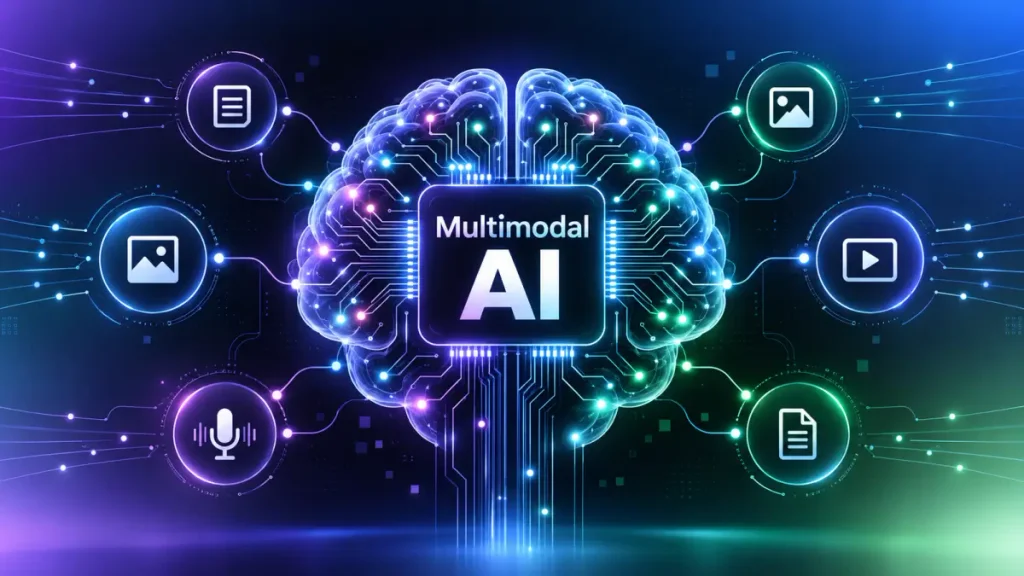
Multimodal AI is built to analyze all these different types of information in the same pipeline and establish relationships between them. Thus, organizations can combine various data sources into a single AI pipeline that connects information from different sources and understands the business process better. It paved the way for innovations in customer support, manufacturing, health care, finance, retail, and many other data-heavy processes.
Key Takeaways
- Multimodal AI brings the pieces together: It can work with text, images, audio, video, and structured data, so businesses don’t have to look at each source in isolation.
- The real advantage is context: When a customer complaint comes with a screenshot, or a machine issue comes with sensor data and maintenance records, connecting those inputs can give AI a much clearer picture of what is happening.
- Not every workflow needs multimodal technology: It makes the most sense where people already rely on different types of information to investigate a problem, decide, or complete a task.
- More data also means more responsibility: Data quality, integration, security, cost, and human oversight all matter, especially when the AI is being used for decisions where a mistake can have serious consequences.
What Is Multimodal AI?
Multimodal AI refers to the systems that can process multiple types of information including text, visual data such as images, audio data, video data, and structured information. The key aspect of multimodal technology is that the machine should be able to interpret between these different data sources.
Consider a customer reporting a damaged product. The written complaint explains the problem. A photograph shows the damage. The order record confirms what was purchased. A previous support conversation may reveal that the same issue has already been reported.
These are different parts of the puzzle. The multimodal AI framework helps integrate all these inputs into each other for interpretation. To put it simply, the multimodal inputs represent the types of data being integrated, whereas the multimodal AI represents the system that does this integration.
The common modalities include:
| Text | Emails, reports, contracts, chat, reviews, and notes |
| Images | Photographs, scan, product pictures, and inspection pictures |
| Audio | Calls, meetings, interviews, and audio recording |
| Video | Security video, training video, and manufacturing inspection video |
| Structured Data | Transactions, customer information, inventory, and sensors |
A business does not necessarily need all of them. The right combination depends on the problem being solved.
How Does Multimodal AI Work?
Essentially, AI multimodal has to take information that is presented in different formats and make sense of it through one system and how it all ties together.
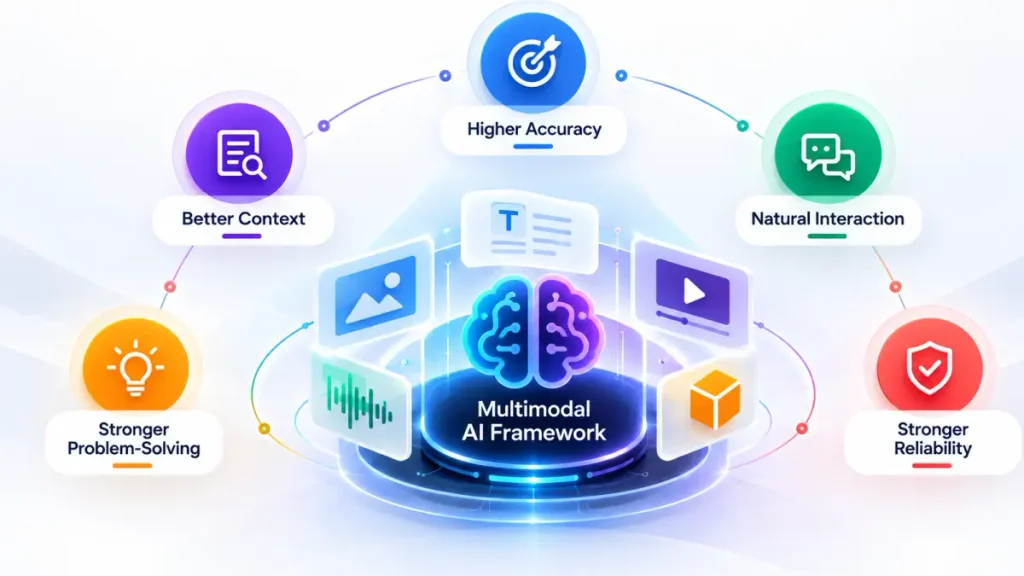
Text, an image, and an audio recording are very different forms of data. Multimodal systems use techniques that convert these inputs into representations that can be processed together. Some composable data architectures use separate components for different modalities, while newer approaches increasingly aim to bring several modalities into a more unified model. ACL Anthology research shows that, unified multimodal large language models are moving toward general-purpose systems capable of understanding and generating across multiple modalities.
Take a manufacturing problem. A camera identifies a recurring defect on a component. Sensor data shows that the machine temperature increased around the same time. The maintenance record shows that a particular part was replaced earlier that day. There is no single record containing the answer. The useful information comes from connecting the three.
As per the application, the AI model developed can be one that answers a question, classifies an image, summarizes a case, detects an anomaly, produces content, or makes a recommendation. Technology underneath can be complicated. The basic business idea is not simply to give AI the information that humans need to understand the situation but to bring different pieces of information together so AI can understand the situation in context and help determine what to do next.
Multimodal AI Models vs. Traditional AI Models
Multimodal models are designed to connect information across different types of input. Traditional AI models are usually built for a specific type of input and task. A text model may summarize a report, while a vision model identifies objects in an image.
| Multimodal AI Models | Traditional AI Models |
|---|---|
| Work across multiple data types | Usually work with one primary data type |
| Connect information across modalities | Focus on a specific task or modality |
| Can combine context from text, images, audio, video, and more | Context is limited to the input they receive |
| Can bring different inputs into the same workflow | Often require separate systems for different inputs |
Key Benefits of Multimodal Technology
- Higher Accuracy: Multimodal technology is capable of comparing multiple sources of information before giving an answer. While an image might have a defect described in text, sensor information might be helpful in providing additional clues. Analyzing these inputs together can reduce the risk of drawing conclusions from incomplete information.
- Better Context: Single-source information may not be enough to describe the situation. What a person says, the tone of his voice, the images he shares, or what is happening in the videos can all give the system some additional information. With multimodal, all these details will be analyzed together to understand the situation better.
- Natural Interaction: Humans do not use only one channel to communicate with other people. The same goes for multimodal technology. It is not limited by textual input only. A user may communicate verbally, show an image, and use a combination of different types of input to describe the situation he needs assistance with.
- Stronger Problem-Solving: Some problems require information from more than one source. A doctor may need to look at a medical image alongside a patient’s records. A customer service team may need a written complaint and a screenshot. Multimodal AI can bring these different inputs together when working through the problem.
- Stronger Reliability: Information is not always complete or clean. An image may be unclear; a recording may contain noise, or one data source may be unavailable. When other relevant inputs are available, a multimodal system may still have information it can use to understand the situation.
Multimodal AI Use Cases Across Industries
The strongest multimodal AI use cases are generally found where people already combine several sources of information to make a decision.
1. Healthcare
A patient’s medical image is only one part of the clinical picture. The doctor might also take into account the laboratory findings, clinical observations, drug history, and any past records. AI Multimodal can assist in integrating these different inputs into medical image analysis, information retrieval, and decision-making processes. Recent advances in the field have focused on the use of multimodal technology in healthcare, as well as issues related to privacy, bias, interpretability, and trustworthiness. The technology should complement clinical judgment, especially if misinterpretation might have serious implications.
2. Manufacturing
Manufacturing produces multimodal data by default. Cameras inspect products. Sensors monitor equipment. Maintenance systems record repairs. Operators add notes about what they see on the production floor. Connecting those sources can help engineers investigate defects or equipment problems. A recurring defect paired with an unusual sensor of reading, for instance, gives the team a more useful starting point for finding the cause.
3. Retail and E-commerce
Retailers have product photographs, descriptions, reviews, transaction records, returns, and customer conversations. Looking at these together can reveal problems that sales figures alone cannot explain. A rise in product returns might initially look like a pricing issue until reviews and customer images point to a quality or product-description problem. Multimodal search is another practical application. A shopper can use an image along with verbal instructions to find products that match what they have in mind.
4. Financial services
Financial institutions deal with both structured records and large amounts of documentation. A loan application may contain financial figures, identity documents, bank statements, employment information, and supporting paperwork. Multimodal can assist with extracting information and comparing details across these sources.
Fraud investigation can also be carried out through multiple signs, such as transaction history, account activities, information about the device, and communication with the client.
5. Customer service
One of the most straightforward cases would be customer service. It can include emails, chats, screenshots, voice recordings of calls, and previous tickets. Rather than having the representative go through all the information manually, an AI multimodal assistant can gather and summarize the history. This leaves more time for the representative to actually solve the customer’s problem.
6. Automotive
Vehicles already generate information through cameras, radar, GPS, and other sensors. Autonomous driving is one clear example of where this information needs to be understood to determine what is happening around the vehicle.
The same approach can be useful beyond driving. Manufacturers can combine vehicle sensor data with diagnostic records and technician notes to investigate recurring faults. Looking at these sources together can help them understand what is causing the problem and improve maintenance.
Challenges of Multimodal AI
More input also means more things that can go wrong.
- Data alignment is one issue. A sensor may record information every second, while a technician adds a note hours later. The system needs to establish that the two events are related.
- Data quality is another. A blurry image, inaccurate transcript, faulty sensor, or incomplete document can affect the result.
- Cost is another challenge. Images, audio, and video require more storage and processing than ordinary text. Research continues to identify computational cost, scalability, data inconsistency, privacy, bias, and explainability as important challenges for multimodal systems.
- Reliability is the last challenge of multimodal technology. A multimodal model can produce a confident answer and still be wrong. That matters considerably in sectors like healthcare, finance, public services, and industrial environments.
Human review, testing, access controls, and clear boundaries around automated decisions therefore remain necessary.
What’s Next: Where is Multimodal Technology Heading
Multimodal technology is also being used to generate content across text, images, audio, video, and other modalities. Market research is increasingly focused on systems that can generate, translate, and transform content across these modalities.
Another significant advancement in AI is the multimodal agents. Consider the case of a field engineer taking a picture of broken equipment and adding an explanation. An AI agent could examine the image, interpret the technician’s notes, check service history, and bring back relevant previous repairs.
The agent is not just answering a question about a photograph. It is using several sources while working through a task. The research is also progressing towards building models that would be capable of processing modalities other than text and images, such as videos, sensors, time-series, and graphs. It may help make multimodal AI more useful for real-world systems, where information does not remain limited to text and dialogues only.
How Should Enterprises Approach Multimodal AI?
The starting point should be the workflow, not the model.
Look for a process where employees regularly move between systems to understand a customer, investigate an incident, review documents, or diagnose a problem. Those workflows are better suited to multimodal technology than processes that already work well with one clean dataset.
Then narrow the scope.
A customer support workflow or equipment inspection process is easier to evaluate than an attempt to connect to every source of enterprise data at once. Ask what information is genuinely needed, whether it is reliable, who should have access to it, and what happens when one modality is missing.
Most importantly, measure the result.
Does combining the information improve response time? Does it reduce manual review? Does it help employees make better decisions? If the answer is no, adding more modalities may simply make the architecture more expensive.
Conclusion
AI is breaking the bounds of the single input with multimodal AI. Systems will now be able to handle multiple types of inputs such as text, image, audio, video, and structured data. However, the future of multimodal technology does not lie in better responses but in a greater capacity to combine context across modalities, considering various pieces of information before determining what to focus on.
The next stage will involve the application of an AI system to accomplish a certain task within the business rather than analysis of a particular information. The more comprehensive approach towards the context also provides a basis for multimodal AI agents that are capable of not only analyzing information but taking actions upon it. A multimodal AI agent may conduct an investigation, look into the supporting documentation, find the relevant records, and make a decision on further actions without requiring employees to put all the pieces together by themselves. Of course, this kind of technology poses some challenges, but one thing is clear, AI is shifting from understanding individual bits of information to understanding their context.
Frequently Asked Questions
When does multimodal AI make sense for a business?
AI multimodality becomes reasonable when multiple types of information are required for the completion of a task or for making a decision. Customer service representatives may require a message, a screenshot, a recording of a phone call, and customer history. A technical support team may need equipment pictures, sensor readings, and repair history. If a process already works well with one reliable data source, adding more modalities may create more complexity than value.
What does an enterprise need to implement multimodal AI?
The first stage is not the model but data and its usage process. For this, an organization requires proper access to data sources, their integration, security and access controls, and a process of assessing the outcome of the AI. The quality of data also counts; poor picture, partial document, and erroneous sensor reading may lead to a wrong output even if the AI model used was very powerful.
Is multimodal AI worth the additional cost and complexity?
It can be, but only when combining different data types improves the outcome. The processing of images, sounds, videos, and other data sources of large size might take more space, computing power, integration effort, and control than a text-based approach would. In that sense, the business case must relate to the quantifiable benefit of reduced manual intervention, improved efficiency, or anything else.
What is the future of multimodal AI for enterprise?
The next shift is likely to be from AI that simply understands different types of information to AI that uses that information while carrying out a task. For example, the field-service AI agent may inspect an image, analyze notes written by a technician, review equipment history, and figure out the next action. As multimodal technologies will become part of the enterprise software, the main question will move from the proof of the fact that AI can understand several inputs to the discussion of where it can really be useful.