 Digital Transformation
 Data Engineering
 Implementation
 Staffing Services


As organizations shift from centralized reporting to distributed analytics, the promise of self-service business intelligence is no longer theoretical, it’s strategic. For CXOs and CTOs, the challenge is clear. They need to enable lines of business to generate insights quickly, while protecting data integrity, managing cost and risk, and ensuring decisions are made from trusted sources. That balance of speed without chaos, is what modern Power BI governance models are built to deliver.
In this blog we’ll discuss:
- How to design governance that scales,
- The organizational capabilities C-suites must develop, and
- The practical controls that let business teams move fast without creating technical debt.
It blends recent platform developments and 2025 market signals with an operational playbook you can act on today.
Why Self-service BI Still Matters and What Changed in 2025?
Self-service BI matters because the highest-value questions rarely live in a central ticket queue. Business leaders need iterative, contextual analysis like quick hypotheses, fast visual exploration, and the ability to operationalize a winning view.
Two forces accelerated this need in 2025:
- The ubiquity of AI-assisted analytics that lowers the technical entry barrier
- Stronger vendor investments in governance and enterprise features that make scaling practical.
Microsoft’s Power BI continued to invest heavily on AI capabilities in 2025, including more capable Copilot experiences. This lets users surface and create insight faster and a set of governance features designed for enterprise scale. Those product developments make self-service more powerful. However, they also make governance non-optional: AI amplifies both productivity and the risk of amplifying bad data.
At the same time, independent market research shows organizations prioritize data and AI literacy as core competencies. Business leaders measure ROI, not by dashboard counts, but by how widely teams can read, interrogate, and act on data.
What is the Goal of Modern BI Governance?
Traditional governance adopted a binary process, which either locked everything down or let everything roam free. But both extremes failed. A modern governance model for Power BI is explicitly outcome-driven. It ensures to:
- Protect data and regulatory compliance (privacy, lineage, retention).
- Maintain performance and predictable costs as consumption grows.
- Clearly identified datasets, owners, and SLAs for refresh and accuracy.
- Make the path from idea to insight short, repeatable, and safe.
Therefore, organizations can consider the Power BI governance models as a platform product. It’s a service you build for developers, analysts, and business users. You need to define SLAs, documentation, and include a developer’s experience for building and certifying semantic assets. Then you can measure the adoption and quality like any product.
What Governance Layers Actually Scale Power BI Across the Enterprise? 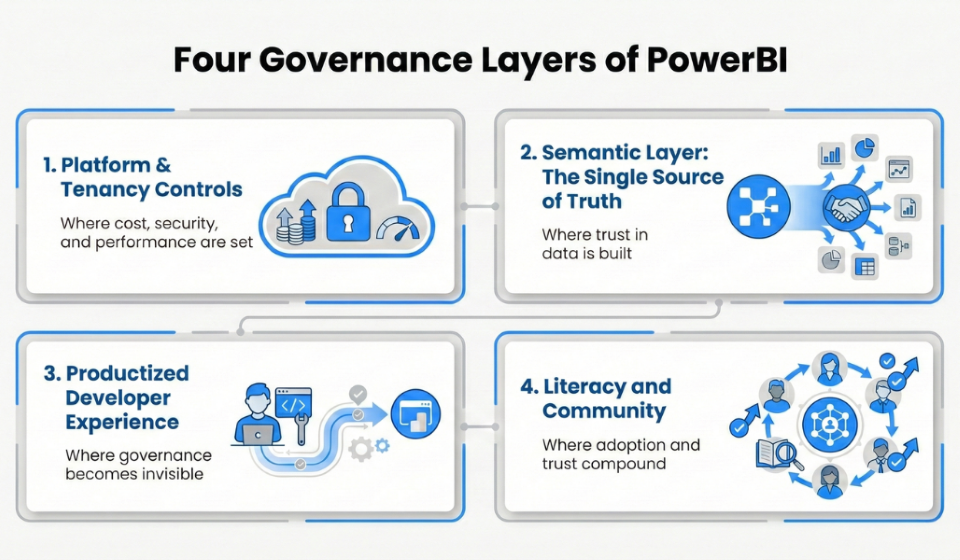
Rather than a long checklist, think in four pragmatic layers that together create a seamless audited environment.
1) Platform & Tenancy Controls
Centralize tenant-level policies (authentication, workspace provisioning rules, licensing tiers). Use capacity planning and workspace tagging to balance performance and cost predictability. Ensure capacity governance is visible to finance and engineering. Unexpected query volume should trigger alerts and a cost-recovery conversation, not surprise invoices.
Platform updates across 2025 added more granular capacity and admin telemetry in Power BI, making it simpler to monitor and automate cost controls.
2) Semantic Layer: The Single Source of Truth
The semantic layer, which includes certified datasets, shared dataflows, and governed models, is where trust lives. Treat certified datasets as first-class products: document them, publish usage guidance, and assign owners who are accountable for refresh windows, lineage, and query performance. A thin, curated semantic layer reduces duplication and simplifies governance downstream.
3) Productized developer experience
Provide templates, a common toolkit, and CI/CD patterns for report development. Offer prebuilt visual and measure libraries that encode corporate definitions (revenue, churn, ARR). Automate checks (naming conventions, forbidden connectors, sensitivity labels) into the CI pipeline so that governance is enforced before content reaches users.
4) Literacy and community
Tools alone cannot create trust, but people do. Invest in targeted training (scenario-based for managers, hands-on labs for analysts) and create a community of practice that surfaces exemplary models. Recognize repeatable reuse: reward teams that publish certified datasets others consume. Market your internal “data marketplace” and adoption will follow.
Which Policies and Guardrails Preserve Agility?
Below are high-impact, pragmatic controls that preserve agility while reducing risk. Each one is operational and measurable.
- Standardize sensitivity labeling and enforcement: Integrate Microsoft Purview or equivalent to ensure labels persist across exports and embedding scenarios, and tie labels to sharing restrictions and DLP policies.
- Require dataset certification workflows: Use a staged model of sandbox → staging → certified. Certification requires owner sign-off, lineage documentation, and performance testing.
- Automate telemetry and anomaly detection: Surface unusual query patterns, exploding refresh times, or rapidly increasing workspace sprawl. Use telemetry to prioritize optimization and to identify candidates for consolidation.
`q1 wwwww - Limit data extraction paths: Allow self-service exploration over governed semantic models; restrict direct (unmanaged) access to sensitive source systems. Where exports are necessary, require automated masking or approval flows.
- Cost governance tied to ownership: Allocate capacity costs to business units or cost centers and require owners to submit a basic ROI case for large, persistent capacity requests.
These guardrails turn governance from a roadblock into a business conversation: justify additional capacity or exceptions with concrete outcomes.
How Does AI Change Power BI Governance?
Artificial Intelligence is wonderful when governed, dangerous when not. Copilot and similar assistants drastically reduce friction. Users can generate visuals, natural-language measures, and draft report pages in seconds. That accelerates insight velocity but also increases the chance of unvetted models or mislabeled metrics being disseminated.
You can avoid the risk of AI by anchoring generated outputs to certified datasets and making provenance visible in the UI. If Copilot or an assistant can create a new measure, enforce an approval step for publishing that measure into a shared dataset. Make the provenance and generation history discoverable so consumers can verify how a value was created. Recent Power BI releases in 2025 emphasized Copilot as a full-screen, cross-workspace assistant and improved controls for how generated content references governed semantic assets. Use those capabilities to keep AI-driven productivity inside your trust boundary.
Which Roles Are Required to Scale Self-Service BI?
Scaling self-service BI requires rethinking roles beyond “IT” and “business”:
- Dataset product owners (often in analytics or data engineering): They are accountable for certified models, SLAs, and lineage.
- Analytics engineers: They bridge between engineering rigor and business proximity; build reusable models and automated tests.
- Governance or platform team: They help with custodians of the platform product like policies, telemetry, provisioning, and cost controls.
- Business champions: They are domain experts who evangelize adoption and provide quality feedback loops.
Measure these teams on both operational metrics (refresh success, query latency, capacity utilization) and business outcomes (time to insight, decisions supported, revenue impact). This dual focus prevents governance from becoming a purely operational exercise.
How Should Enterprises Measure Governance Success?
Move beyond vanity metrics (number of reports) and track indicators that show quality and impact:
- Adoption quality: Percentage of users accessing certified datasets vs. ad-hoc sources.
- Trust signals: Refresh reliability, data lineage completeness, and certified dataset reuse rate.
- Cost efficiency: Capacity utilization and query-per-dollar metrics.
- Time to insight: Average time from request to publish the governed report.
- Data literacy growth: Proportion of employees passing practical data competency assessments.
Market research in 2025 shows organizations shifting investment from tooling alone to literacy and processes, measuring literacy and uptake of governed assets tracks whether governance truly enables value.
What Will Be the Phased Implementation (90-day Horizons Playbook)
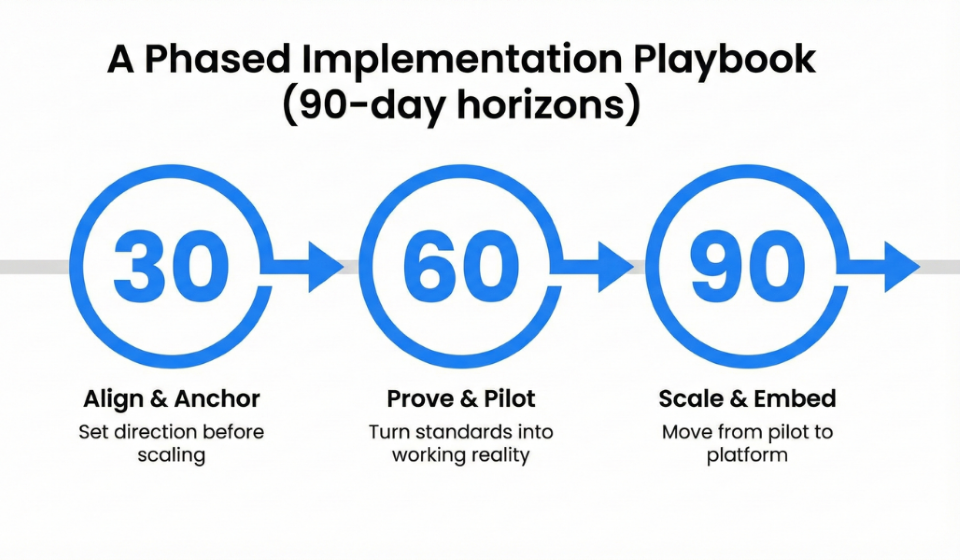
Large programs succeed when broken into short, measurable sprints. Here’s a pragmatic sequence that preserves momentum:
Days 0–30: Stakeholder alignment. Map critical datasets, identify top BI consumers, and define cost/benefit measurement. Establish a governance steering group with finance, legal, IT, and business reps.
Days 30–60: Pilot certified datasets and automated CI checks. Implement tenant tagging, baseline telemetry, and one small business unit as a proof of concept. Publish initial training and “how to get started” content.
Days 60–90: Scale certification pipelines, roll out sensitivity labeling enforcement, and integrate Copilot usage policies. Launch a data literacy cohort and measure initial shifts in reuse and time to insight.
This process delivers tangible operational improvements quickly and creates the governance narratives necessary to get wider buy-in.
Common Pitfalls and How To Avoid Them
Most governance failures are not technical, they are behavioral and structural. The following pitfalls surface when governance is designed without empathy for how teams actually work. Avoiding them requires balancing control with enablement, standards with flexibility, and scale with accountability. Here are some of the common pitfalls:
- Pitfall: Treating governance as policing.
- Solution: If users feel blocked, they will find workarounds. Adapt design approval processes that are lightweight and automated for low-risk changes.
- Pitfall: Over-centralizing semantic models.
- Solution: Some duplication is healthy if it reduces latency or supports a different process. In such cases, encourage reuse but allow sanctioned divergence with clear lineage.
- Pitfall: Neglecting literacy.
- Solution: Tools are amplifiers, but without literacy you amplify noise. Invest in role-based training that builds judgment, not just tool skills.
- Pitfall: Ignoring cost accountability.
- Solution: Analytics growth without cost controls creates unsustainable bills. Therefore, merge capacity to business outcomes and cost centers.
Final Thoughts: Governance As A Growth Lever
Self-service BI at enterprise scale is not an IT project, it’s an organizational capability. When governance is treated as a platform product, and when literacy and clear semantics are prioritized, the result is a flywheel. Trusted assets drive reuse, reuse reduces duplication resulting in cost reduction, faster and better decision making.
Power BI’s 2025 investments in Copilot, semantic experiences, and tenant governance make large-scale self-service more realistic than at any prior point. Leaders who pair those platform capabilities with clear ownership, lightweight approval flows, and meaningful literacy programs will capture the economics of faster insight while avoiding the hidden costs of chaos. Microsoft power automation services continued positioning as a leader in analytics platforms in 2025 signals that mainstream enterprise tooling has matured. The main aim of organizations now is to operationalize governance and human capability.
Infojini experts can guide you to get the self-service BI at scale.