 Digital Transformation
 Data Engineering
 Implementation
 Staffing Services


When enterprise technology leaders first encountered Snowflake, their initial response was filled with doubt. Another cloud data warehouse promising to solve all problems? The industry has heard that before.
However, as engineering teams began testing it, something different emerged. The way it manages the concurrent workloads without the usual performance drop is truly impressive. Today, after organizations have moved critical enterprise tasks to Snowflake, the conclusion is clear: its architecture marks a real shift in how the industry thinks about data platforms.
The secret lies in what Snowflake calls “multi-cluster shared data architecture.” The term may sound complex at first, but this article breaks it down in simple terms, showing why it matters for modern organizations.
Snowflake’s Architecture at a Fundamental Level
By default any virtual warehouse runs on a single cluster. When queries come in, the cluster distributes its compute resources across each request and processes them in order. If the cluster is already at capacity, any new queries simply wait in a queue until resources open up.
Snowflake platform is a multi-cluster shared data architecture. All the data is stored in one central layer, and compute clusters work independently on it. These additional clusters can be added manually or allowed to scale automatically based on workload. When setting up a multi-cluster warehouse, the user defines the minimum and maximum number of clusters.
This separation allows organizations to scale analytics workloads without moving or copying data. It also lets teams run workloads simultaneously without competing for the same processing resources.
While the engineering behind the platform is complex, the main idea is straightforward. Snowflake removes the traditional limits that link storage and compute. By separating them, it is possible to scale each based on need.
The three layers of the architecture
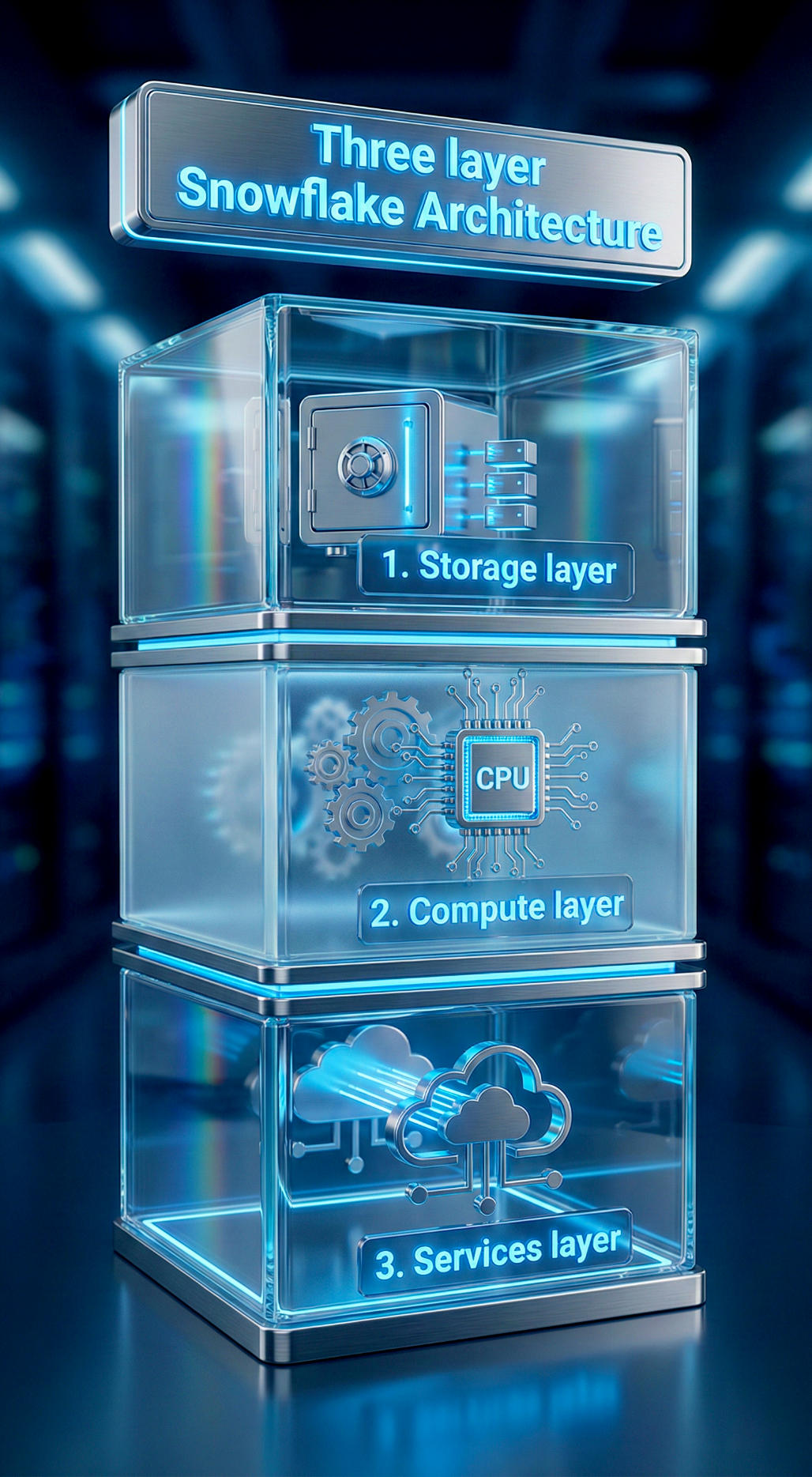
This infographic illustrates the three-layer Snowflake architecture, consisting of the Storage layer for data storage, the Compute layer for query processing, and the Services layer for cloud services such as security, optimization, and metadata management.
Snowflake organizes its platform into three functional layers. This structure is important because it serves as the foundation for how the system works at scale.
1. Storage layer
Snowflake stores all data in a central cloud storage system. The platform automatically optimizes this storage. Data is compressed, organized into micro-partitions and kept in a columnar format. Users do not need to configure storage settings or manually build partitions. This means every team works with the same data. There are no inconsistent copies or fragmentation across systems. Snowflake documentation explains that the storage layer is designed to minimize cost while maximizing query efficiency.
2. Compute layer
Compute is delivered through independent clusters called Snowflake virtual warehouses. These clusters perform queries, roll out transformations, and process tasks. They do not store data. They only request the data they need from the storage layer. Multiple virtual warehouses can access the same data simultaneously. This setup allows for concurrent operations and workload separation. A warehouse used for data engineering does not disrupt a warehouse used for finance reporting or machine learning experiments.
3. Services layer
Apart from the storage and compute, there is an orchestration layer. This layer manages authentication, metadata, optimization, access governance, and query planning. It ensures consistency and security across the entire platform. Snowflake’s services layer takes care of tasks that would usually need a lot of manual work in traditional cloud systems. This includes transaction management, resource balancing, and access control. According to Snowflake’s technical documentation, this layer is crucial for providing a managed, stable, and secure cloud data experience.
The addition of multi-cluster capability
The term multi-cluster describes Snowflake’s ability to scale and compute horizontally. A virtual warehouse can contain a single cluster or multiple clusters. When load increases, Snowflake can automatically start additional clusters. When load decreases, those clusters can shut down.
This automatic scaling provides Snowflake with its flexibility. More importantly, it makes sure that concurrency does not hurt performance. Analysts running reports, data scientists building features, and engineers loading data can all work simultaneously. Multi-cluster compute ensures they do not disrupt each other.
The design also supports predictable performance. If a warehouse is configured with multiple clusters, peak usage from one group will not slow down another. The system adapts based on actual demand.
Multi-Cluster Snowflake Architecture: The Role & Business Impact
Moving beyond the technical elements, the architecture supports several real business advantages. These advantages are applicable to mid-size companies that want to modernize data operations as well as large enterprises managing hundreds of workloads.
Improved collaboration
With Snowflake, teams can work on analytics, reporting, and ETL workloads at the same time. It removes the bottlenecks that occur when users compete for limited computing resources.
Operational efficiency
The IT teams will spend less time managing hardware, tuning systems, or planning capacity. Snowflake takes care of most of the administrative tasks that used to hinder traditional warehouses. This cuts down on operational costs and lets technical resources focus on more valuable projects.
Cost transparency
Storage and compute are billed separately. Organizations pay for compute only when they are in use. Warehouses can suspend automatically when idle. This provides more predictable cost control.
Analysts such as BCG and McKinsey note that cloud elasticity reduces overspending on infrastructure by eliminating the need for peak-capacity provisioning.
Unified governance
Since all workloads draw from the same storage layer, governance becomes simpler. Access control, audit logs and data lineage become easier to manage. Data sprawl is reduced because teams no longer need to create separate copies for different workloads.
Support for mixed data types
Snowflake can store structured, semi-structured, and unstructured data in the same repository. Analysts and developers do not need separate solutions for JSON, XML, or hybrid formats. This simplifies data architecture across the organization.
Speak to Infojini experts for your Snowflake migration
How the architecture affects data modeling
Snowflake’s architecture also simplifies data modeling practices. Many traditional systems require detailed planning for indexing, partitioning or distribution keys. Performance often depends on these choices.
Snowflake reduces this burden. The platform manages partitioning and optimization internally. Organizations can design schemas based on business logic instead of hardware constraints. This does not eliminate the need for good design, but it shifts effort from physical optimization to analytic usability.
Some teams choose to adopt star or Snowflake schemas, while others use data vault or wide tables. The architecture supports all of these approaches because performance is not tied to physical layout decisions.
Common Misconceptions and the Real Story
Years of working with Snowflake have surfaced a few recurring misunderstandings. Clearing these up helps teams set the right expectations and avoid costly mistakes.
More clusters don’t always mean faster queries. Many assume that adding clusters boosts performance. In reality, a single query is always processed by one cluster from start to finish. Multi-cluster warehouses help when there are many concurrent queries, not when one heavy query needs acceleration. For faster single-query performance, you need a bigger warehouse, not more clusters.
Snowflake isn’t automatically cheaper. The platform offers powerful ways to control and optimize costs, but those savings don’t happen by default. If warehouses run continuously or multi-cluster settings are never tuned, costs can rise quickly—sometimes beyond traditional systems. The real advantage is the flexibility to match spend to usage, but that requires active monitoring and thoughtful configuration.
Easy to start doesn’t mean instant expertise. Snowflake is user-friendly, but achieving the best performance still requires proper understanding of its architecture. Features like clustering keys, materialized views, and result caching can provide value only when understood and used properly. Snowflake can automate many tasks, but knowing your data patterns is still important.
Migration is simple, but modernization is not. Loading data into Snowflake is easy. The challenge arises when legacy ETL processes are moved without rethinking them. Workloads that worked in a traditional warehouse often need to be restructured to take full advantage of Snowflake’s multi-cluster, shared-data model. Teams should prepare for some workflow redesign to unlock the platform’s full potential.
Where Snowflake provides the strongest value
Snowflake’s architecture is most impactful when certain conditions are present. These include organizations with high concurrency needs, rapid growth, multi-department data usage, or a mix of analytics and operational workloads.
A company with multiple business units that require access to the same data benefits significantly. For example, a retail company may have finance, supply chain, marketing, and operations teams running queries throughout the day. Snowflake allows each department to operate independently using its own warehouse while accessing shared data.
Similarly, technology companies using machine learning pipelines can isolate workloads for feature engineering, inference and reporting. Each pipeline can run without slowing down others.
Enterprises with fluctuating workloads also gain from automatic scaling. End-of-month reporting, periodic regulatory submissions or seasonal peaks no longer require permanent provisioning of expensive resources.
Adoption considerations for organizations
Organizations evaluating Snowflake should consider several strategic decisions before transitioning.
Understanding the workload patterns
Before deployment, the teams should identify the types of workloads running across the business. Separating ingestion, analytics, data science, and operations helps determine warehouse sizing and the use of multi-cluster settings.
Governance and access control
Snowflake’s central storage layer makes governance simpler, but it still requires structured planning. Clear role hierarchies, data sharing rules, and access boundaries must be established early.
Cost management
Implementing automatic suspension, resource monitors, and usage alerts helps keep compute spending predictable. Snowflake provides detailed billing visibility, but organizations must create internal processes to guide usage.
Migration planning
Most companies begin migrations in phases. A pilot project often proves the architecture’s benefits before moving large workloads. During migration, teams may need to refactor SQL, adjust pipelines or retire old systems.
Looking forward
Snowflake’s multi-cluster shared data architecture clearly moves away from the limitations of traditional data warehouses. By separating storage, compute, and services, it creates a platform that supports concurrency, scalability, cost efficiency, and simpler governance.
For organizations looking at modern data platforms, this architecture gives a solid base for both current workloads and future growth. It offers a straightforward way to bring together data, support teams, and expand operations without adding complexity.
If implemented with proper management and careful workload planning, Snowflake is more than just a technology option. It becomes the foundation of a modern, data-driven business.
Infojini offers Snowflake consulting services. If you are looking for a smooth transition or just querying about Snowflake, contact us today!